By CONTRIBUTING WRITER William Patterson
I am a Contemporary Realist painter. Contemporary Realism is diverse and wide-ranging; it is more than narrative, encompasses fantasy, reality and psychology, and is grounded in a thorough understanding of abstraction and contemporary concepts of picture space.
The aesthetic content of my work is a result of intense visual study, looking into and through nature. Various themes are expressed through the multi-layers of meaning achieved with composition, in the handling of paint, and the manipulation of space, atmosphere and light. My work is neither formalistic nor purely naturalistic, but a delicate balance of both abstraction and reality. What is expressed, if it is to have meaning, is achieved through abstraction. What is felt, what I see visually and emotionally comes from life around me.
For a painter, images come in continuously. For me, it is in the process of drawing that they become tangible. In addition to the acute visual intelligence, high craftsmanship, and refined skills one associates with fine art, a visual artist must develop depth of emotion, depth of soul, a developed sense of creativity, perception, and imagination.
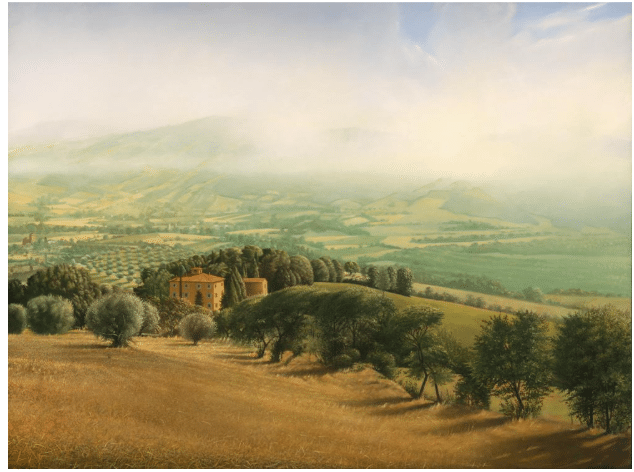
William Patterson, Villa in Umbria, Oil on canvas, 36” by 48”
An artist is a product of his or her regional culture, as well as the product of a world culture and an historical culture. Freedom for a visual artist comes from learning the nature of drawing, design, color theory and its practical applications, combined with one’s own visual discipline. The latter includes authentically developed concepts, content, methods, and handling of materials. A working artist never stops studying.
My focus is on the process of developing images both conceptually and technically, rather than the completion of finished works. Although, finished works do result from the process, studying and learning, not the finished work, is the primary intent. Faced with a blank piece of paper, canvas or other, one must bring something forth from the void (something from nothing). What is the process involved in doing this? While it’s about the work at hand, a total commitment and effort, for me, the main ingredient in this is passion.
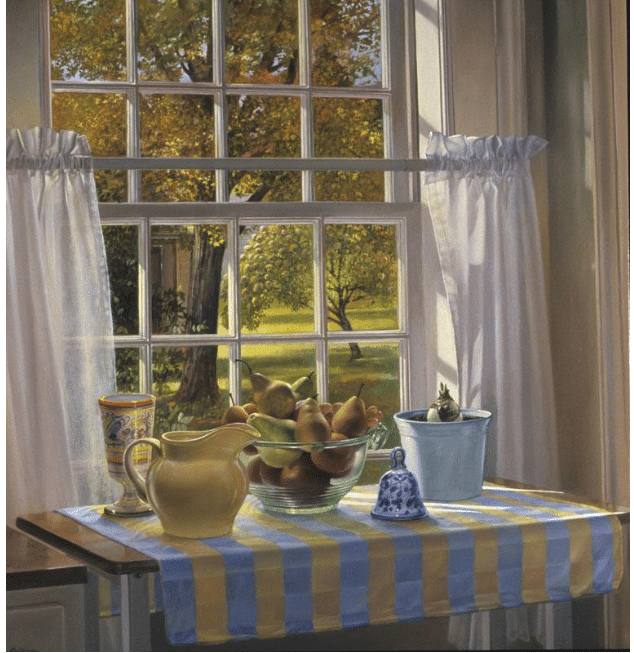
William Patterson, October Morning. Oil on canvas on panel, 23” by 22”
Process for me focuses on particular aspects of drawing and painting. My part in this is two-fold: One, that I am inspired and: Two, to recognize and develop my talent. It all begins with drawing. Drawing and conceptual design (composition) teaches me to see, a way to think visually, and it is the backbone of picture making. Michelangelo, who called drawing “The mother of all the arts”, used the term, “disegno” to encompass both drawing and design. To draw is to see, really see. Drawing is also intimate and personal. It is an individual matter. Everyone has their own handwriting – their touch. Painters try to paint what is in the depth of their soul, what moves them deeply. Sculptors invent forms that express profound moments in time. Architects conceive unique and original spaces. Drawing, what the Renaissance painters called “disegno,” addresses all of this.
But drawing is not only a series of skills to be mastered. It is also a continuing process of search and discovery. Drawing is the way we graphically freeze our sights, insights, thoughts, feelings, imaginings, concepts, fantasies, and ideas. Drawing can be a search for plastic form, a search or even a playing with abstract formal relationships, or perhaps simply a visual note in one’s sketchbook. Drawing is the way we do our research, a way to gain information from the outer world of nature and the senses as well as the inner world of the intellect and imagination. Drawing can be a penetrating study of nature on one hand, or on the other, a kind of scribble or super doodle. Drawing is the way an artist thinks.
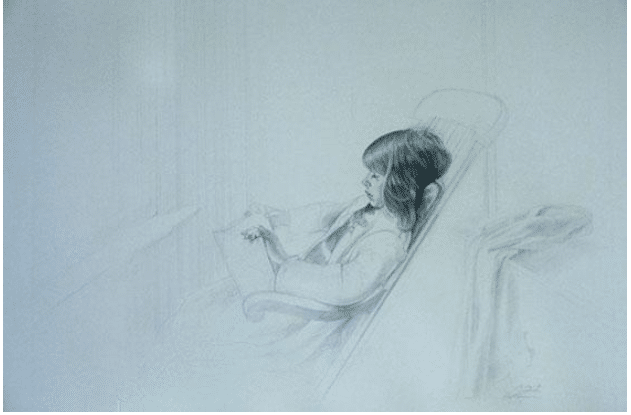
William Patterson, Catherine Reading, Pencil, 22″ x 30″
The human figure is often a central subject in drawing programs because it encompasses and informs the visual perceptions and skills necessary in all other subjects. A landscape painter should be trained in all facets of two-dimensional art and above all this includes many hours studying the figure.
Composition is the vehicle by which I communicate visually, to say something. My chosen subject in the open-air filters through my aesthetic sensibilities and emotions and becomes a personal statement. Composition deals with the organization of picture space using the elements of pictorial design, imagination, intuition and experimentation. It too is all about a process of search and discovery. Critical analysis is essential, as is to study the myriad of ways landscape artists from all periods organized their pictures.
I make many studies that includes something I call the pencil painting, which is a value study done quickly to get at the whole before the parts within the whole, or done slowly in order to study more subtle tonal nuances. The idea is to put down the abstract essence of a chosen subject. If I can think abstractly, to see shapes, values, light and shade, perspective, relative scale, proportion, directional movement etc., a composition, color perceptions and technique follow naturally.

William Patterson, Asciano, Oil on panel, 14” by 14”
Often, I use pictorial design in the landscape with a method called, thematic development. A series of drawings are made for a specific theme. For example, a sequential drawing might be to express emotion or movement in landscape, as opposed to a passive theme. The key elements would be empathy, the senses, emotion, gesture, structure and so on. Artists I may study might be, some of the 17th century Dutch painters where a turbulent sky sets the emotive tone, the open-air oil sketches of Constable, Bonington, Corot, Daubigny, Van Gogh and so on. Of course, there are many others.

William Patterson Catherine and Sarah, Pencil, 22″ x 30″
For me drawing into painting and drawing with paint brings me through the front door of painting. Cézanne wrote, “Drawing and color are by no means two different things. As you paint you draw.” The concept of the oil sketch done directly, with solid painting, in a gestured or controlled manner, teaches me about moving paint and about picture space. A direct “alla prima” approach develops my rapport with the wonderful substance we call paint. I have learned over many years that much of painting is about touch. I begin to think with paint and relate directly to the handling of thin and thick paint, soft or crisp edges, brush work and so on. I try to see objects, planes, masses of light and dark shapes or spots of color. My job is to see everything abstractly as shapes of tone and color.
The more proficient one becomes technically, the better one is able to focus on content. I recommend developing artists keep a journal recording their ongoing study of master and contemporary artists in and out of their painting classes. If one aspires to be a painter, one must know the field, historical and contemporary. At the advanced level, after a program of rigorous study, painting/drawing students reach a point where they have both the confidence and ability to develop a body of work. It has been rewarding, as a teacher, to see both my BFA and MFA students blossom in their careers.
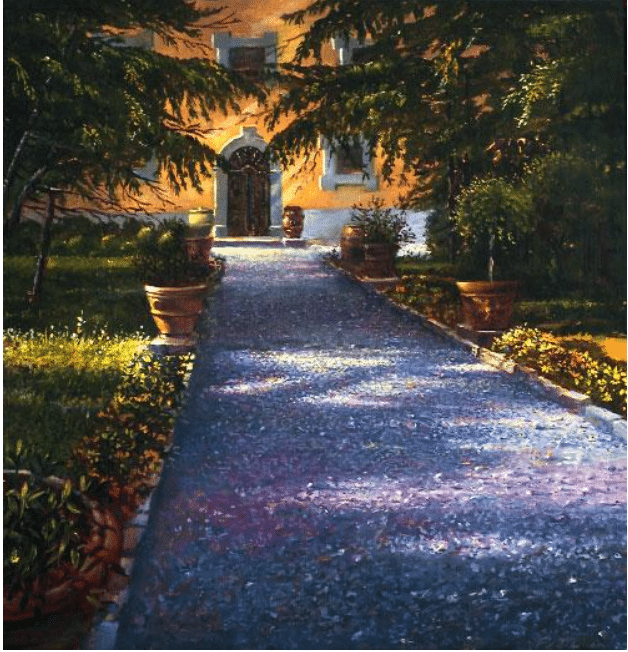
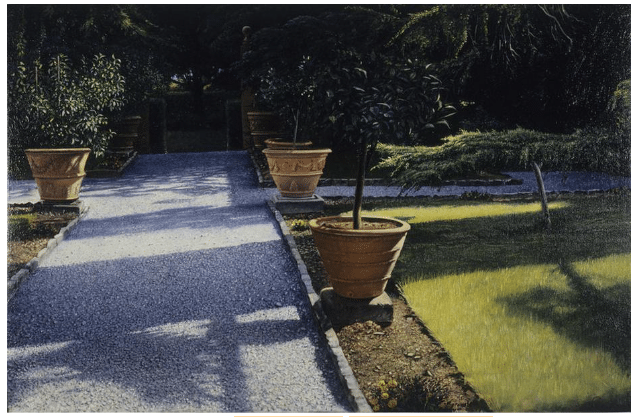
William Patterson, Villa Pathway, Field Sketch, 6.5″ x 6″
William Patterson is Professor Emeritus at the University of Massachusetts in Amherst, Massachusetts. A recipient of the prestigious College Outstanding Teaching Award, Mr. Patterson is a Fellow of the American Academy of Rome, Italy, where he was awarded the Prix d’ Rome. While teaching, he developed a hands-on studio course called The History of Painting Methods and Materials.
He is currently writing a book to be titled “My Sketchbooks,” a roundup of favorite painting and drawing locations in Italy, France, Cozumel, Mexico, California, New England and around his home in Allen, Texas.
Painters Painting Themselves
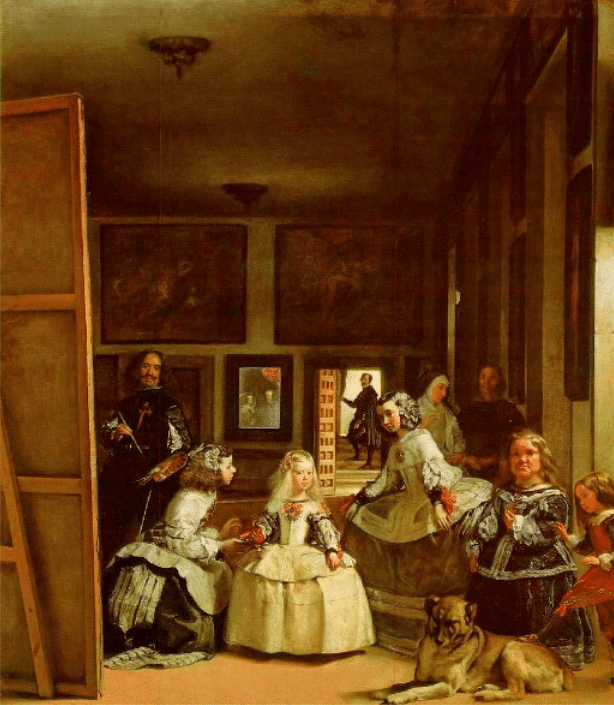
Diego Velasquez, Las Meninas, oil on canvas, 1645.
One of the most famous paintings of a painter painting is Las Meninas or Maids of Honor by “Old Master” Spanish realist Diego Velasquez.
Commissioned by the king of Spain, Las Meninas shows us “the Infanta,” that is, young Princess Margarita in the center, surrounded by her maids of honor and several other figures from the royal court. And that is Velasquez at the easel squeezed, as would be proper for a mere artisan of the king, into the shadows off to the left. Antonio Palomino, the first to write about Las Meninas made this clear when he said, “… the name of Velasquez will live from century to century as long as that of the most excellent and beautiful Margarita, in whose shadow his image is immortalized.”
Through the presence of the princess, king and queen, the canvas commemorates Velasquez’s own position as royal painter and stakes a claim, radical for the time, about the nobility of the art.
The reflection in the mirror is actually aligned precisely with what is on the canvas that Velasquez is painting – and not with the viewer. That means that the princess and her maids are the audience for what Velasquez is painting: a portrait of the king and queen, seen from the royal couple’s point of view.
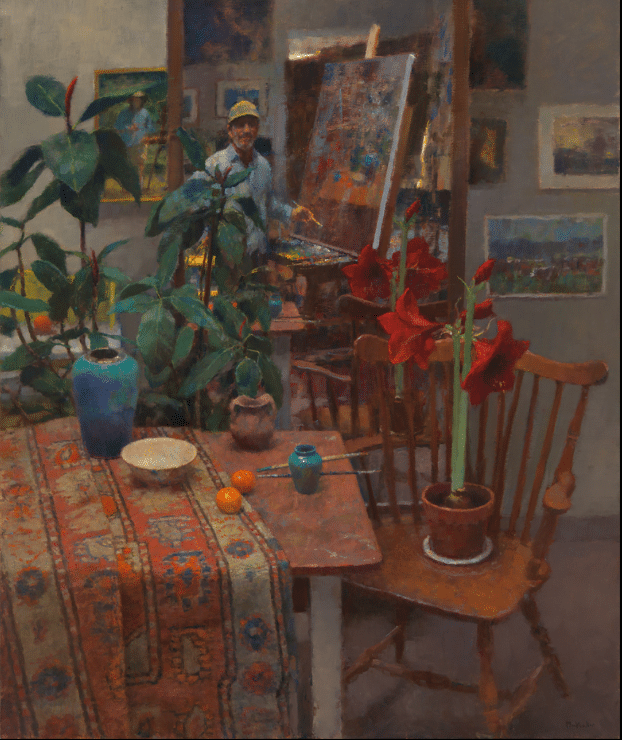
Jim McVicker, Amaryllis Self-Portrait, oil, 54×48 in.
Another painter of himself painting is Californian Jim McVickers. McVickers has depicted himself in the act of painting in this painting and ALSO in the self-portrait hanging on the wall behind him too. He’s even dressed in the same painting duds and posed in a very similar position.
Who doesn’t love paintings of painters painting? Here, by the same painter, is a fine landscape painting of a painter painting the landscape, just because.
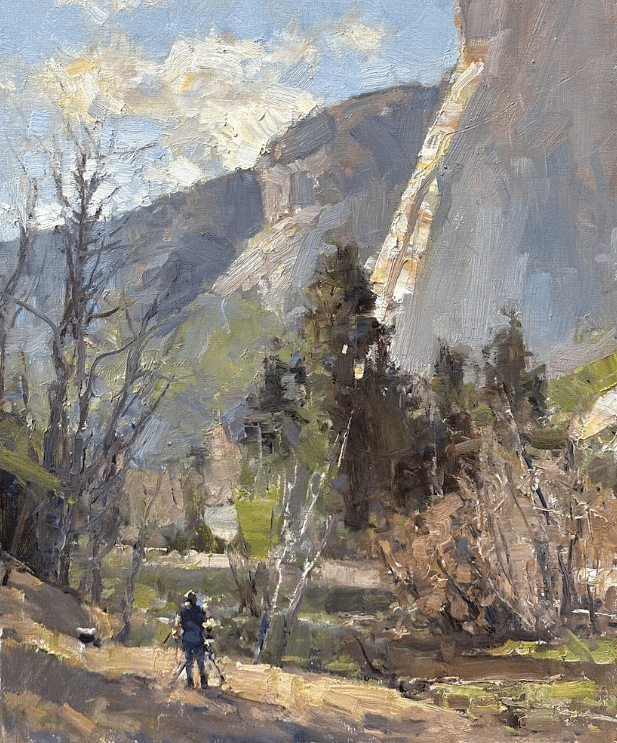
Jim McVickers, Rana Painting, oil, 20×16 in.