“Attention is the rarest and purest form of generosity,” wrote French mystic, philosopher and activist Simone Weil. For our fast and furious media culture however, it often feels like distraction itself has become our practice. Substantive art offers sustenance and reconnection for our starved spirits and shattered attention spans.
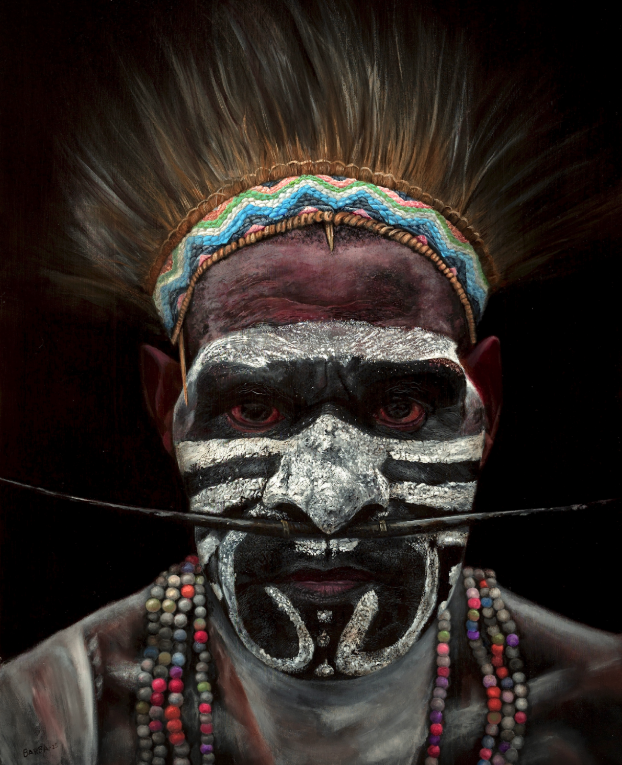
We have chosen, for the 18th ARC (Art Renewal Center) Inside Art Prize, “Agats,” Ralph A. Barba’s portrait of an Asmat, Papua New Guinea man in ceremonial face-paint. Among the many incredibly skilled and ingenious entries we received, this probing oil painting of an extraordinary individual touched deep. It resonated for us as a meditation on self and other richly layered with humanity. To the thoughtful eye, “Agats” speaks eloquently of the role art plays in understanding ourselves and inhabiting our world.
To fully understand this painting, or any good work of realism, you must be willing to sit with it, look past the surface, and engage with all of what’s there. Good realist painting teaches us a kind of “deep looking. It invites us to be fully present in what these days amounts to something like an act of radical attention. Barba’s “Agats” demands attention and refuses to let go until something mysterious and significant has transpired between work and viewer.
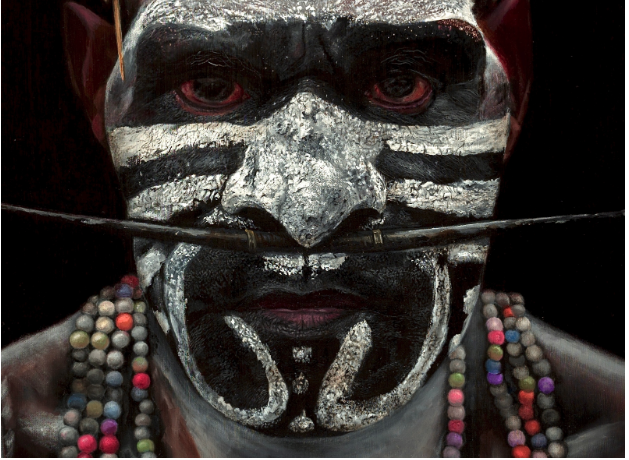
Detail of “Agats.”
Western art rarely valorizes the indigenous cultures imperial global ambitions have historically displaced, dispossessed, and destroyed. For centuries, the portrait has primarily been reserved for idealized depictions of “cultured” (often wealthy and mostly white) women and children in comforting and attractive settings. Modern exceptions might be Pablo Picasso, Francis Bacon, Lucien Freud, and contemporary artist Jenny Saville.
“Agats,” however, sidesteps the expected and leans into the intense realism and “tenebrism” associated with Renaissance and Old Masters such as Caravaggio, Rembrandt, and Velasquez. As in those paintings of very real, often flawed individuals, Barba uses chiaroscuro, a strong contrast between light and dark and a dramatically unlit background, to convey gravitas, depth, and insight. We encounter, as a result, a seeming otherness: startling face paint referencing bone and death offset by colorful weavings and beads (primal forms of artistic creativity), and at the heart of it all, an individual. Thus “Agats” invites us, citizens of the industrialized and “developed” world, to reach across cultural conditioning to encounter the profoundly human. This is a foundational role of art.
Barba met the man while on an expedition cruise in Indonesia. The people of Agats (the name of the man’s village) greeted their Western visitors with traditional war canoes and a ceremonial ritual normally reserved for funerals of village chiefs.
“This one particular gentleman that I painted stood out the most of the many pictures I took,” Barbas says. Standing before the man, he says, “those eyes didn’t just look back at me, they looked through me….I still remember gesturing to him with my iPhone if I could take his picture and he slightly nodded approval without ever breaking even the hint of a smile. The look he had in person was unlike anything I’d ever seen…. The whole experience was awe inspiring and I wanted to capture this as best I could.”
Jesuit theologian Walter Burghardt called prayer “a long, loving look at the real.” Is there such a thing as a spirituality of attention? Can art help us intentionally direct and soothe, if not heal, our media-saturated and distracted minds?
Surely art at least invites the possibility of mindfulness and a path to presence, connection, healing, and a deeper understanding of ourselves and our world.
The Inside Art Award is one of many offered by the International ARC Salon, the most prestigious realist art competition in the Americas and perhaps the world. The ARC Salon offers over $100,000 in cash awards and International recognition through partnerships with magazines, galleries, museum exhibitions, and a strong online presence. Check out ARC online here.
‘Art is the Province of Every Human Being’
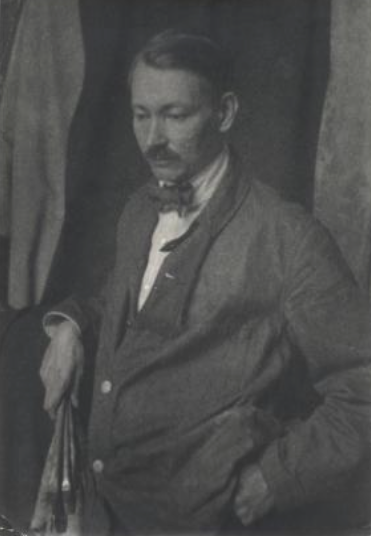
Robert Henri’s wonderful book, The Art Spirit, continues to inspire artists to create as honestly and authentically as one can live deeply and joyfully. This is a book to carry with you, to open at random, and to allow the ideas to roll around inside your mind and touch your heart. Henri writes:
“Art when really understood is the province of every human being. It is simply a question of doing things, anything, well. It is not an outside, extra thing. When the artist is alive in any person, whatever his [or her] kind of work may be, he becomes an inventive, searching, daring, self-expressing creature. He becomes interesting to other people. He [or she] disturbs, upsets, enlightens, and he [or she] opens ways for a better understanding. Where those who are not artists are trying to close the book, he [or she] opens it, shows there are still more pages possible. Art tends towards balance, order, judgment of relative values, the laws of growth, the economy of living – very good things for anyone to be interested in.”
So, Henri entreats us to live life like the adventure it is; to master “such as we have” to explore and to put our whole selves exuberantly into our work; to create beauty, express truth as we understand it, and to always keep the book open – in a spirit of generosity and goodness. Robert Henri can teach us a great deal. Maybe he will touch your mind and heart, too.
“The Art Spirit … that sort of became my Bible, because that book made the rules for the art life…it was one of those things that is so fantastic, because it sets you on your way.” -David Lynch