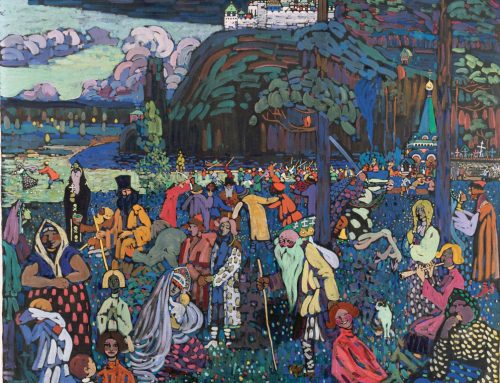

What interests me most is neither still life nor landscape: it is the human figure. – Henri Matisse
The term “figure painting” (or “figurative painting”) typically refers to representational art related to the human form. Knowing how to believably represent the body is challenging enough, but then there’s taking it further and making the painting be about something (even if no one can definitively put it in words).
Though it’s as old as cave art, figurative painting came into its own during the Renaissance. From roughly 1400 on, figurative artists benefited from the rediscovery of sculptural models literally buried since Greek and Roman antiquity combined with the emerging scientific understanding of the human body. Prior to the Renaissance, of course, religious doctrine had forbidden the dissection of corpses to uncover the mysteries the human body.
However, some say that what really interested Leonardo and Michelangelo is what interests the figurative artis now, and it’s something more than anatomy or psychology. The human body itself can be a kind of medium that painters of the figure can use to explore meaning and the significance of human experience (Michelangelo’s David, for example, is much more than merely its outward anatomical form).

Cesar Santos, figure painting in oil of a woman juxtaposed with a sphinx
A figure painting differs from a portrait in that, in the former, facial features join with expressive gesture and bodily form. Both allow figurative artists to communicate powerful and complex emotions and ideas.
In the classical tradition, students learn the figure by working from a live model, typically nude. Many consider this the truest way of understanding how to render the three-dimensional shapes and contours of the human body. The same students also drew from plaster casts of classical sculpture, copied the work of masters, and participated in hands-on lessons and demonstrations from their teachers.

Nancy Boren, I Wonder, 16” x 12,” oil
Perhaps figure painting’s true strength is its ability to convey the sense of a narrative. The term “human interest” is actually quite apt; we naturally respond to stories about other people. Paintings that work that muscle can hook us with just the hint that there is a story at all – something significant under the surface – even though we may not be able to say exactly what it is.

Nancy Boren, The Air Turned to Joy, 12”x12” oil
Figure painting requires a high level of proficiency with paint as well as awareness of anatomy, proportion, color theory, and composition. If you’re interested in the challenge of honing these skills, you might want to check out Cesar Santos’ video Secrets of Figure Painting or Nancy Boren’s Light, Motion and Drama.
NFT Market Crashes Hard

Beeple’s collage, Everydays: The First 5000 Days. Image: Beeple via the Verge
“NFT’s” were supposed to be NBTs, that is, the Next Big Thing. Once hyped as the biggest revolution in the history of modern and contemporary art, NFTs are digital images supposed to be as unique as physical works made of the “analog” materials of real life. They were also supposed be worth as much money, albeit in the digital form of cryptocurrency. But these days, it’s looking like “not so much.”
This month saw the second major art-world NFT company pull the plug. The first, “Nifty” shut down in May. The latest casualty, Recur, was definitely the Big Time – but neither its exclusive license with the Hello Kitty design nor the backing of the actual Museum of Modern Art could save it from going under.
“With the market in a severe downturn, it’s safe to assume the NFT bubble has well and truly burst,” says John Hawkins (Senior Lecturer, Canberra School of Politics, Economics and Society, University of Canberra) in a recent article for website The Conversation.
At the height of the boom, digital artist Pak sold an NFT project titled “The Merge” for $91.8 million on Nifty Gateway in 2021. The most famous NFT sale, which took place the same year, was a digital image collage by the artist Beeple that sold at Christie’s for $69.3 million. The many who at the time shook their heads in perplexed astonishment, are shaking them now.
“It was never clear why these digital collectables traded for such large amounts of money,” writes Hawkins. “Now they mostly do not.”
Some see hope for a comeback of sorts as new “innovative” use scenarios (other than art) come into being. But, as a story last month in Business Insider reported, “Most NFTs may now be worthless, less than two years after a bull run in the digital collectibles. A study examining more than 73,000 NFT collections found that 95% had a market cap of 0. Out of the top collections, the most common price for an NFT is now $5-$100.”