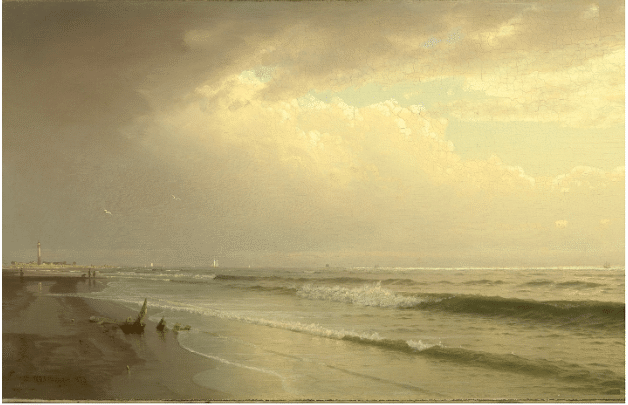
Almost literally luminous, the seascapes of 19th century American artist William Trost Richards (1833 – 1905) have earned an honored place in the history of American landscape painting.
William Trost Richards’ seascapes are introspective paintings, emotionally resonant with a feeling for the transience of things amid the on-rolling waves of eternity, something today’s solitary walkers of the world’s shores may yet recognize in themselves.
From a technical standpoint, Richards elongated the Hudson River School’s large-scale cinematic format to make it even more “widescreen.” He adopted the tonal “luminist” evocation of spirituality and beauty in nature and applied it to the seascape with understated yet majestic calm.
Thomas Cole, the movement’s guiding light, set the tone in a series of essays published in the 1840s. The goal of American art, he wrote, was “the sublime and beautiful bound together in an indissoluble chain,” by which he meant appreciation of the native land’s raw wildness refined by contemplation in tranquility. American art, he said, should have a dual nature, a marriage of “grandeur and loveliness … the sublime melting into the beautiful, the savage tempered by the magnificent.”
What’s “sublime” in nature is immensity, force, whatever chastens and diminishes our all-too-human delusions of mastery. In Richards, the sublime resides in his shifting, unpredictable storm-weathers and the sheer vastness of his open spaces stretching far into the distance. To drive home the message in the Atlantic City painting above, Richards added the shattered timbers of a wrecked vessel jutting up from where the sea’s dragged and buried it: a reminder of mortality and the indifference to human frailty of nature’s mighty, oceanic forces. Evidently the lighthouse is powerless to stay the hand of oceanic ruin.
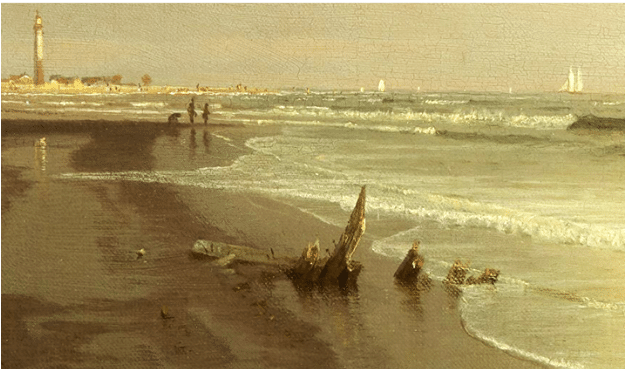
Detail of the above painting by William Trost Richards, “Seascape with Distant Lighthouse, Atlantic City, New Jersey,” 1873, Oil on canvas. 29.9 x 50.8 cm
While Richards’ seascapes make gestures toward the sublime and “savage” powers of nature, he ultimately renders the wildness tempered by “timeless beauty.” In doing so, he brought to marine painting Cole’s prescription for the landscape: the “union of the picturesque, the sublime, and the magnificent” in paintings with “the power to mend our hearts.”
But beach painters take note: this is not a big sunny blue-sky day. None of Richards’ seascapes are, and for good reason. He’s out to convey a deeper feeling for majesty, beauty, and the forces of nature that humble us. Still, the shadowy clouds and haze are relieved by a delicate sliver of pale blue sky hovering in the background.
Richards plants the viewer right where he presumably painted the study; the artist was well-known for painting studies while standing in the water. More importantly, he quickly tilts away and flattens out the plane of the ocean. The effect of this is to telescope the distance by narrowing the horizon and diminishing the viewer in terms of scale. Keeping the foreground verticality to a minimum maximizes the distance and the full, luminous space, which the light opens up above, below, and before the viewer as the gentle wavelets break.
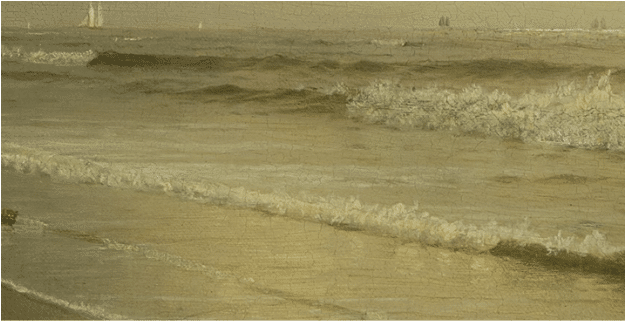
Closeup of the waves in William Trost Richards’ “Seascape with Distant Lighthouse,” 1873

William Trost Richards’ paintbox and palette, a 1994 gift from the artist’s granddaughter, Edith Ballinger Prince of Virginia Beach, was displayed in a 2016 exhibition of Richards’ seascapes at Virginia’s Chrysler Museum of Art.
What does it mean to paint a “poetic” seascape? It means first putting yourself in it – choosing the most expressive colors, composition, and design for what you feel, and then mustering everything technical you’ve absorbed about rendering sand, clouds, water, and waves.
If you’re ready to approve your ability to paint compelling seascapes, check out some of these teaching videos for deep-dive knowledge and instruction from the pro’s on how it’s done.
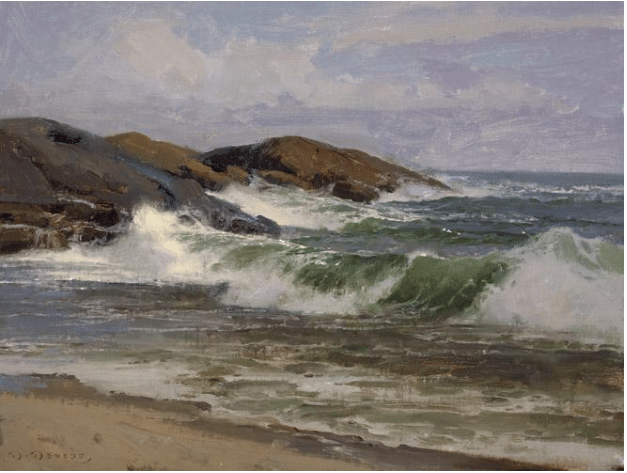
Donald Demers, “Warren’s Beach,” 12 x 16 in .oil
Internationally acclaimed artist Don Demers is a leading painter of the sea’s many moods. Experience one of the most comprehensive courses painting the sea in his teaching video, Mastering the Sea..