Clyde Aspevig teaches his oil painting approach and technique in his video, ASPEVIG.
As we approach the July 4 celebrations of America’s Independence Day, we offer a hopeful message regarding the power of art and imagination to bring people together and to move us all forward for the greater good.
Life’s complex. Nothing is as simple as we’d like, especially the “big” things like truth, justice, nationhood, and increasingly, what’s real and what isn’t. But creativity itself – that’s a fundamental commonality among all people at all times, a universal energy that runs through all. Tapping into yours can be a major joy – and challenge – your whole life long. And sharing it with others can do more good in the world than you might realize.
Former Boston Symphony Orchestra CEO Gail Samuel once said that the purpose of classical performances is to “bring people together around collective human experiences.” That seems to me one of the best definitions I’ve come across of what art is and why we make it.
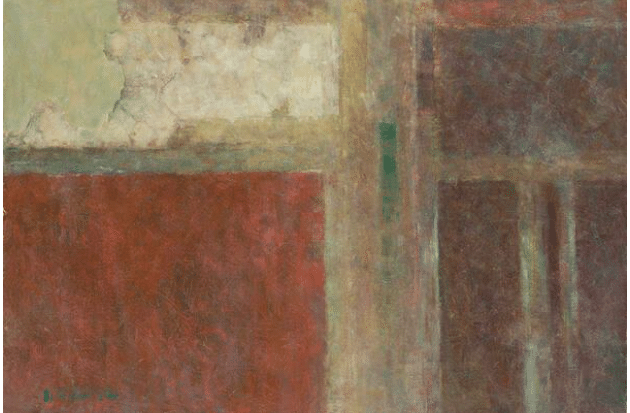
Clyde Aspevig, “Time Dancing,” oil, 20 in. x 30 in. an abstract mediation on time, based on an ancient Roman fresco. Clyde Aspevig teaches his oil painting approach and technique in his video, ASPEVIG
Art unites us in a common cause – to live better, more meaningful and more enjoyable lives. Take a painting like “Time Dancing” by Clude Aspevig (above). At first it might not look like much, but consider the title a clue and ask yourself what are you seeing and feeling from it?
Admittedly, this is MUCH EASIER to do in person, but I think it’s not impossible to appreciate this work’s meaningful expression, not only of history and mortality (the ravages of time) but the nature of art. After all, this is a painting of a painting, an ancient Roman fresco – so the work itself demonstrates that art and beauty transcend time, connecting us across geographies, histories, and cultures. The artist “saw” all of this in a flash when he stood before that ancient wall. You need to be alive – to be fully awake as a person – to “see” like that. And you need the technical skills necessary to express it to others.
If you let it, over the long haul, art will subtly wake you up and encourage you to be that much more fully alive. Seeing things in new ways means quietly reinventing your world on a daily basis, even if only in small, seemingly trivial increments.
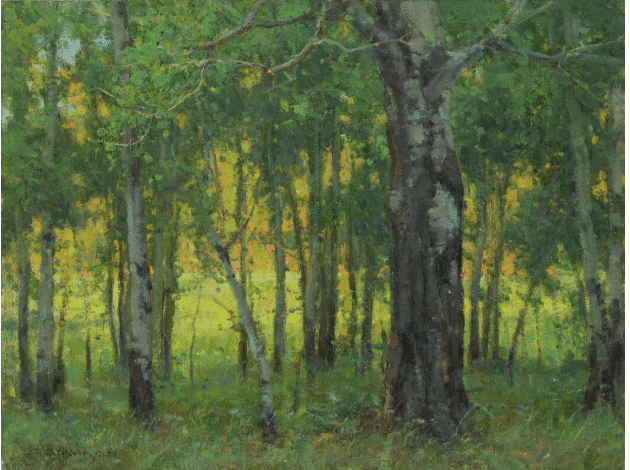
Clyde Aspevig, “Aspen Grove,” oil, 12 in. x 16 in. Clyde Aspevig teaches his unique oil painting approach and technique in his video, ASPEVIG
To share the results of that with others – visibly, in solid, expressive form – that’s the miracle of art! Light illuminates a wine glass on a countertop; blue shadows nestle in snow: We tend to dismiss our own insights and experiences until we receive them from someone else. But learning to recognize what we value is part of becoming an artist – defined as one who shares creatively what he or she values, and in the process creates a bond that people can share.
Paintings made in that spirit also teach and encourage others to live more deliberately, to use Thoreau’s word – meaning to get out of our ruts, open our eyes, and LIVE. Art creates common ground that fosters the being present, living in creative openness to experience, that feeds creativity and the creation of more art. As twentieth-century spiritual leader Abraham Joshua Heschel put it, “Our goal should be to live life in radical amazement …. to get up in the morning and look at the world in a way that takes nothing for granted. Everything is phenomenal; everything is incredible; never treat life casually.”
Art pulls us together as it pulls us in and dares us all to live a fuller, freer life. At its very best, it summons us collectively to what Heschel called, “Awe … the encounter of the human mind with the universe.” The collective human experiences are those we all understand – love, sympathy, grief, longing, and awe. Awe is what we feel when we reach the top of a mountain, stand beneath a truly starry sky – when we open our eyes to the miracle of existence. Suddenly we no longer take for granted the vastness and beauty of the cosmos. With awe comes the kind of beauty that feeds the heart and nurtures the soul.
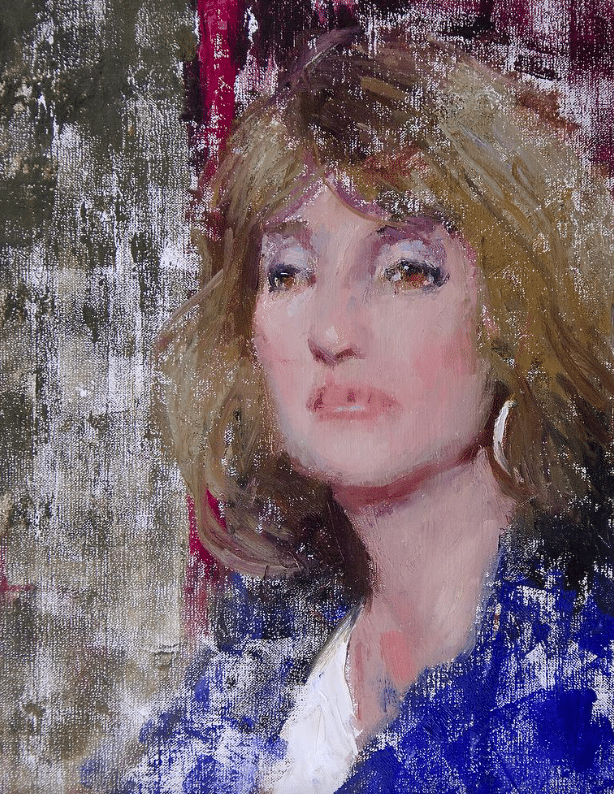
William A. Schneider, “Before All This,” oil, 16 in. x 12 in.
No one has to be a “genius” to do this. Painting is a wonderful pastime that’s good for you. The challenge and promise of it is that the deeper you channel your inner truths in your work, the better it will connect and create that deep, untranslatable bond that moves the heart and brings people together.
Learn all the techniques you need – there’s no shortcut for that. Eventually, when you can allow your emotion to lead but not dominate, you will begin to combine technique and personal expression in the free interpretation of what you see and know. That’s where the treasure lies – not the treasure of money, fame, power, or “being right” – I mean the treasure of “collective human experience,” in other words, that of the human heart.
Good art reminds us that, as Heschel says, “what we lack is not a will to believe, but a will to wonder.” At times such as those we’re living through today, who’ll deny we could all use a little more of that.

William A. Schneider, “Red Tail Dawn,” oil
From that important technical perspective, improving your sense of design is probably the quickest way to make better paintings. For a thorough overview, you might want to consider an instructional DVD such as William A. Schneider: Design Secrets of Masters – Key to a Successful Painting
Bringing Portrait Paintings to Life
By Guest Contributor Milène J. Fernández
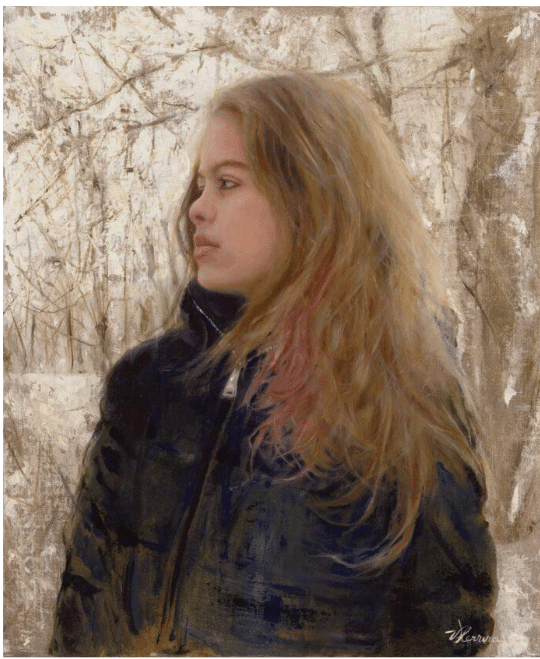
Victoria Herrera, “Winter Struggle of a Soul,” 2022, oil on Belgian linen, 24 x 20 in., private collection
For portrait paintings to be successful, you have to find a way to grab viewers’ attention. Find out below how Victoria Herrera brings portraits to life.
On a stormy weekend in 2024, I sat with Victoria Herrera (b. 1964) in her big cozy studio, which spans the entire basement of her home in Montclair, New Jersey. Surrounded by paints and canvases, reference photographs, and inspiration images pinned all over the walls, she recalled her first experience of feeling confident and enjoying a specific activity — drawing.
As a child growing up in Panama, she also loved running around in the rainforest taking in the wonder of nature in all its intricate detail and grandeur. Everything there piqued her curiosity, and nothing was taken for granted. Now, as an adult, whenever Herrera visits Panama to see relatives, she makes sure to spend some time alone in that rainforest. “I feel such a connection with nature,” she explains. It is the foundation of everything she paints, and the original reason, she says, “I still practice observation a lot.”
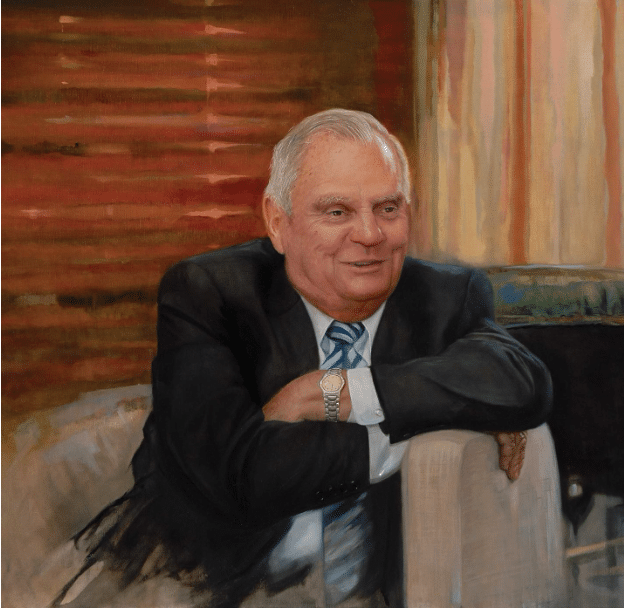
Victoria Herrera, “Portrait of Mr. Federico Humbert,” 2019, oil on Belgian linen, 48 x 44 in., private collection
Before she decided to become a painter, 35 years ago, Herrera wanted to be a photojournalist. She still admires photographers like W. Eugene Smith, Dorothea Lange, and Mary Ellen Marks. “I was so attracted to the idea of capturing that perfect instant that can tell a whole story,” she remembers. Although her parents particularly discouraged her from pursuing a career as a war photographer, she has been able to satisfy — through the painting of portraits — that early desire to capture people’s meaningful expressions, ones that serve as portals to their whole story. To achieve this goal, she studied full-time for four years at New York City’s Grand Central Atelier under its founder, Jacob Collins. “It was a rigorous and difficult training that required many sacrifices,” she notes, “but I would not exchange it for anything.”
Asked about her general approach to composition, Herrera replies: “For a painting to be successful, you have to find a way to grab viewers’ attention. And you must invite them to participate — to keep them interested in discovering what else is going on in the image.” She continues, “In 2006, when I painted my first botanical, I decided to arrest viewers with the canvas’s large size [72 x 72 inches] and with its lack of color. By using only neutral grays, I would let the viewer decide what color the flower could be.” That painting turned out to be “a showstopper,” so Herrera has been painting hibiscus flowers ever since. (“Metamorphosis” is illustrated below.) In a way, her botanicals are like portraits, and some collectors have noted they look like “angels or ballerinas.”

Victoria Herrera, “Metamorphosis,” 2015, oil on Belgian linen, 60 x 60 in., private collection
An Approach That Works for Portrait Paintings
Although most portraitists prefer to have their sitters pose many times, clients don’t often have schedules that allow them to do this. Therefore, all of Herrera’s commissions have been developed from photographic references. In our busy world, this is an increasingly common situation, yet it is seldom discussed in the field of contemporary realism. Embracing this challenge, Herrera holds herself to a high standard.
“It’s important to connect with the ‘essence’ of the person I am painting,” she observes. That’s why she has many conversations with sitters, gathering abundant information through their storytelling and as many photographs as possible — to learn about their personality, traits, character, tastes, and even dreams. She is especially eager to learn what they want others to think or feel upon seeing the portrait.”
If you’re looking to improve your own portrait skills, check out one of these master teaching videos.