Clyde Aspevig teaches his oil painting approach and technique in his video, ASPEVIG.
“Tradition is not the worship of ashes, but the preservation of fire.”
― Gustav Mahler
Life’s complex. Nothing is as simple as we’d like, and that includes big things like truth, justice, what’s real and what isn’t as well as “small” things like what you paint and why. But creativity itself – that’s a fundamental commonality among all people at all times, a universal energy that runs through all. Tapping into yours can be a major joy – and challenge – your whole life.
As an artist, it’s a given that need technique. You’ll spend many hours learning, both through study and through trial and error, the basics of composition, drawing, edges, color, and the numerous basic principles and techniques of painting passed from master to student for hundreds of years.
Yet, there’s a danger in disciplining yourself to acquire these skills: there’s so much to learn that one can end up sacrificing creativity, invention, spontaneity and expression, the very things that drive creativity in the first place. You need both. To open the doors to the more elusive creative impulses, one must think of tradition and technique only as tools, not ends in themselves. This can require a whole reorientation of one’s relationship with the art.
Think about it this way: every standard academic technique was once a spur of the moment invention. Maybe an artist’s vision demanded an expression with so much force that a technique was born out of necessity. More likely, however, our artist got into a jam and needed to think fast to save the painting, and voila, a new technique, soon to be a “rule,” was born.
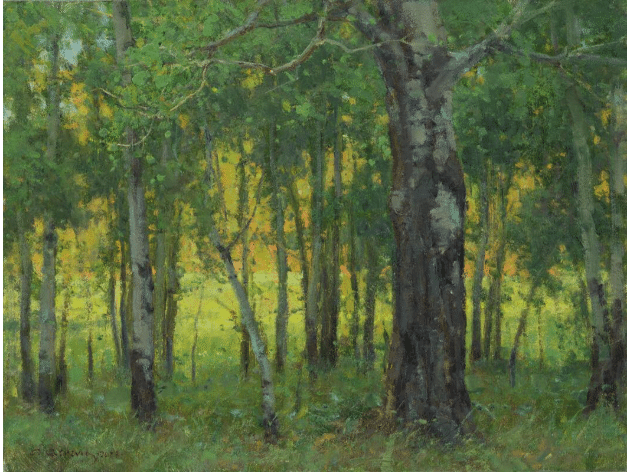
Clyde Aspevig, “Aspen Grove,” oil, 12 in. x 16 in. Clyde Aspevig teaches his unique oil painting approach and technique in his video, ASPEVIG
So yes, we’re supposed to find our authentic voice AND learn the secrets of conjuring three-dimensional forms onto a two-dimensional surface – It’s a lot! But the result – strong, honest artwork – is one of the things that unites us all, and we could all do with a little more that right about now.
There is nothing wrong with sticking to well-travelled paths. Painting is a wonderful pastime that’s good for you. If you’re restless though, it could be because you sense that the deeper you know and connect with your inner truths in your work the stronger it will connect and create that deep, untranslatable bond that moves the heart and brings people together.
Seeing Our Own Worth
The real problem is not the inability to be creative – it’s our inability to see what’s of value in what we create. In other words, we can spend so much time looking at “good” paintings and expend so much energy developing the proper techniques for making them, that when we step outside those parameters, what we create looks like a failure – how can it not, when it doesn’t check the boxes we’ve been told are “supposed to be” checked!
And yet, in each “hot mess” we make, there’s a little of ourselves in there. There’s something unlearned, uncontrived, honest, and raw. It may be something as yet undeveloped and rudimentary, but it’s something that corresponds to how you really feel and who you really are in the world. Look for that. See that. Honor it.
Learn technique – and also risk stepping out from behind it, in little bursts of creative feeling. Painting is a slow burn.
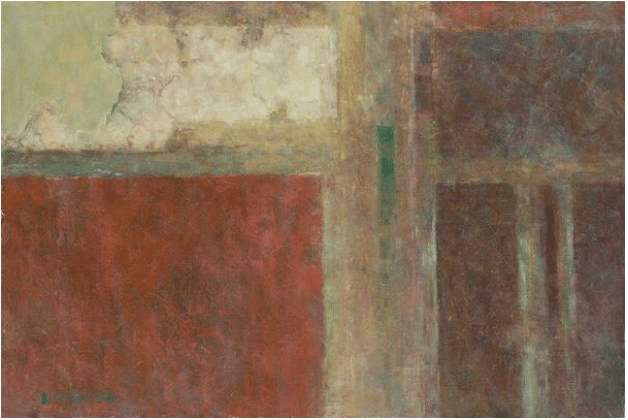
Clyde Aspevig, “Time Dancing,” oil, 20 in. x 30 in. an abstract mediation on time, based on an ancient Roman fresco. Clyde Aspevig teaches his oil painting approach and technique in his video, ASPEVIG
It helps if every now and then you go completely off the rails and paint without thinking too much about it, without trying to do something good. Surrender to the moment. You don’t have to show these paintings to anyone. But make them, keep them, own them for what they are and what they could be. Or hey, destroy them immediately! But know that you have gotten at least a little bit closer to making your art your own if you let it. Your so-called failures are the flagstones that will lead you to yourself.
Eventually, when you can allow your emotion to lead but not dominate, you will begin to combine academic technique and personal expression in the free interpretation of what you see and know. However, this won’t happen if you don’t take risks.
Get Inspired Again!
Here are three ideas for stretching yourself as you seek beyond your boundaries:
- Remind yourself what artists do. Seek out an historical artist whose work you respond to immensely and learn everything you can about them as a person. The only requirement is that they be dead. Do some deep-dive art history searches. Find the originators of what everyone is copying: find yourself a Sargent, a Turner, a Klee, a Raphael, Inness, Corot, Constable or Latour. Splurge on real art books and read the words in them. Find out what the critics, then and now, as well as what the artist had to say about the work. Seriously, go see the work in person whenever you can. (Don’t study these paintings to learn how to use oil paint, watercolor, or pastels; the most important lesson the masters can teach you isn’t about technique – it’s about what inspired them to make the work they did.)
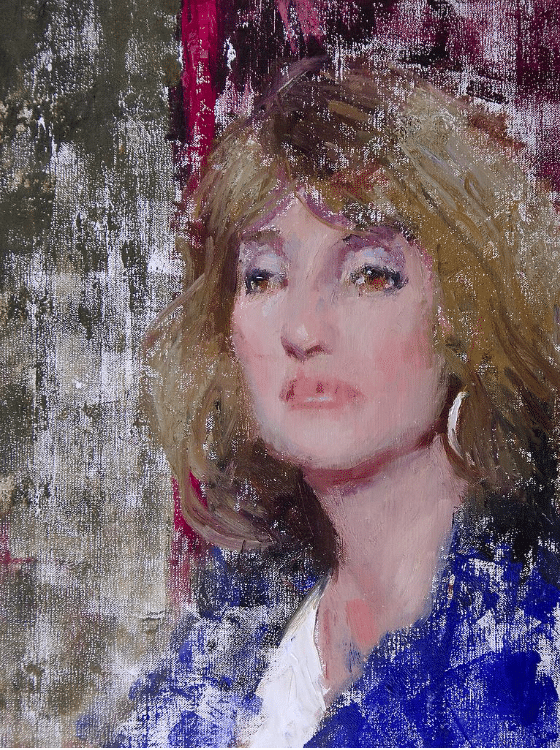
William A. Schneider, “Before All This,” oil, 16 in. x 12 in.
- Learn about different kinds of art. We tend to gravitate to a particular genre of art and the artists who make it, but there are many art worlds. Stumble onto a few of them now and then. Figure out why the artist made that kind of art and not another. Follow some unfamiliar links online, read about art you aren’t even initially interested in, discover new galleries and styles and seriously consider the merit of the work they show. Learn to see technique as an impressive skill meant to be adapted to convey an artist’s meaningful and heartfelt feelings about the world. Always be open to expanding your definition of art.
- Figure out what you have to say. Knowing yourself is a huge advantage as an artist. Ask yourself what you like about the work you admire – not just in terms of technique, but in terms of what’s behind it, what the artist put into it, what the work conveys about life! What’s important to you? As Emerson said, when you are most yourself you are the most universal – when you trust yourself, you hit common ground – you sound an original note on the instrument of your soul, and “every heart vibrates to that iron string.”
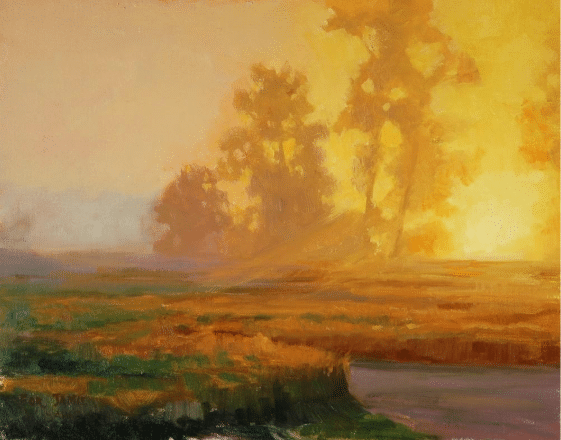
William A. Schneider, “Red Tail Dawn,” oil
From that important technical perspective, improving your sense of design is probably the quickest way to make better paintings. For a thorough overview, you might want to consider an instructional DVD such as William A. Schneider: Design Secrets of Masters – Key to a Successful Painting
Bringing Portrait Paintings to Life
By Milène J. Fernández
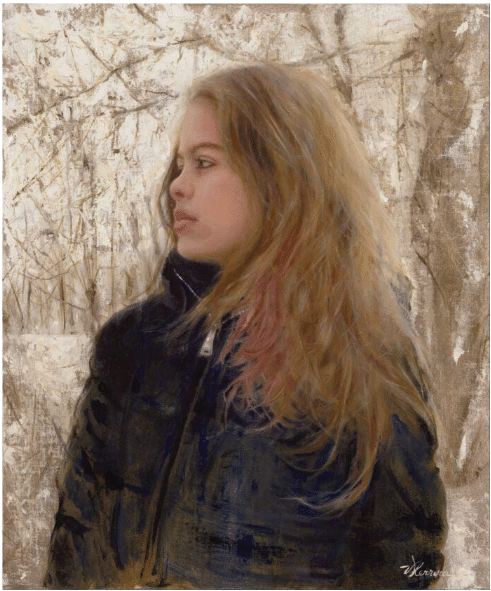
Victoria Herrera, “Winter Struggle of a Soul,” 2022, oil on Belgian linen, 24 x 20 in., private collection
For portrait paintings to be successful, you have to find a way to grab viewers’ attention.
Victoria Herrera Brings Portraits to Life
By Milène J. Fernández
On a stormy weekend in 2024, I sat with Victoria Herrera (b. 1964) in her big cozy studio, which spans the entire basement of her home in Montclair, New Jersey. Surrounded by paints and canvases, reference photographs, and inspiration images pinned all over the walls, she recalled her first experience of feeling confident and enjoying a specific activity — drawing.
As a child growing up in Panama, she also loved running around in the rainforest taking in the wonder of nature in all its intricate detail and grandeur. Everything there piqued her curiosity, and nothing was taken for granted. Now, as an adult, whenever Herrera visits Panama to see relatives, she makes sure to spend some time alone in that rainforest. “I feel such a connection with nature,” she explains. It is the foundation of everything she paints, and the original reason, she says, “I still practice observation a lot.”
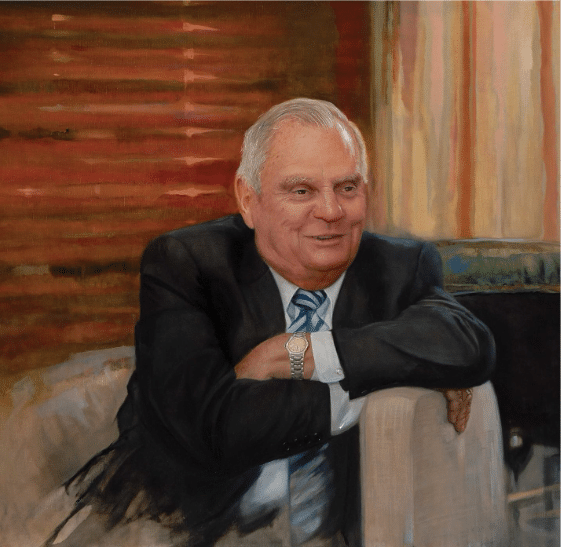
Victoria Herrera, “Portrait of Mr. Federico Humbert,” 2019, oil on Belgian linen, 48 x 44 in., private collection
Before she decided to become a painter, 35 years ago, Herrera wanted to be a photojournalist. She still admires photographers like W. Eugene Smith, Dorothea Lange, and Mary Ellen Marks. “I was so attracted to the idea of capturing that perfect instant that can tell a whole story,” she remembers. Although her parents particularly discouraged her from pursuing a career as a war photographer, she has been able to satisfy — through the painting of portraits — that early desire to capture people’s meaningful expressions, ones that serve as portals to their whole story. To achieve this goal, she studied full-time for four years at New York City’s Grand Central Atelier under its founder, Jacob Collins. “It was a rigorous and difficult training that required many sacrifices,” she notes, “but I would not exchange it for anything.”
Asked about her general approach to composition, Herrera replies: “For a painting to be successful, you have to find a way to grab viewers’ attention. And you must invite them to participate — to keep them interested in discovering what else is going on in the image.” She continues, “In 2006, when I painted my first botanical, I decided to arrest viewers with the canvas’s large size [72 x 72 inches] and with its lack of color. By using only neutral grays, I would let the viewer decide what color the flower could be.” That painting turned out to be “a showstopper,” so Herrera has been painting hibiscus flowers ever since. (“Metamorphosis” is illustrated below.) In a way, her botanicals are like portraits, and some collectors have noted they look like “angels or ballerinas.”
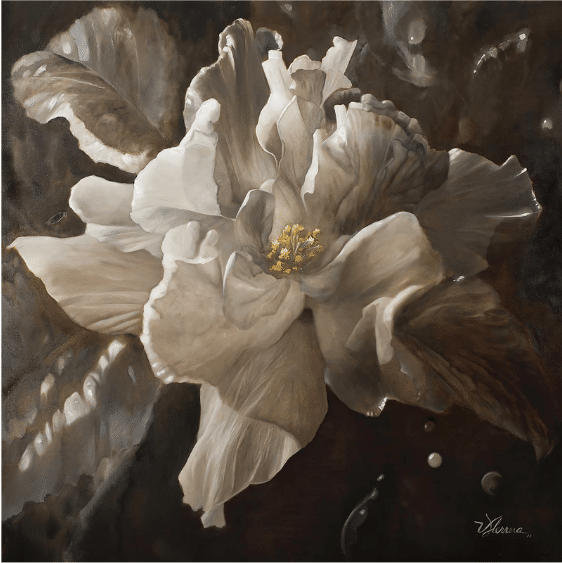
Victoria Herrera, “Metamorphosis,” 2015, oil on Belgian linen, 60 x 60 in., private collection
An Approach That Works for Portrait Paintings
Although most portraitists prefer to have their sitters pose many times, clients don’t often have schedules that allow them to do this. Therefore, all of Herrera’s commissions have been developed from photographic references. In our busy world, this is an increasingly common situation, yet it is seldom discussed in the field of contemporary realism. Embracing this challenge, Herrera holds herself to a high standard.
“It’s important to connect with the ‘essence’ of the person I am painting,” she observes. That’s why she has many conversations with sitters, gathering abundant information through their storytelling and as many photographs as possible — to learn about their personality, traits, character, tastes, and even dreams. She is especially eager to learn what they want others to think or feel upon seeing the portrait.”
If you’re looking to improve your own portrait skills, check out one of these master teaching videos.