
Forget trying to find yourself as an artist. Embrace your inner dunce. If you are worried that you don’t have a style, can’t find your voice – don’t worry. If you keep on painting, you will.
Don’t worry if you don’t like what you’re doing – it will change. Don’t fret if you don’t feel you’re “original,” or if “all” you do is paint what you see or what other people have painted. If you take your journey seriously enough to be asking the question, sooner or later the answer will present itself. So just keep going. Eventually you’ll stumble onto doing something genuinely your own.
Learn to Love the Slump
It won’t feel that way at first. In fact, it starts with a slump – maybe you’re bored with your work, or jealous of someone else’s, or just “not feeling it.” You start to think it’s over. BUT that’s exactly the right kind of soil you need to grow as an artist. You’d never see a sudden burst of light from the heavens if you didn’t learn to live with the clouds.
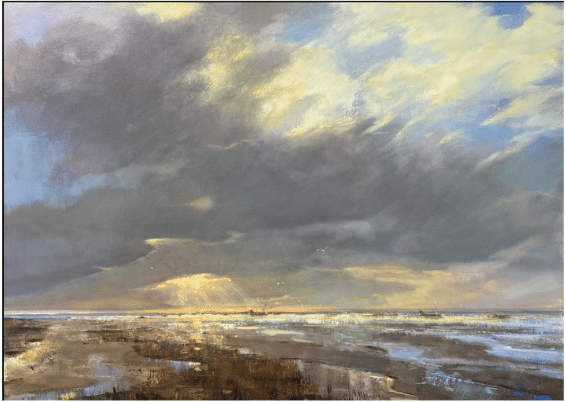
Nancy Tankersley, “Bound for Baltimore,” oil, 36 x 38 in. Nancy Tankersley teaches sound painting technique from the ground up in her video, Essential Painting Principles.
You see, when you first start painting, you’ll think that art is supposed to be a certain way. If you’re willing to be patient with yourself, you’ll eventually figure out how to make successful paintings just like those you admire. And it’ll feel great! And maybe that’s more than enough.
But it could also happen that one day you realize it’s no longer all that interesting, because it’s no longer a challenge, or maybe what you get out of it – the reward for your hard work – is no longer worth it. You might begin to wonder why you’re doing it. What then?
If you’ve built a career around your art and don’t have the option to stop making work, rejoice – you’re in the ideal position. There’s no better fire you can light under your imagination than Necessity. You’ll be forced to start experimenting and stretching if only to avoid dying of boredom. But your ideas about painting – the work painting does in the world, what painting really is, what purpose it serves (or should or could serve) – will have changed too. Naturally you’ll want your art to catch up with your new sense of art’s meaning and importance. It’s then that inspiration shows up and leads the way.
No, You Don’t Have to Become an Abstract Artist
This doesn’t have to mean that you “progress” from representation to abstraction. Sure, many long-term career artists say that you start out with representation (replication of what you see) and move further and further into expression (how you conceptualize, or feel about what you see, what you want to “say”).
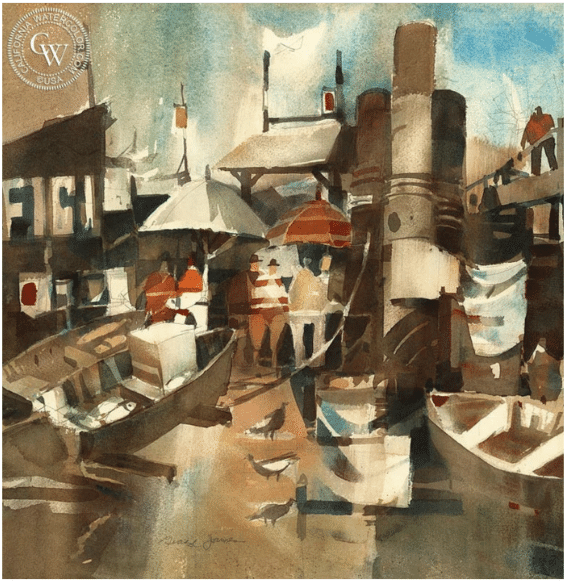
George James, “Newport Marina,” watercolor, 20 x 19.5 in. In this painting, George James jumbles graceful abstract swoops and curves with dynamic diagonals in a delightful interpretation of the sights and scenes of a lively public waterfront. James teaches his approach to design and composition using watercolors in his video, Designing for Content.
Yet all that means is that you supplement your skills in replication with the ability to express something you think or feel. That’s it. That’s what’s called the almighty, mythical Artistic Vision: your ability to bring your personal sense of what’s important in art and life into what you create.
It’s not about whether it’s realism or abstraction. It’s what you put into the work that counts.
You can play Bach’s piano pieces with or without feeling (traditional realism). You can bang on the keys and call it expression, or you can gently play notes with a mysterious sense of elation or sadness (both would be a form of abstraction). You can use the principles of classical music to compose an elaborate and moving piece about anger or joy or grief – or use them to create a dud that expresses nothing but its own technical prowess.
But first you must learn to play the piano. And become comfortable improvising on the keys. And play and play and play and keep on playing.