Anything can be a subject for vital painting provided you have a strong enough imaginative vision.
What I'm calling imaginative vision is different from imagination per se; it's more like a "thought-feeling" that takes a sudden visual form within the mind. There's vision – seeing with the eyes – and then there's imaginative vision – seeing with the "inner eye," usually in a flash of insight compounded of visual memory, emotions, and ideas, in which a future painting appears in the mind as if already painted.
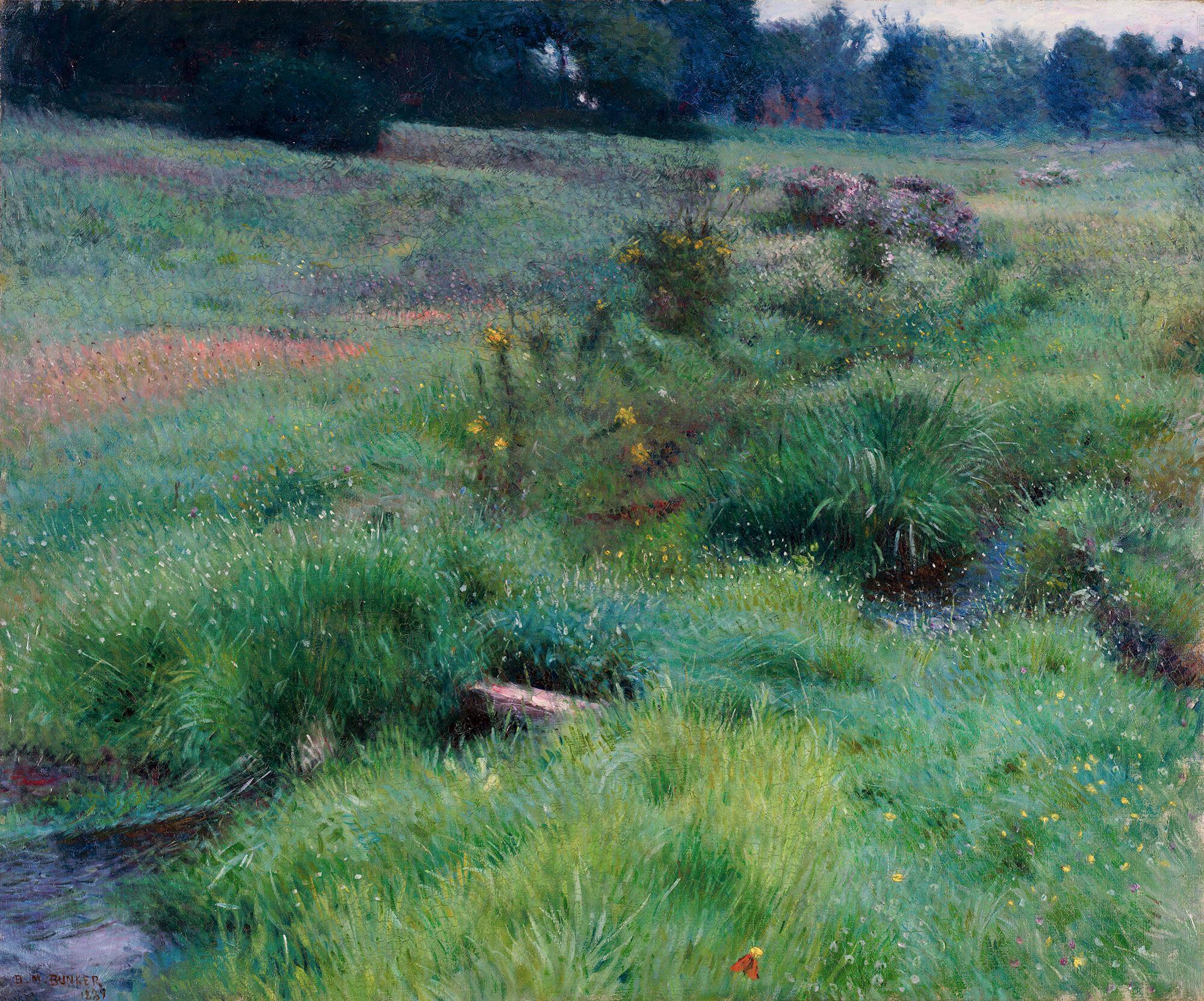
It happens when you're not looking for something to paint. Maybe you're driving somewhere, or just out waking, not thinking about anything in particular. It can even happen in an "empty" field, as New England American Impressionist Dennis Miller Bunker proved, in a fascinating and beautiful series of paintings he created during the summers of 1889 and '90.
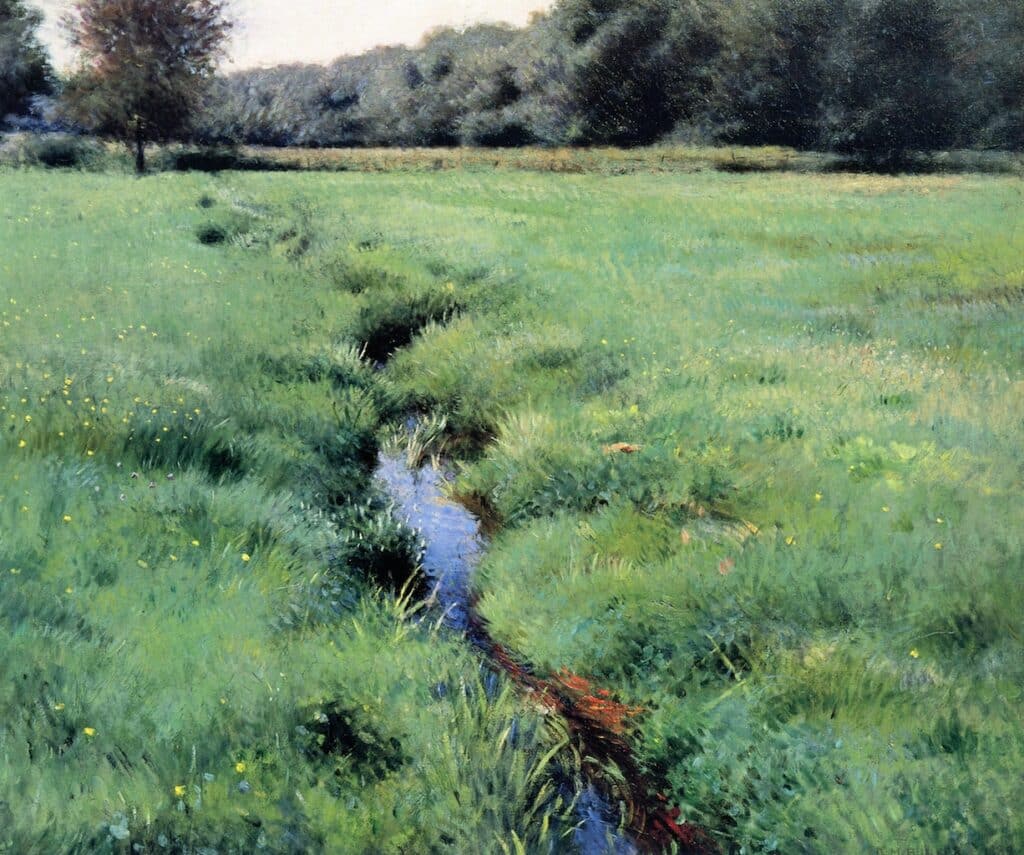 |
| Dennis Miller Bunker, The Brook at Medfield, 1889 (one of his several versions of this motif)
|
Though his life would be tragically cut short just six years later, Dennis Miller Bunker at the age of 23 was one of the most promising of the young American Impressionists who sprang up in Boston toward the end of the 19th century. Bunker and other Boston painters mentored by William Morris Hunt, including Tarbell, Childe Hassam, Wm. Merrit Chase, and Frank Benson, became avid disciples of prominent French painters, most conspicuously Claude Monet. Collectively they're referred to as the Boston School.

Dennis Miller Bunker (1861-1890), who died at age 29.
Though academically trained by French Neoclassist Jean-Leon Gerome, Bunker learned Impressionism from John Singer Sargent in England and during a summer spent painting with Monet. In 1889, when he couldn't afford to return to England with the famous portraitist, his patron Isabella Steward Gardner (who'd lost a young son who would have been Bunker's age) recommended the young man go and see Medfield, Massachusetts.
Medfield had been immortalized when George Inness set up a studio there and began painting it around 1860. It was here that Inness, moved by French Barbizon painting and the onset of the Civil War, created his first great, fully realized spiritual visions of the American landscape that would eventually give birth to the Tonalist movement.
 |
| George Inness, Clearing Up (Medfield), 1860
|
Isabella was in the habit of taking Boston socialites there for parties and concerts at the summer cottage of her friend Charles Martin Loeffler, a well-known composer and concertmaster for the Boston Symphony Orchestra. Bunker fell in love with the place and, while staying at a congenial boarding house, painted dozens of canvases over the the summers of '89 and '90, his most productive years ever.
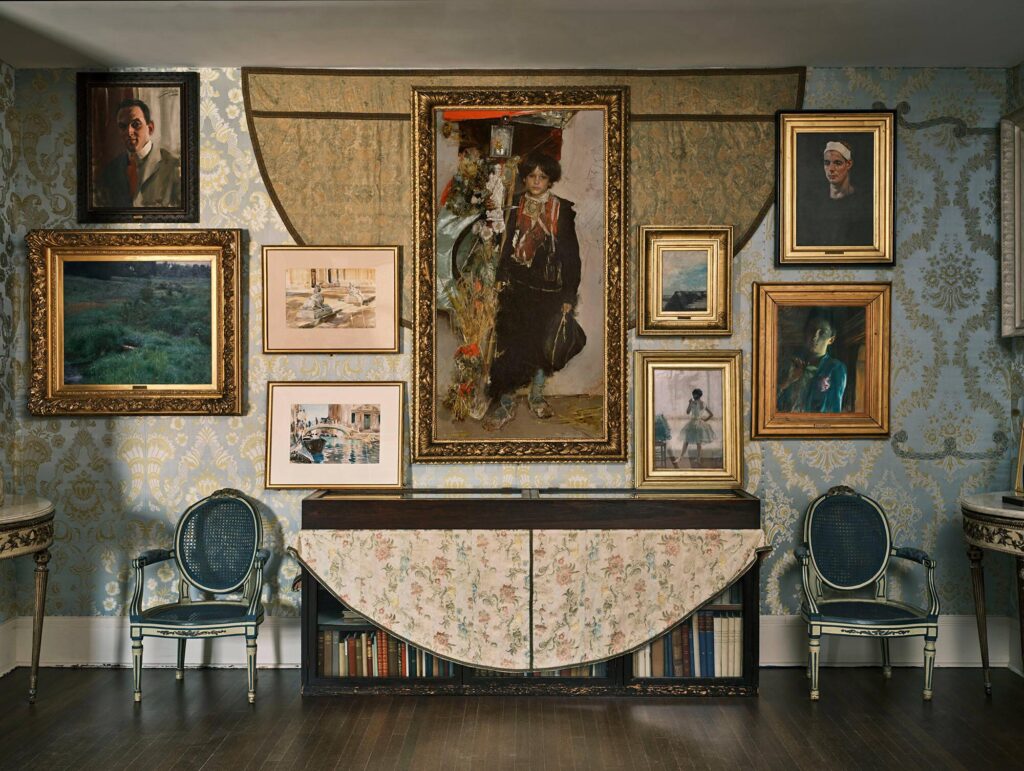
Dennis Miller Bunker's "Brook at Medfield" painting in its natural habitat at the Isabella Stewart Gardner Museum in Boston (you can spot it at eye level on the left hand side)
You can see examples of these paintings at the most prestigious historical museums in New England, the Isabella Stewart Gardner Museum, the Boston Athenaeum, and the Museum of Fine Arts in Boston. The public saw the first of Bunker's Medfield paintings in 1890.
 |
| Dennis Miller Bunker, The Pool, Medfield, 1889 or '90
|
"Freaks of Painting"
Though obviously simply gorgeous work to us now, these were rather shocking paintings for an American artist at the time, and Boston's art world was duly fascinated. A reviewer for the Boston Evening Transcript wrote: "The skies are represented only by reflection in these interesting freaks of painting and they may be classified as bold and original experiments in the representation to that eternal phenomenon which possesses such a powerful fascination for all painters—sunlight."
 |
| Dennis Miller Bunker, The Brook at Medfield |
Those words are still true today. Bunker's paintings of the brook at Medfield are unlike anything else of the time and instantly recognizable as his own.
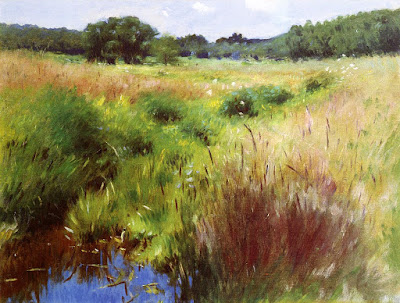 |
| Dennis Miller Bunker, The Brook at Medfield, 1889/90
|
Evidently, he approached his subject with the same intensity of observation and execution that Monet lavished on his haystacks and Giverney. Instead of relics of the quickly fading agrarian age, Bunker chose a simple field without pretensions to exotic or classical beauty, a scrap of Massachusetts landscape that most passed without thinking. His subject was the common property of the passerby: little slivers of sky-reflecting water, humble tufts of meadow-grass and and ground-blossoms, as democratic as the grass in Walt Whitman's Song of Myself.
This kind of honesty and originality demands the artist reject formulaic subject matter and be fully present to immediate sensation. For me, this is what makes Bunker's Medfield paintings seem so much more "American" than the more conspicuously European-influenced parlor pieces and landscapes of his Boston School peers (Tarbell and Hassam especially).
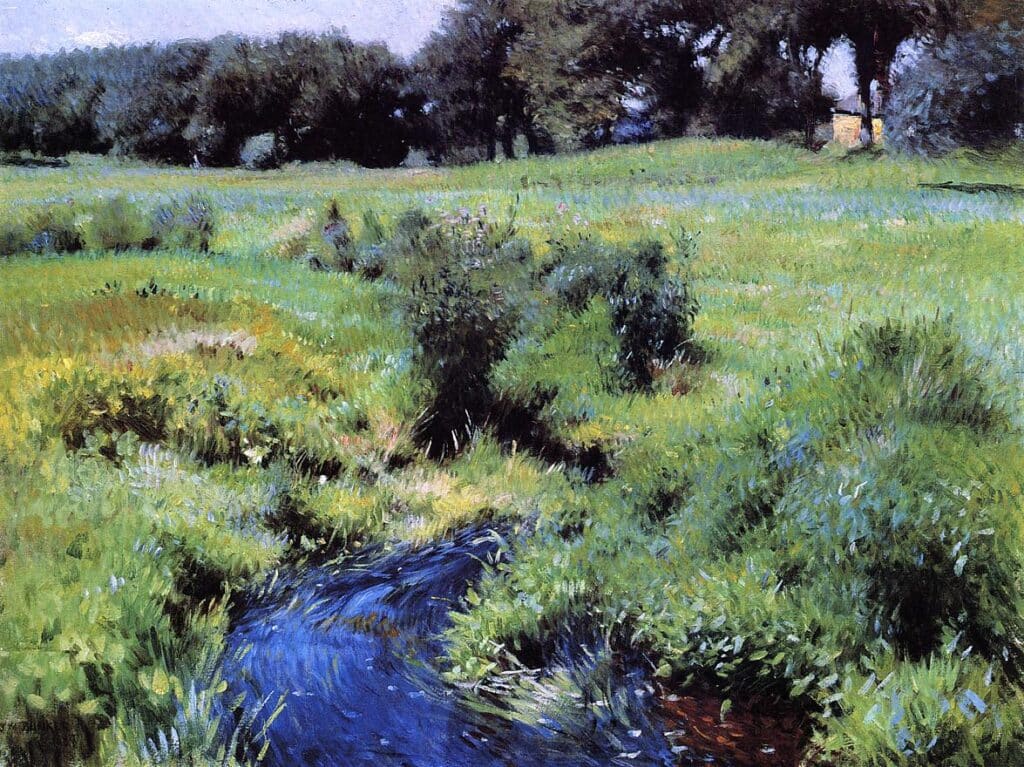 |
| Dennis Miller Bunker, The Pool, Medfield, 1889
|
Bunker teaches us that in order to make successful paintings, we don't have to find spots in nature that look like other successful paintings we've seen. His legacy are these marvelous visual sonnets on finding beauty in the commonplace and his dedication to imaginative vision, an immediate and grounded attitude of genuine looking, seeing, and painting that alone could have produced them.
 |
| Dennis Miller Bunker, The Brook at Medfield, 1889
|
If you'd like the Impressionistic style broken down for you, step by step, IN ACTION, check out
Barbara Huse's video Impressionism and let your inspiration loose along with your brush.