For watercolorist Iain Stewart, sketching is far more than a rehearsal for a painting; it’s a joy in its own right, a key to personal creative vision, and a portal to freedom and delight in front of the studio easel as well.
“Often overlooked and underused,” he says, Stewart sees an artist’s sketchbook as “a simple tool, that if used with regularity, will begin habits that will change the way you approach your work and see the world in ways you cannot imagine. … There is no other tool at your disposal better suited to explore your ideas with abandon and a carefree attitude.”
Iain is a Scots-born watercolor artist and a Signature Member of both the American and National Watercolor Societies. His original style makes him a highly coveted watercolor mentor and judge. He’s been featured in numerous books and periodicals, and his art is celebrated worldwide. He’s built a major career on the practice of sketching and approaching studio painting with the same freshness of spirit.
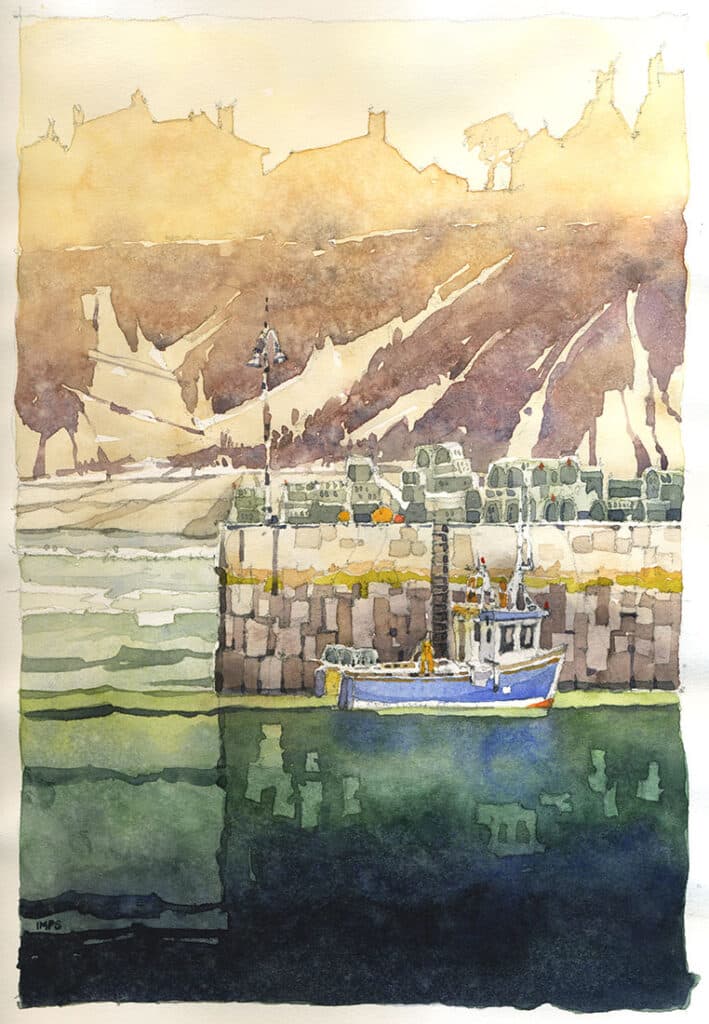
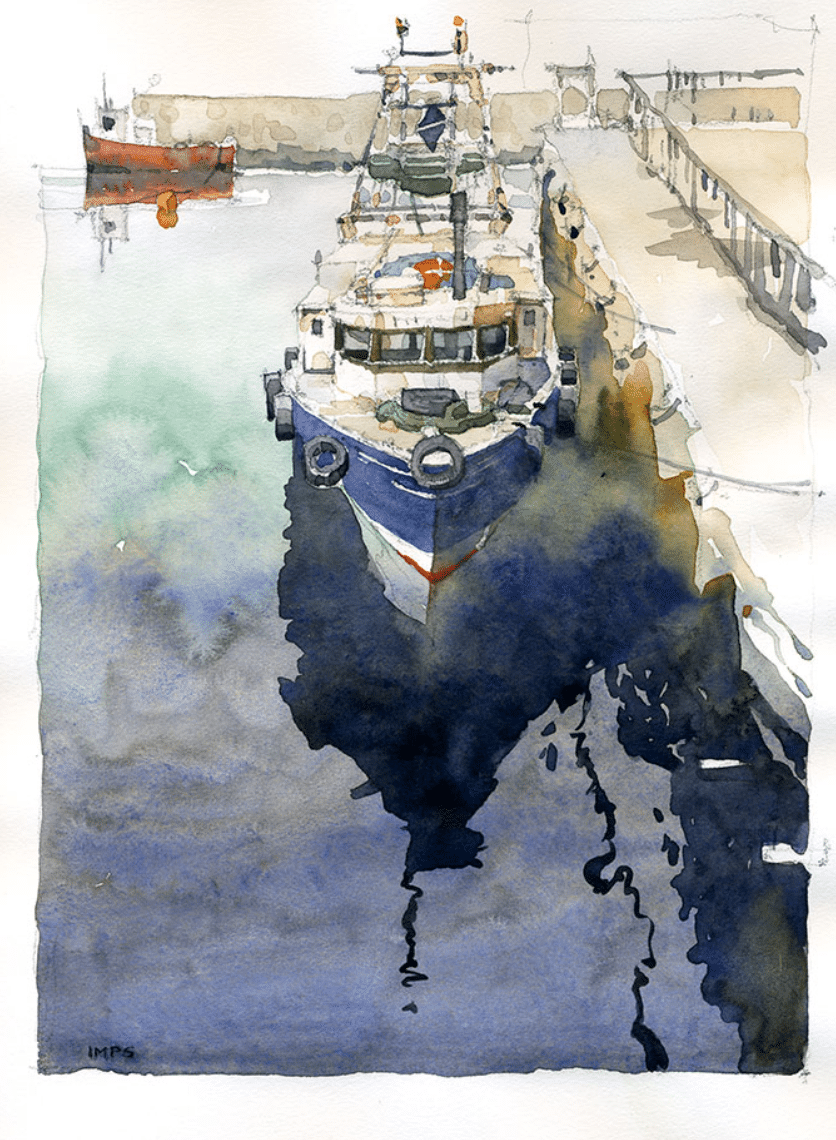
Iain Stewart, Crail Harbour Reflections, watercolor sketch
More than a way to document your surroundings, Stewart writes in his blog, a sketchbook can be a time capsule, a kind of time machine that can take you back to the feel of the places, sounds, and conversations of a vanished moment: “the seagull that tried to steal your breakfast, standing outside a fish and chip shop warming yourself by the fryer vent on a July day in Scotland, that perfect moment when your wife brings you a lavender ice cream in Provence just as you are finishing up your work for the day.”
Stewart finds photographs too impersonal to have that kind of effect. An artist using a sketchbook, be it for five minutes or an hour, can know a place much more intimately than someone taking shots with a camera for any number of days, he says.
“For every artist there is a process and the idea of a result, and over the course of teaching across the U.S. and abroad, I have noticed one constant,” Stewart says. “The more you use your sketchbook the more you get out of your travels and the better your work becomes. This is my passion. This is my joy. When involved in the act of drawing on location I become me. I know I am creating memories and rarely worry about the outcome. After all it’s only a sketch, right?”
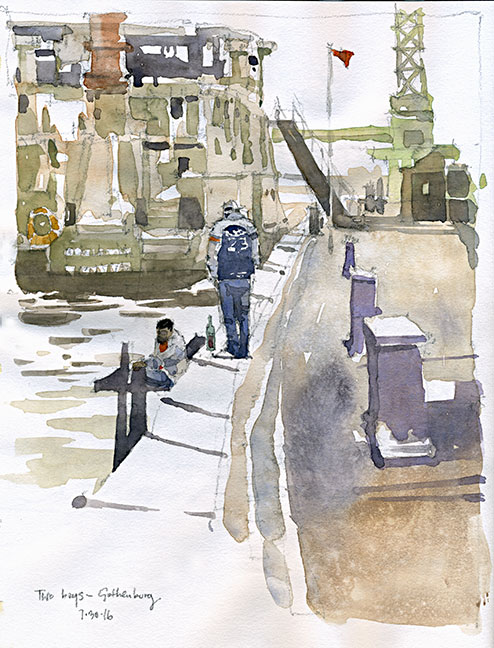
Iain Stewart Two Boys in Sweden, watercolor sketch
Over the last few years Stewart has focused on recapturing that feeling in his studio work. He combines site photography and sketches done on location to begin the important work of editing, creating a strong composition, and thinking in terms of shape and light rather than detail and other unnecessary clutter. However, his goal is to revisit the moment of the sketch with the same freshness and sense of freedom that he felt while making it.
“When moving from your sketchbook to the full easel set up and all its accoutrements, there is a sense that now things are getting serious. Why?” he says. “Don’t let those little voices start,” Stewart says. “Shut them down and enjoy being in that place at that particular time. Life is fleeting. Enjoy those moments. Cherish them and they will pay you back in ways you never expect.”
The trick in fleshing out a painting, he stresses, is to not put too much pressure on yourself to perform: “If a work becomes precious, then the natural reaction is to protect it. This is akin to putting a chain on a young bird as it begins to spread its wings and to take its first flight. Allow your work the freedom to soar or, if need be, fail in a spectacular fashion. No middle ground- go for it and don’t worry about the results. They will come in time.”
For this artist, it’s really about passion and joy, painting for the sheer pleasure of the process. “Whether the studio is outside or indoors is irrelevant as long as you spend as much time as possible drawing from life,” Stewart says. “To be outside amongst the elements and in full view of your subject is the best lesson in painting or drawing. Nothing can replace that.”
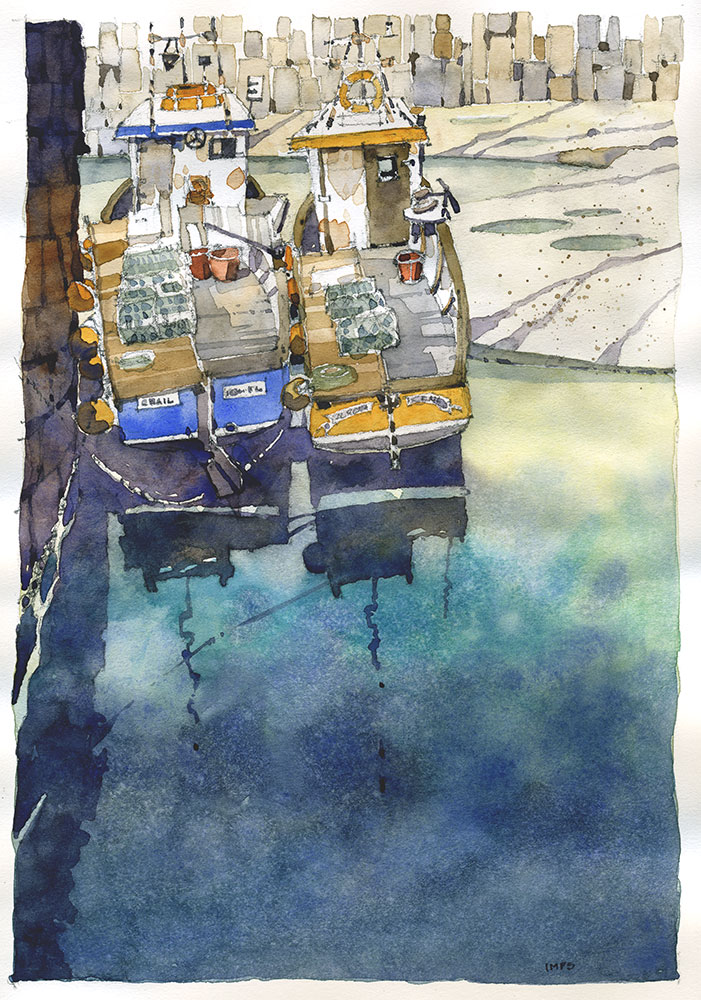
Iain Stewart, watercolor sketch
When you do take your work inside your studio, those lessons will become more and more apparent as you spend time observing. If you take joy in the act of painting and let go of the dread of failure, everything will fall in place in time and with practice. You will begin to surprise yourself. That will lead to repeating the process and around and around we go.”
The true beauty of this is that you are building repeatable habits that will allow you to see more difficult subjects in less detailed ways. By using a sketch as your starting point, you are creating a map that leads you to the final painting. Most importantly, you are teaching yourself the important lessons of self-critique, composition, editing, and line work.”
Iain Stewart teaches his methods and shares his enthusiasm for the creative process in the video “High Level Sketching.”
——
12th Annual PleinAir Salon Annual Winners
Grand Prize $15,000 and the Cover of PleinAir Magazine: Kimball Geisler, “Tower of Towers”
Second Place, $3,000: Robin Caspari, “The Edge”
Third Place, $1,500: Luis Azon, “Late Afternoon in Spain”
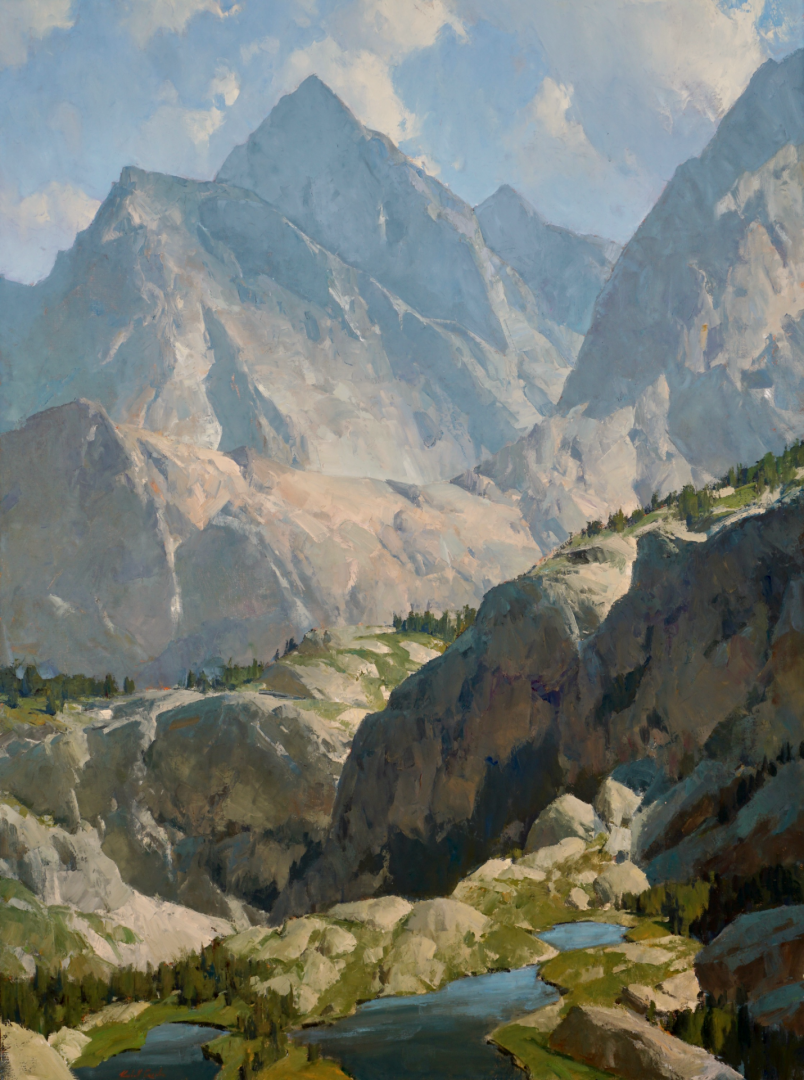
Congratulations to the incredible artists of the 12th Annual PleinAir Salon Art Competition from PleinAir™ Magazine. Cheers to all the winners and runner-ups!A standing ovation for Kimball Geisler, the Grand Prize winner. Kimball’s painting, “Tower of Towers” was the big winner.This year was truly a global celebration of art with over 10,000 paintings entered from nearly 4,000 artists from 65 countries, including Israel, Turkey, Ukraine, Czechoslovakia, and Vietnam. The awards were announced live on stage at the 10th Annual Plein Air Convention & Expo (PACE) in Denver, Colorado.