Artist Grace Hartigan (1922-2008) was an important figure in the “New York School” of painters born of the excitement of the Abstract Expressionist movement of the 1940s and ‘50s. Her large painting titled “Giftwares” shows why.
It’s a “genre-defying” work in that it’s a still life, technically, but it’s also – and primarily – an abstract expressionist painting.

Grace Hartigan, Giftwares, 1955. Oil and charcoal on canvas. SUNY Purchase. Neuberger Collection.
In “Giftwares,” Hartigan arranges a wild variety of surfaces, textures and objects of many sizes and shapes, some identifiable some not, as if they’re displayed in an impossibly crowded store window in midtown Manhattan.
And while it may look like chaos, it’s carefully composed. After sitting with it for a while, we find multiple repeated and “rhymed” shapes and colors which, along with a masterful handling of dark/light values, do much of the spectacular design work.

Detail of Grace Hartigan’s “Giftwares,” showing the two shaded lamps near the center.
For example, the composition is anchored by a white ceramic lamp with a pleated shade in the painting’s center, echoed by a similar lamp just back and off to the left, which in turn connects with a shimmery-colored curtain or drapery that relates and unites the two forms. It’s an incredible example of order amidst chaos.
But that’s not why it’s a great painting. Technical matters aside, this work radiates energy. It’s the sheer exuberance of painting itself that’s being celebrated here. We know that because of the fearless brushstrokes visible everywhere and moving in every direction. The traditional still life approach has been rejected (or augmented) so that the work can conjure the artist’s feeling for life in the urban American environment.
The very word “giftwares” is a modern one (it didn’t exist before the 20th century). In fact, it’s arguable that “giftwares” specifically – recently manufactured mass-produced objects specially made to appeal to buyers looking for “the perfect gift” – had never been the subject of a painting before. But then again, the real subject of this painting is not a bunch of gifts – it’s the artist’s gift of the busy energy and life of the city she likes to depict. How? In every way, with every tool of painting: color, brushwork, composition and design.

Hartigan’s mark-making, her visible brushwork and charcoal lines and dashes carry on a lively conversation with our gaze. It’s a conversation that has barely if anything to do with the subjects she’s depicting. She’s reveling in the materials, and we’re here for the artistry more than the motif.
But let’s be clear. Nor is the magic attributable to simply foregrounding the materials for their own sake (as in so much mediocre and empty abstract art) – because, “It is never by its external forms that music (or painting) exercises its true power,” says Fabre d’Olivet… “it is by means of the principles that constitute them.”

It’s part of the fun– and this both the intention and part of the painting’s final “meaning” – to try to make out what some of the shapes are describing. Is that a blue ceramic pitcher (or two) resting on top of a Victrola in the detail above? Below are a few more details from the painting
(it’s a curious fact that, in many strong paintings, if you cardon off just one little patch from any part of it, the result is very often a self-contained painting-in-miniature with much the same quality of the whole).


Besides being a central figure in the New York art scene, Hartigan was very close to poet Frank O’Hara, who wrote her into many of the poems he composed on lunch breaks from his job at the Museum of Modern Art. O’Hara’s poetry has a similar seemingly casual, up-tempo, contemporary quality quite in step with the visual art of the time.

O’Hara’s poem to Grace, titled “For Grace, After a Party” is like Hartigan’s painting in that it seems to express the hope of holding on beauty, love, something real, amid the mad jumble and rush of modern life.

If you’d like to learn more about Grace Hartigan, check out the de Young Museum’s lavishly illustrated catalog of a recent retrospective of Hartigan’s work: And if imaginative and innovative still life painting intrigues you, check out this affordable video from Annie O’Brien Gonzales, Expressive Still Lifes – Mixed Media Painting Workshop.

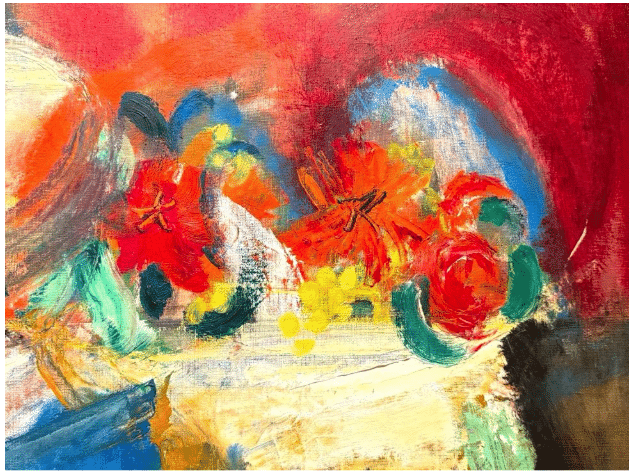
Annie O’Brien Gonzales, A lively and expressive still life with flowers and fruit.