
“Tradition is not the worship of ashes, but the preservation of fire.”
― Gustav Mahler
As an artist, it’s a given that you’ll spend many hours learning, both through study and through trial and error, the basics of composition, drawing, edges, color, and the numerous basic principles and techniques of painting passed from master to student for hundreds of years.
There’s so much to learn that one can end up sacrificing energy, invention, spontaneity, and expression, the very things that drive creativity in the first place. You need both. To open the doors to the more intuitive creative impulses, you have to think of tradition and technique only as tools, not ends in themselves. This can require a certain adjustment in one’s relationship with the art.
Think about it this way: every standard academic technique was once a spur of the moment invention. Maybe an artist’s vision demanded an expression with so much force that a technique was born out of necessity. More likely, however, our artist got into a jam and needed to think fast to save the painting, and voila, a new technique, soon to be a “rule,” was born.
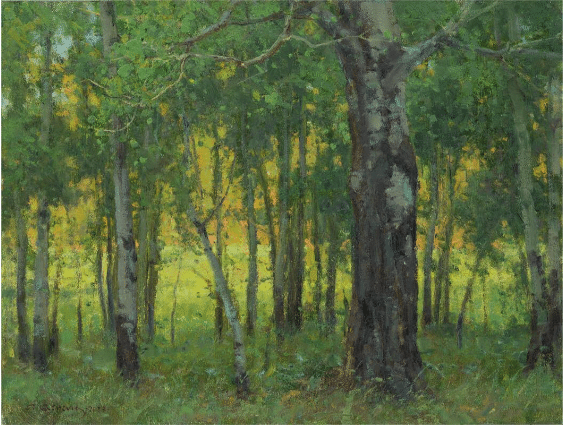
Clyde Aspevig, “Aspen Grove,” oil, 12 in. x 16 in. Clyde Aspevig teaches his unique oil painting approach and technique in his video, ASPEVIG
So yes, we’re supposed to find our authentic voice AND learn the secrets of conjuring three-dimensional forms onto a two-dimensional surface – It’s a lot! And painting’s supposed to be fun, right?
There is nothing wrong with sticking to well-travelled paths. Painting is a wonderful pastime that’s good for you. If you’re restless though, it could be because you’re holding your creative self back.
Seeing Our Own Worth
The real problem is not the inability to be creative – it’s our inability to see what’s of value in what we create. It’s a glass half-full sort of thing. We can spend so much time looking at “good” paintings and expend so much energy developing the proper techniques for making them, that when we step outside those parameters, we fear that what we create looks like a failure – and how can it not, when it doesn’t check the boxes we’ve been told are “supposed to be” checked!
And yet, that in each “hot mess” we make, there’s a little of ourselces in there. There’s something unlearned, uncontrived, honest, and raw. It may be something as yet undeveloped and rudimentary, but it’s something that corresponds to how you really feel and who you really are in the world. Maybe it’s just a color choice, or maybe the subject, or the paint handling – something that you recognize as carrying a little bit of yourself into the work. Look for that. See that. Honor it.
Learn technique, and practice stepping out from behind it in little bursts of creative feeling. Becoming an artist is a slow burn.
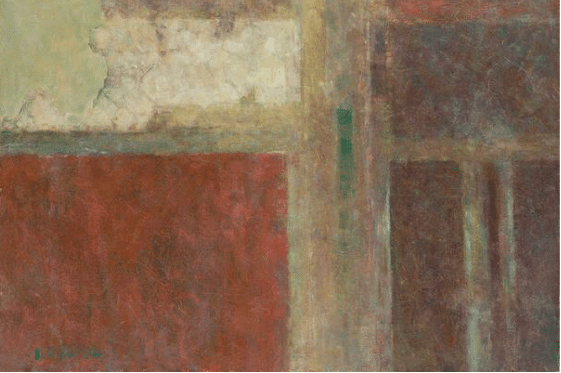
Clyde Aspevig, “Time Dancing,” oil, 20 in. x 30 in. an abstract mediation on time, based on an ancient Roman fresco. Clyde Aspevig teaches his oil painting approach and technique in his video, ASPEVIG
It helps if every now and then you go completely off the rails and paint without thinking too much about it, without trying to do something good. Surrender to the moment. You don’t have to show these paintings to anyone. But make them, keep them, own them for what they are and what they could be. Or hey, destroy them immediately! But know that you have gotten at least a little bit closer to making your art your own if you let it. Your so-called failures are the flagstones that will lead you to yourself.
Eventually, when you can allow your emotion to lead but not dominate, you will begin to combine academic technique and personal expression in the free interpretation of what you see and know. However, it won’t happen if you don’t take any risks.
Get Inspired Again!
Here are three ideas for stretching yourself as you seek beyond your boundaries:
- Find out what artists do. Seek out an historical artist whose work you respond to immensely and learn everything you can about them as a person. The only requirement is that they be dead. Do some deep-dive art history searches. Find the originators of what everyone is copying: find yourself a Sargent, a Turner, a Klee, a Raphael, Constable or Latour. Splurge on real art books and read the words in them. Find out what the critics, then and now, as well as what the artist had to say about the work. Seriously, go see the work in person whenever you can. (Don’t study these paintings to learn how to use oil paint, watercolor, or pastels; the most important lesson the masters can teach you isn’t about technique – it’s about what inspired them to make the work they did.)

William A. Schneider, “Before All This,” oil, 16 in. x 12 in.
- Learn about different kinds of art. We tend to gravitate to a particular genre of art and the artists who make it, but there are many art worlds. Stumble onto a few of them now and then. Figure out why the artist made that kind of art and not another. Follow some unfamiliar links online, read about art you aren’t even initially interested in, discover new galleries and styles and seriously consider the merit of the work they show. Learn to see technique as an impressive skill meant to be adapted to convey an artist’s meaningful and heartfelt feelings about the world. Always be open to expanding your definition of art.
- Figure out what you have to say. Knowing yourself is a huge advantage as an artist. Ask yourself what you like about the work you admire – not just in terms of technique, but in terms of what’s behind it, what the artist put into it, what the work conveys about life! What’s important to you? As Walt Whitman wrote, “the passionate play goes on – and you can contribute a verse.”

William A. Schneider, “Red Tail Dawn,” oil
Design is probably the most important and most easily assimilated aspect of traditional technique. For a thorough overview, you might want to consider an instructional DVD such as William A. Schneider: Design Secrets of Masters – Key to a Successful Painting.
Italian Artist’s ‘Alchemical’ Paintings Charm New York
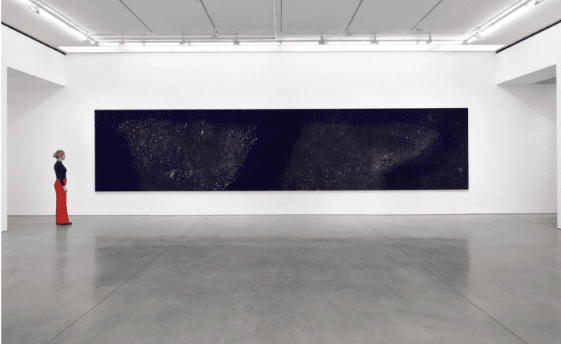
Pier Paolo Calzolari makes paintings that New York City shouldn’t like, given the kind of conceptual and more socially inflected work that has been wowing critics of late. Yet Calzolari’s return to a New York gallery after an absence of five years has been a critical triumph, and much of the work is magical – straightforward, honest, poetic, and rich with semi-abstract natural-spiritual mystery.
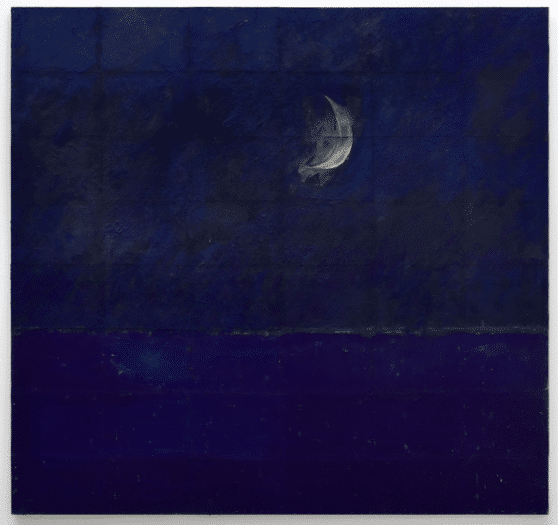
Senza titolo [Luna] / Untitled [Moon], 1979, Wax water tempera, egg tempera and oil on cardboard pieces glued on wood, 74″ x 78″
While the artist continues to incorporate sculptural elements made of organic matter such as salt, feathers, clover petals, and seashells, he is now using raw pigment powders and tempera in startlingly saturated colors. The luminous canvases include fields of intense primary yellows, reds, blues, and whites with varying surfaces and textures that call to mind nature in the form of sunlight, fire, and a night sky, making this exhibition a meditation on the transience and the delicate beauty of everyday life.
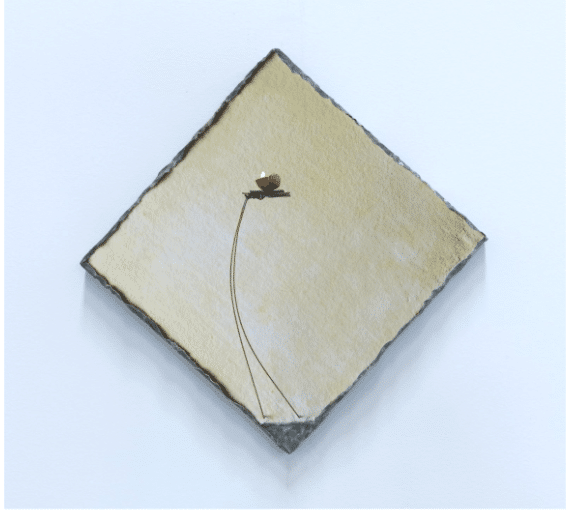
Pier Paolo Calzolari, Studio, 1980, Salt on cardboard, copper, lead, snail, oil candles, 25″

Pier Paolo Calzolari Untitled, 1976
Lead, copper, iron, oil lamps
37 1/3 x 49 1/2 x 3 1/4 inches 95 x 126 x 8 cm

Pier Paolo Calzolari, installation shot, Marianne Boesky Gallery, NYC. All photos courtesy of the gallery.
The artist has said that “painting should be about getting lost finding oneself or finding oneself getting lost. But for me painting has always been, above all, a lover: I have a bond with it that comes from a fascination of the senses and, at the same time, the loss of the senses. Painting is the gesture that comes before the decision, the insecurity brought to economy.”