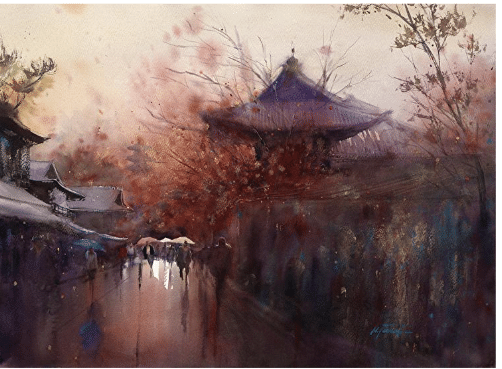
Plein Air watercolorist Keiko Tanabe (“Storytelling with Watercolor“ and “Painting Sunlight“) was born in Kyoto, Japan. As a child growing up in an art-loving family, she always enjoyed drawing and painting and won many awards in children’s art contests. However, she didn’t study art in school; rather, she earned a B.A. in intercultural communication and an M.A. in international education and worked in international relations for most of her career. Her work has allowed her to travel extensively in Europe, Asia, and North America. In 2018 and 2019, she was invited to be a faculty member for the Plein Air Convention & Expo<<https://pleinairconvention.com , the world’s largest plein-air painting event. Keiko currently lives in San Diego, California.
Keiko speaks about her technique below.
Why work en plein air? What does plein air give you that working from a reference photo in a studio can’t?
Being in the moment and staying focused. Nature has taught me how to do this, and how to use this discipline when I paint outdoors. All that stimulates my senses and contributes to activating parts of my brain that might not be used if I was working in the studio. I like the way I can synthesize a painting this way, as opposed to relying heavily on a visual reference source such as a photo.
Working outside trains me to paint faster. With the fast-changing light, I am forced to make quick decisions in the creative process. This is an important capability, especially with watercolor, as this medium dries so fast and painting slowly means making too many strokes or hard edges visible if not taken care of skillfully.

Keiko Tanabe, “Amore,” watercolor, 14 x 21 in.
Could you walk us through your painting process? What are you trying to solve at each stage of your process?
I generally work in three stages.
Preliminary stage: This is when I interpret the landscape and think of a way to translate it into a visual language. I try to visualize the finished painting and build a composition that communicates my vision. I also try to identify potential problems at this stage and think of solutions. Oftentimes I make a small sketch, and make a drawing for a painting based on the sketch.
First stage: I paint lights and establish base tones in my first wash. The focus is more on big shapes in the composition, not so much on smaller details. I lay down the wash, using a fairly large brush in a loose manner. An overall color feel is something I like to show and use to unify all the elements.
Second stage: I tie darks together to create depth and a passage of light. To finish, I make smaller details more prominent, putting them in a dark tone or painting them negatively. I keep the details minimal, just enough to tell a story or suggest my intended narrative.
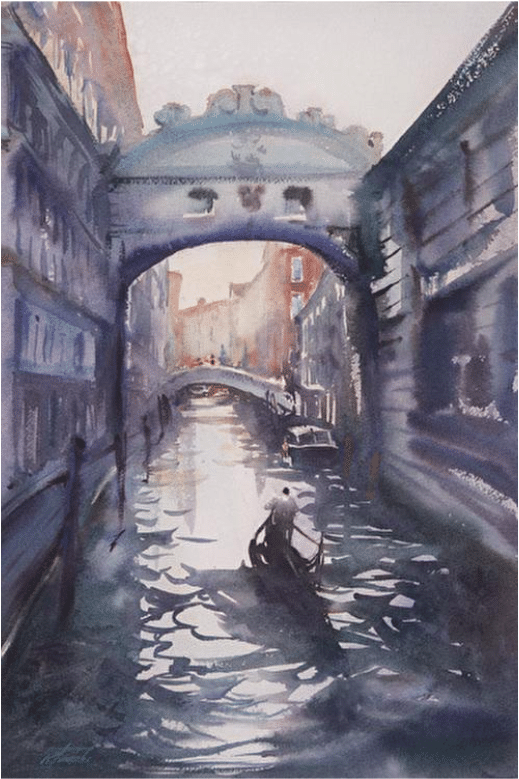
Keiko Tanabe, “Venice Canal,” waterolor, 21×14 in.
How has your process evolved as you’ve become a more skilled painter? Has it gotten faster or slower? Why, and how?
I don’t think the basic process itself has changed a lot. As I have gained more experience, however, I became better at predicting what will happen on the paper with each brushstroke. That opens a door of opportunity for me to explore more creative options. It allows me to be more proactive with a potential problem rather than responsive to the problem after it happens. Consequently, this ability enables me to paint with more confidence and speed.
In plein air, what do you look for when looking for a subject to paint? Many artists, especially when first starting out in plein air, feel a rush to find a pretty location and get painting as quickly as possible.
I believe that artwork is a mirror of what an artist feels about the subject, so it has to effectively communicate the artist’s vision through various techniques and components. What often triggers me to paint is not really the subject matter itself. When I see an interesting pattern of light and dark creating a certain mood or atmosphere, I stop and observe because it has an evocative quality and it speaks to me. When I see that and am moved by it, I know I have found something that could be an emotional basis, as well as a design component to create a painting from.
As a landscape artist, I also strive to capture a sense of time and place. Especially when I am on location, I feel the place in all of my senses. The connection I establish with the subject is important. It allows me to feel I am part of the scene. It helps me delve into finding out what about it really speaks to me. As I always say, I don’t think I choose a subject; rather, it chooses me. I just have to be acutely aware when that happens. I think my painting is a mere response to that.

Keiko Tanabe, “Firenze, Italy II,” watercolor, 10 x 29 in.
Why is planning important? What does planning allow an artist to do that an artist who doesn’t plan can’t?
Planning is to have a road map to a certain destination. That means there’s a chance I may get lost on the way, but at least I know I can correct the direction I was going in order to minimize the loss of time. I also use planning as a guide for subsequent creative decisions. That said, I don’t plan for everything, but only for important things like value and edge. I like to allow myself plenty of freedom to paint more intuitively.
How do you make a strong composition? How much do you take from the scene directly in front of you, and how much do you change for composition purposes? How do you decide what to leave in and what to take out?
Making a strong composition starts with knowing what it is that I want to communicate in my painting. With that in mind, I try to understand the relationships between big shapes in the scene, and rearrange them sometimes to create excitement, harmony, rhythm, and even drama in the overall design. I avoid too much symmetry or repetition. Then I place a focal point and distribute a few points of interest on a picture plane. When I do this, I must consider the underlying value structure to be able to make a contrast for important points of interest.
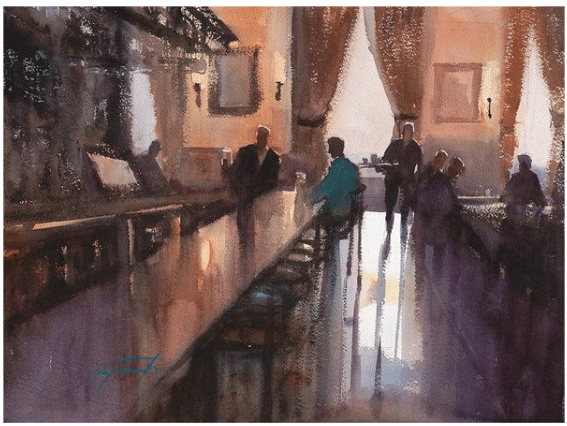
Keiko Tanabe, interior, watercolor.
Along the same lines, when you do a value study, how much do you change the values from what you see in front of you? Why?
Sometimes I am lucky and I find a perfect light and dark pattern in a chosen subject. Most of the time, however, to make a strong painting, I have to change the values to create a more interesting tonal relationship. When I find tonal relations that are too flat or too complicated, that is when I feel compelled to change the values, either in dark masses or light spaces.
Keiko Tanabe teaches how to achieve his spectacular tonal relationships and his roadmap for successful paintings in two videos: “Storytelling with Watercolor” and “Painting Sunlight“from Streamline Publishing.
If you’re eager to get your hands wet with water media, you may be interested in the inaugural Acrylic Live virtual art conference and learn from some of the top acrylic artists and faculty from around the world. Acrylic Live is March 26-28, 2025, with an optional Essential Techniques Day on March 25. Register now at AcrylicLive.com!
And don’t forget the PleinAir Convention & Expo (PACE) takes place in Lake Tahoe this May! Find out more here.