They weren’t just painting the land – they wanted to reveal its very soul.
Perhaps that’s why their landscapes feel so full of feeling and authenticity. The greatest Russian and Ukrainian landscape paintings of the mid 19th to early 20th centuries were driven by nationalistic fervor: “Russian artists sought to portray the soul of Mother Russia,” says art historian Christopher Riopelle. “Russian Landscape artists wanted to penetrate imaginatively into the very essence of their countryside. For them, painting is a means, not an end in itself, not “art for arts’ sake”.’
Today’s post, the first of two on the topic, takes a closer look at how they did so, in a quick walk-through of some of the greatest winter snow paintings ever created.
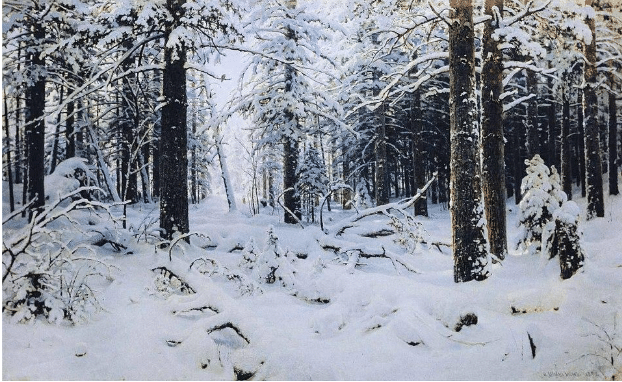
Ivan Shishkin, “Winter,” 1890, oil on canvas. 125,5 x 204
One of the most important Russian landscape painters of the 19th century, Ivan Shishkin is famous for his incredibly detailed, realistic, and majestic depictions of Russian forests, fields, and mountains. He explicitly set out to capture the spirit of the homeland in paintings full of feeling, emotion and spirit. How he did so in such a seemingly photorealistic (or as the kids say, “high res”) style is a mystery to me.
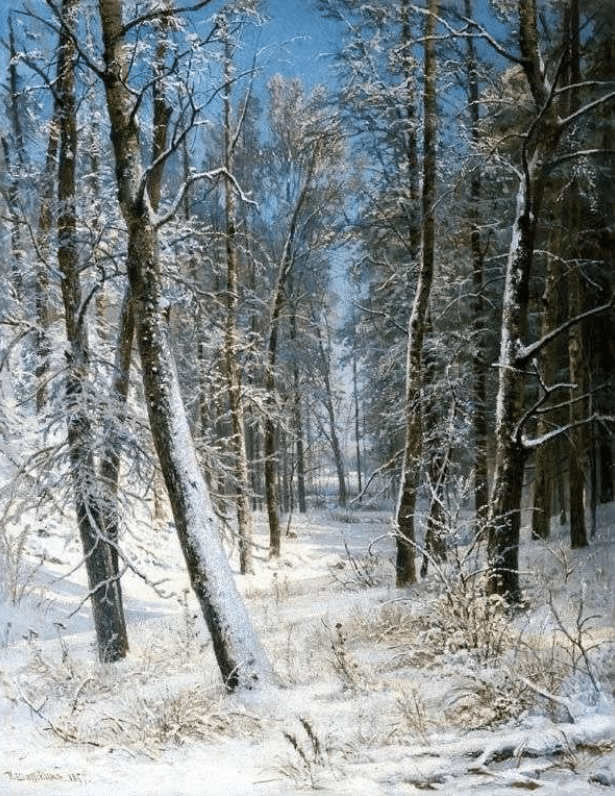
Ivan Shishkin, “Winter in the Forest (Rime Ice),” 1877.
Both of the paintings above blend precise realism with undeniable beauty and feeling. Shishkin basically defined the art of the Russian forest for generations through such breathtakingly detailed and emotionally resonant landscapes. I believe it is the primarily through his rendering of the light that he conveys such emotion; in no other aspect of painting does he allow himself anything other than the nearly impossible task of rendering every. Single. Leaf. Stone. And branch.
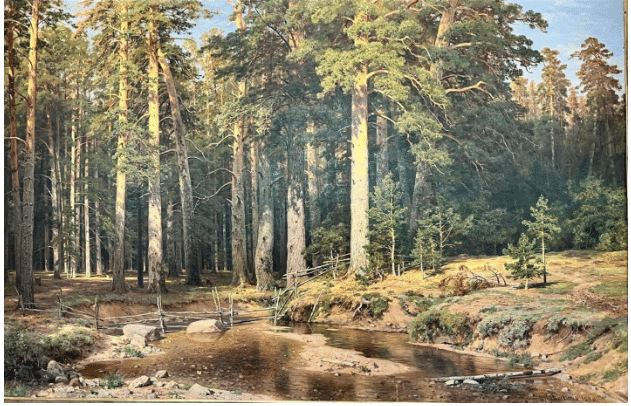
One of the greats!
As a contrast, below is an example of the “mood” style of Russian landscape painting as it came some decades after the Shishkins we’re been looking at above. Precisely by stepping back from so much detail and being more expressive with color, Arkhip Kuindzhi’s “Moonlight Spots in the Forest, Winter” (below) turns an ordinary winter night into a mysterious, lunar otherworld.
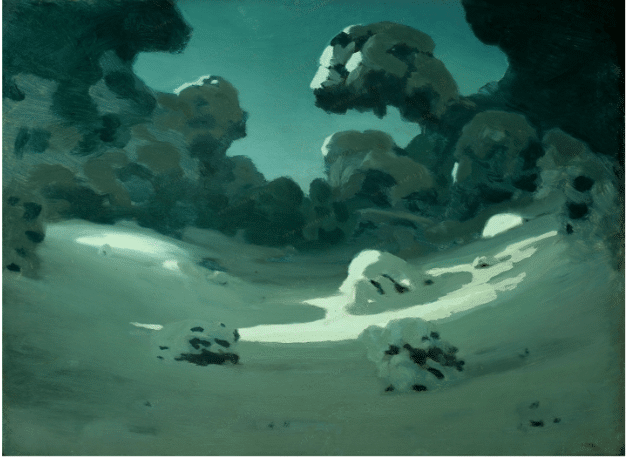
Arkhip Kuindzhi. Moonlight Spots in the Forest. Winter. 1908
Shishkin could paint poetically, anticipating the Tonalist mode, too. His painting of a proud and stalwart pine tree, “In the Wild North,” (below) takes its title from the first line of a famous Russian poem titled “The Pine Tree.”
In the wild north a pine tree stands alone
On the bare top of a mountain.
It slumbers and sways, covered with
Powdery snow like a mantle.
And it dreams constantly: that in faraway wilds
In the land where the sun rises,
A cheerless and lovely palm stands alone,
Growing on a gloomy cliff.
Translated by D. Smirnov-Sadovsky
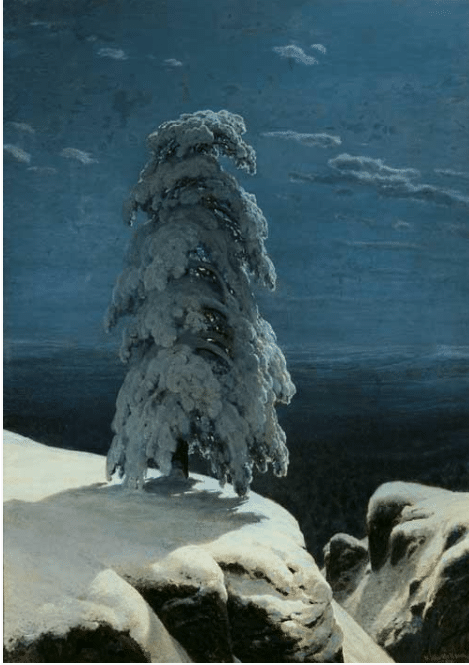
Ivan Shishkin, “In the Wild North,” 1891. Oil on canvas 161 x 118 cm. Museum of Russian Art, Kiev nv. 190 © Museum of Russian Art, Kiev
Shishkin painted “In the Wild North” on a canvas more than six feet tall. The majestic scale and solidity resonates with his idea of his country’s primal geography with distinctly Russian iconography (in this case tied to a famous poem about Russia) and a sense of monumental order. With that in mind, Shishkin’s clear-eyed, large-scale landscapes, such as “In the Wild North,” present the very image of epic Russian steadfastness — staunch, expansive, and rich, beyond emotion and equal to time itself. This is not “reading into” the paintings (Shishkin himself plainly trumpeted his desire to paint “Russianness”), but rather a way of deepening our understanding of the artist’s mindset and his achievement by viewing it in context.
You’ll find more on this painting and Shishkin here.
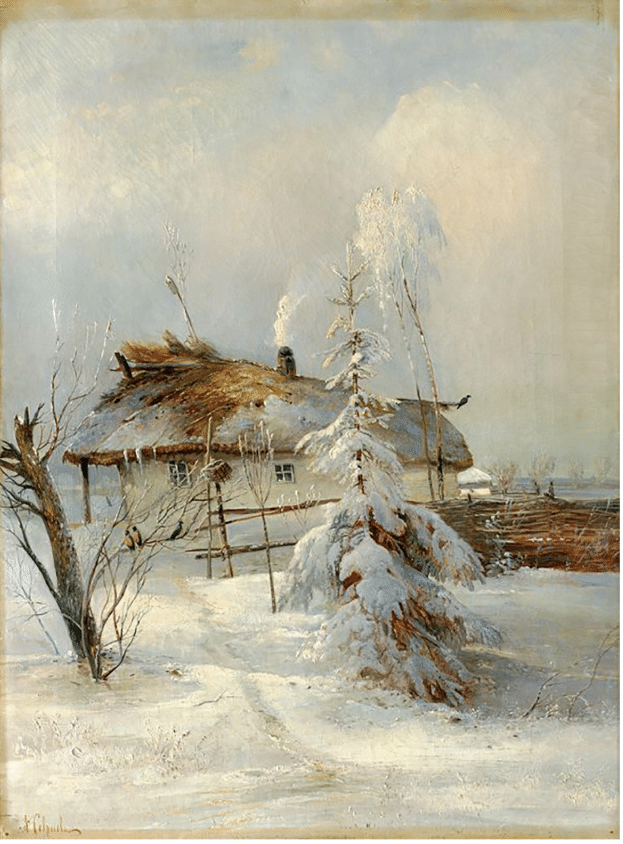
Alexey Savrasov, “Winter”
A much “warmer” winter painting is Alexey Savrasov’s “Winter,” above. It’s afternoon, the sun is breaking through, the verticality stretching from the snowy pine tree to the blushing, cottony clouds, seems to literally lift the house out of the doldrums. Savrasov is best known for his painting The Rooks are Back, which is about the return of spring and rather in the brighter, Shishkin mode. We’ll end on that hopeful note – with our eyes on those patches of fresh, blue sky coming through the gray.
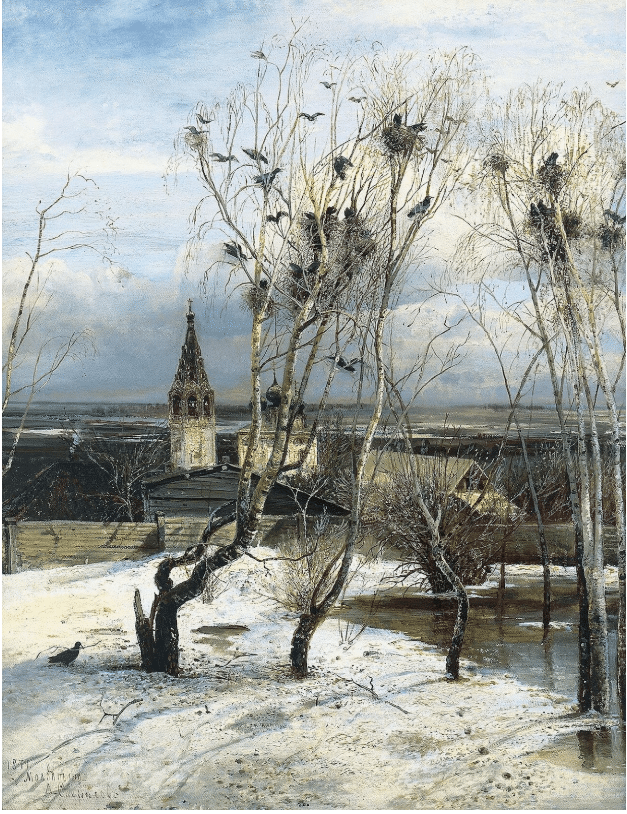
Alexey Savrasov, “The Rooks Have Returned” 62 cm × 48.5 cm (24 in × 19.1 in), oil on canva
And finally, because you made it this far, here’s this:
Just … because.
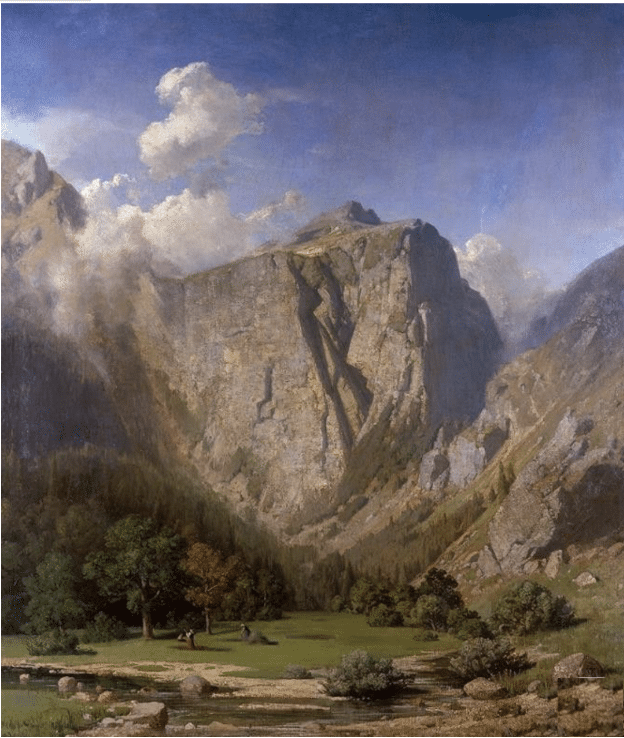
Adolf Kosárek, Alpská krajina, 1857–1858, Moravská galerie v Brně

Dave Santillanes, “Remnants of Winter,” 24 x 44 ins., oil on canvas
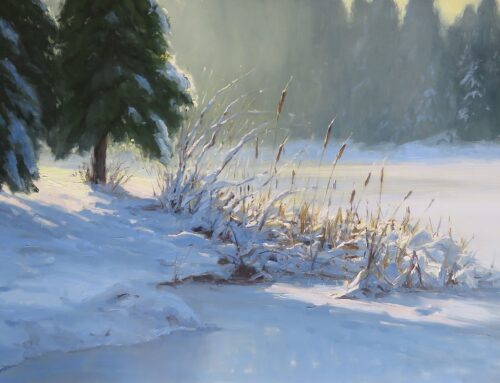
American painter Dave Santillanes teaches his contemporary, atmospheric approach to painting beautiful snowy landscapes in his professional instructional video, “Winter Landscapes.”
Esoterica:
From 1873 to 1898, Shishkin became the professor of painting at the Saint Petersburg Imperial Academy of Arts. The Academy still operates today and is one of the most prestigious art schools worldwide, complete with a significant museum of paintings, sculpture, and plaster casts.
The Academy has maintained a reputation as one of the finest art schools in the world, training artists like Shishkin who became world-renowned, including Ilya Repin, Vladimir Makovsky, and many others. Together these artists were responsible for what has become known today as the “Russian Style.”
Today, the school, known as the Saint Petersburg Institute for Painting, Sculpture, and Architecture, remains true to the vision of its founding in 1789: to train and prepare artists to reach their highest level of mastery, and only the finest artists get to become professors there.
One such teaching artist, Nikolai Blokhin, has a reputation as a leading portrait painter. He shares his approach to portraiture step by step in the “Russian Style” in his video, Russian Master Portraits. Download it here.