It’s good for any artist, beginner, experienced, realist or otherwise, to have a sense of the inspiring stories of men and women who believed in themselves enough to place painting at the center of their passions.
Over the last few years, the work of a little-known Swedish mystic has upended the narrative of art history and redefined how many think of abstract art.
Abstraction (of the non-representational sort) was not invented to shock the viewer, rebel against art history, or call attention to itself (or to the artists) like a look-at-me spoiled Victorian child. Nor was it primarily the rule-breaking arrangement of colors, shapes, and geometric designs its thought to be today. Non-representational paintings were never intended to be “paintings about nothing.”
Art historians ignored this fact, (perhaps because they didn’t “get it,” they had to understand and write about it in terms of style, technique, and influence) but the roots of fully abstract art – works by the early twentieth-century Modernists such as Kandinsky, Mondrian, Malevich – applied the materials of painting to the world of spiritual visions. And though it’s only now widely known, Swedish artist Hilma af Klint (1862-1944) pioneered it first.
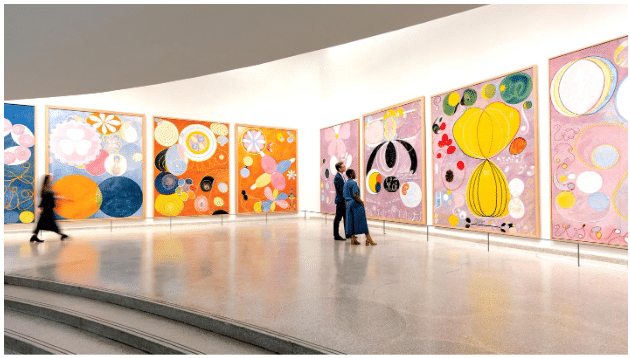
Hilma af Klint’s paintings at the Guggenheim in 2022.
Hilma af Klint
Begun in 1909, Hilma af Klint’s abstract paintings preceded Kandinsky’s better-known abstractions by five or six years. With a major exhibition currently at London’s Tate Modern and recent shows in West Hollywood, Belgium, Stockholm, the David Zwirner Gallery and the Guggenheim Museum in New York, af Klint is currently one of most celebrated artists in the world.
Born in Stockholm, Hilma studied at the city’s Royal Academy of Fine Arts, graduating with honors in 1887. She established herself as a respected artist in Stockholm, exhibiting figurative paintings, taking technical illustration commissions, and serving briefly as secretary of the Association of Swedish Women Artists.
However, her real genius was to show itself in colorful, large-scale egg tempera paintings intended to reflect the realm of the spirits. They were the first abstract paintings in the world – and the world wasn’t ready. Hilma knew it, and she left provisions in her will to have all of her important work hidden away for at least two decades after she died.
Now, more than a century after she painted them, they’re being introduced to the art world to the astonishment and captivation of critics, historians, and art lovers everywhere.
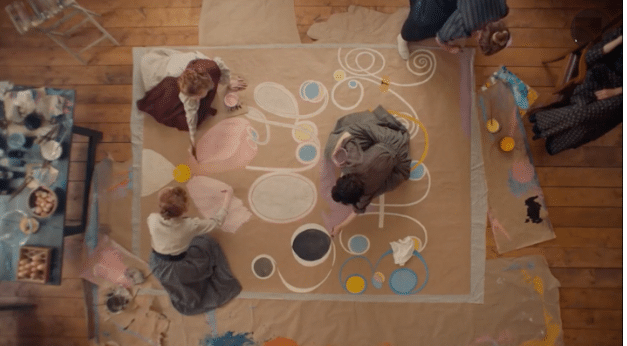
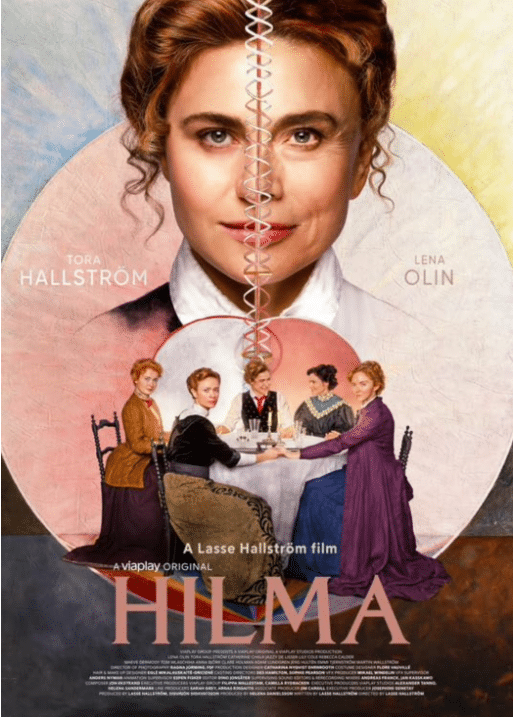
A still from the biopic Hilma (2022)
No one had created paintings like hers before – so monumental in scale, with such radiant color combinations, enigmatic symbols and other-worldly shapes. In an era of limited creative freedom for women, her paintings became an outlet for her exceptional intelligence, sincere spiritual quest, and ground-breaking artistic vision.
Only spiritually interested audiences had any knowledge of this body of work. Her attempts to exhibit these paintings, even to like-minded individuals, remained largely unsuccessful, and remarks in her notebooks indicate that she understood that the world was not quite ready for the message they were intended to communicate.
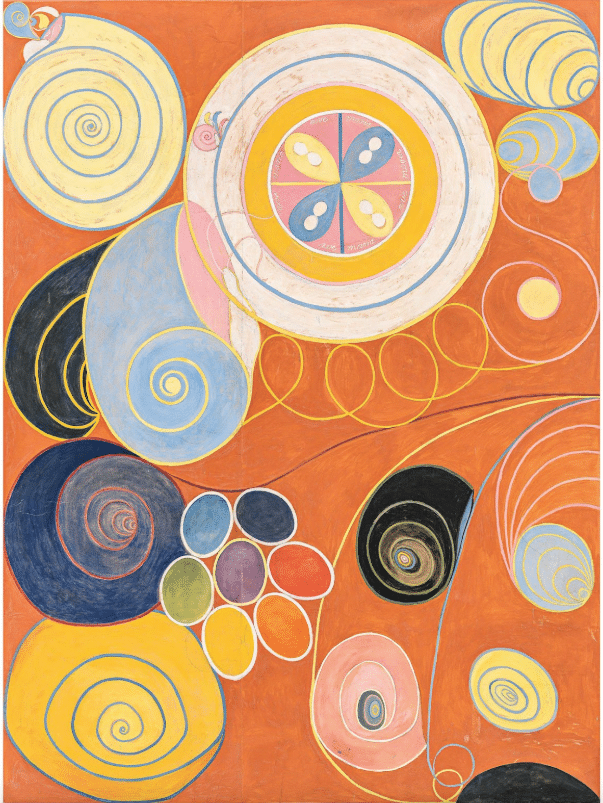
Hilma af Klint, “Group IV, The Ten Largest, No. 3, Youth,” from 1907. Photograph by Albin Dahlström.
The earliest Modernist abstractions didn’t resemble anything in our world because the artists weren’t using art to represent our world at all. Hilma and the artists who followed believed art could serve a higher purpose and be “religious” again in a stunning new way. Painting could be a mirror for that which, as Hilma wrote, “lies behind the forces of matter.”

Hilma af Klint
By letting go of the “things of this world,” painting could open a visual portal directly into the spiritual realm. “That is beautiful which is produced by the inner need, which springs from the soul,” wrote Kandinsky much later, in Concerning the Spiritual in Art (1935).
When she died in 1944, af Klint left more than 1,300 paintings and some 26,000 pages of writing.
A movie about her life titled Hilma came out in 2022. The film delves into Hilma’s personality and relationships, her passion for art, her struggle against difficulties female artists faced at that time, and her higher calling to document a secret spirit world in her art. It was preceded by a 2019 documentary, called Beyond the Visible, which you can find and watch for free on Youtube.
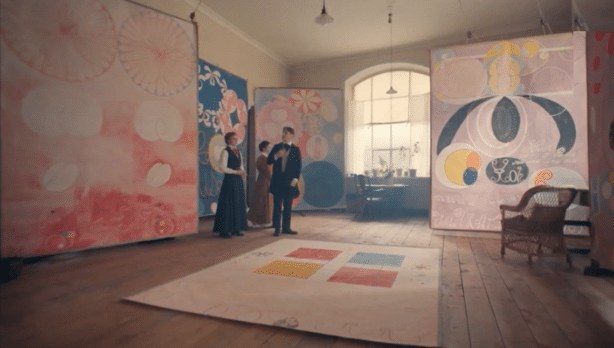
Finding yourself as an artist is an essential part of the painting journey. Landscape artist Steve Curry has a video about discovering your unique strengths and calling while woriking in the landscape genre. It’s called Finding Your Voice: Painting with Creative Expression, and you can check it out here.
More to the Story…
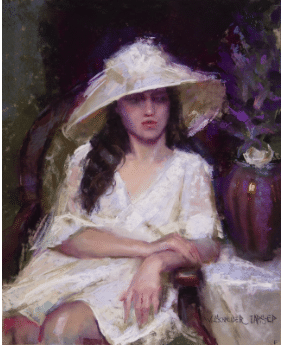
William A. Schneider, “Southern Comfort,” pastel
William A. Schneider’s pastel painting “Southern Comfort” (image above) recently won the President’s Award at the Northwest Pastel Society’s 39th Annual Open International Exhibition.
Juror of Awards, Barbara Jaenicke, said “William did an incredible job with minimal stroke application to create the folds and fabric texture, creating such volumes of information with so few strokes.”
William teaches exactly that (along with the elusive essentials of hands and faces) in his teaching video, Heads and Hands.
William commented, “This was painted from life in one of my Wednesday night open studio sessions. The cast shadow of the flamboyant hat made her eyes almost invisible and added a feeling of mystery! At first glance she seems to be a prototypical Southern belle relaxing at a party, but there seems to be more to the story. I felt good about my decision to emphasize her hands!”
William was trained at the American Academy of Art. He is a figure and landscape artist, who works in both oil and pastel from his studios near Chicago, IL and Naples, FL.
You can find out more about William at schneiderart.com. For more information on this award, contact Anne Knapp at [email protected].