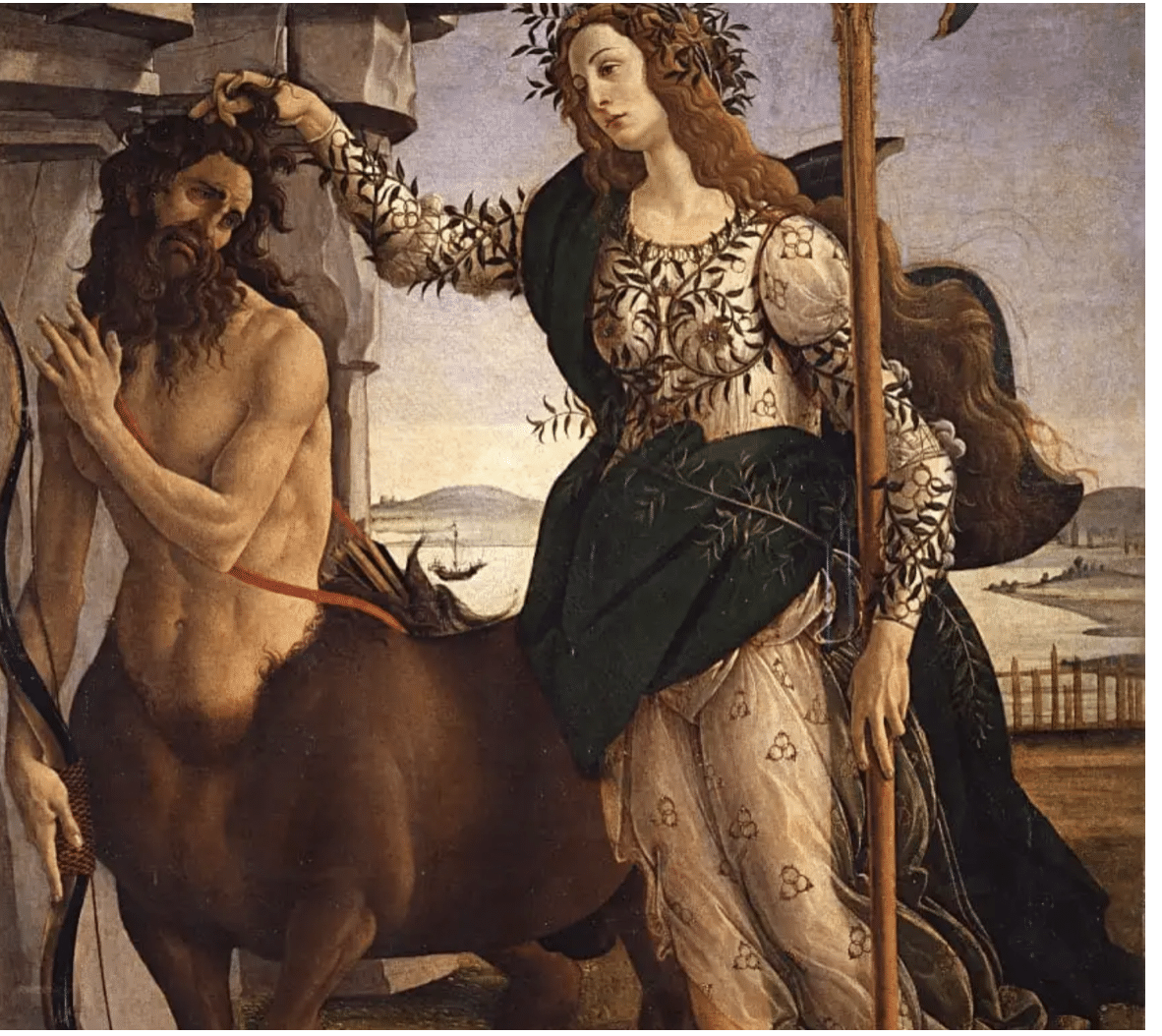
If you spend much time in any museum’s European painting section, you’ll encounter exquisitely rendered images of gods and goddesses, mighty heroes and hapless mortals and fantastical creatures both beautiful and grotesque. One such mythological figure is the centaur.
In Greek mythology, the centaurs were part-man and part-horse. Therefore, they had both a civil and a savage side to their nature.

An ancient Greek “black figure” depiction of a centaur.
Most famously, the centaurs figure in the sculptures that once adorned the Parthenon in Athens (and which are now displayed at the British Museum). The outside of the Greek temple showed scenes from an epic battle between the centaurs and the Lapiths, the legendary inhabitants of ancient Thessaly.

Battle of the Centaurs and Lapiths, the Parthenon, marble, 432 B.C.
The story goes that the centaurs had been invited to a royal wedding. Unfortunately, the wine went to their heads. When one of them attempted to carry off the bride, their animal natures got the better of them and all at once they began going after the women.

Battle of the Centaurs and Lapiths, the Parthenon, marble, 432 B.C.
The Lapiths within moments were drawing their swords and spears and soon managed to drive the frenzied centaurs away. For the Greeks, the popular myth symbolized the triumph of order over chaos and, more specifically, the superiority of the civilized Greeks over Persian “barbarians.”
Of course, the theme of Reason overcoming man’s impulsive animal nature appealed to the artists of the Italian Renaissance. Hundreds of years after the Parthenon was left a ruin, the Italian humanists were reviving Greek sculpture and architecture when the works of Plato and others were being translated.

Giambologna, Hercules and Nessus, 1599, Loggia dei Lanzi, Piazza della Signoria, Florence, via travellingintuscany.com
In the legend of Hercules and Nessus (depicted in the 1599 sculpture above), the centaur Nessus was helping Hercules cross a deep river when he dumped the trusting hero off his back and attempted to assault his wife. Hercules killed the centaur by shooting him full of arrows.
Not all the centaurs were creeps. As many paintings show, a wise centaur-teacher named Chiron took young Greeks under his wing and taught them to be great heroes.

Thetis Entrusts Achilles to Chiron, by Pompeo Batoni, 1761
Chiron’s dual nature symbolized the need to balance the ‘wildness’ with the ‘reason’ within humanity’s soul. He taught his aspiring heroes to control their dangerous impulses but also how and when to listen to their inner nature.
Chiron encouraged his heroes how to trust their creativity, how to play stringed instruments such as the lyre, and taught them medicine and
philosophy as well as practical skills such as hunting, archery, and sword-fighting.

The Education of Achilles by the Centaur Chiron, by Jean Baptiste Regnault, 1782, via the Louvre
Centaurs don’t appear in contemporary art all the much anymore, but knowing a bit about them can help you appreciate some of the great European painting of the past.

Arnold Bocklin, Centaur Watching Fish, 1873
If you’d like to see a “real” centaur (kidding!), visit the art installation called The Centaur Excavation at Volos at the University of Tennessee.

The Centaur Excavation at Volos, via Torchbearer, The Magazine of the University of Tennessee
The exhibit uses the conventions of scholarship to make the centaurs of Greek mythology come to life, presenting something fictional as authentic. The artist used tea to give the (real) horse and human bones an “ancient” patina.

Odilon Redon, Centaur Aiming at the Clouds, lithograph, c. 1900
How did artists paint centaurs if they never existed? They simply combined what they knew about rendering human and animal anatomy and hoped what they created seemed physically plausible. If you’re interested in learning how to paint animals yourself, a number of videos available on painttube.tv point the way.
Albert Handell to Judge August 2023 PleinAir Salon

August 2023 PleinAir Salon Judge Albert Handell
Albert Handell, a Master Pastelist of the Pastel Society of America, will be judging this month’s PleinAir Salon. Handell was only the third living artist to be inaugurated into the Pastel Hall of Fame. Since 1961, he has had over 30 one-man shows, and has received over 70 prizes and awards. Handell’s work is in numerous private, public, and museum collections.
The monthly PleinAir Salon rewards artists with over $33,000 in cash prizes and exposure of their work. A winning painting, chosen annually from the monthly winners, is featured on the cover of PleinAir magazine. The deadline is a rolling one, so visit PleinAirSalon.com to learn more.