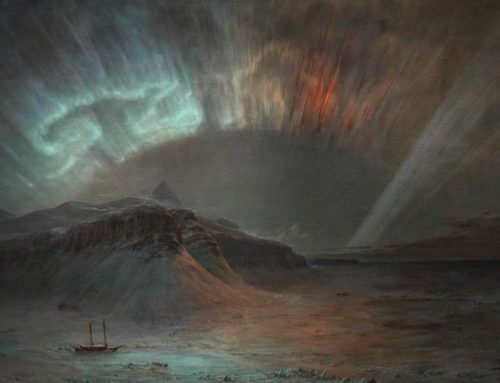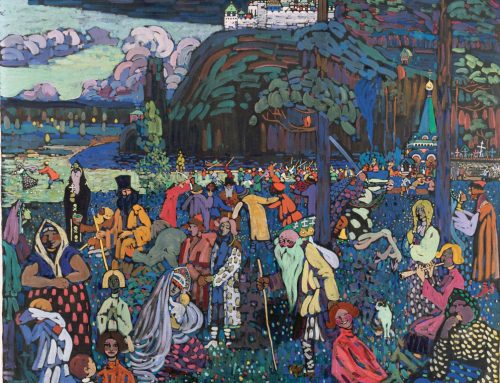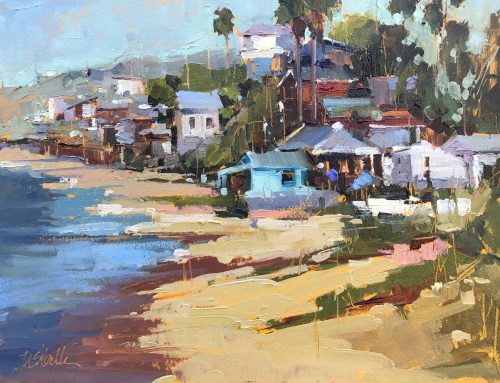

Founded in Los Angeles in 1909 and headquartered in Pasadena, the California Art Club is one of the oldest and largest art associations in the western United States. Its roots reach back to Southern California’s celebrated turn-of-the-20th century Impressionists, and it remains an active and dynamic group.
This month the Club will take its annual fundraising sale online as a silent auction accessible globally through the Internet.
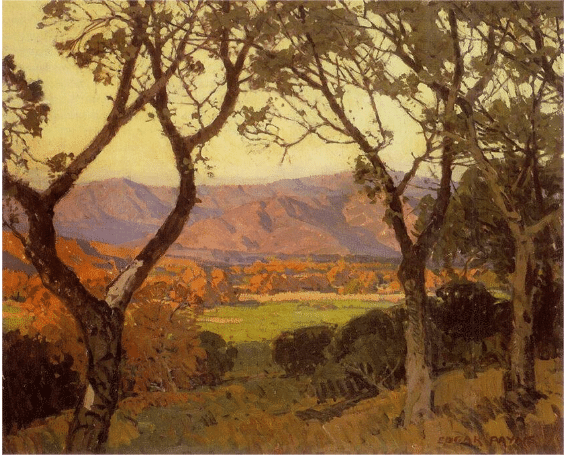
Edgar Payne, Vista through Sycamores, the Ojai Valley (Southern California), oil on canvas, 38” x 34”
Early in its history, the California Art Club acted as a catalyst for painters influenced by Impressionism. Among the Club’s ranks were such bright lights as Edgar Payne, Franz Bischoff, Granville Redmond, and Anna Althea Hills. Their paintings fit comfortably within the Impressionist style, with its emphasis on color and light, broken brushwork, and the spontaneous apprehension of nature.
Like their French forbears, they largely painted en plein-air, taking advantage of the mild climate and the singular quality of Southern California light.
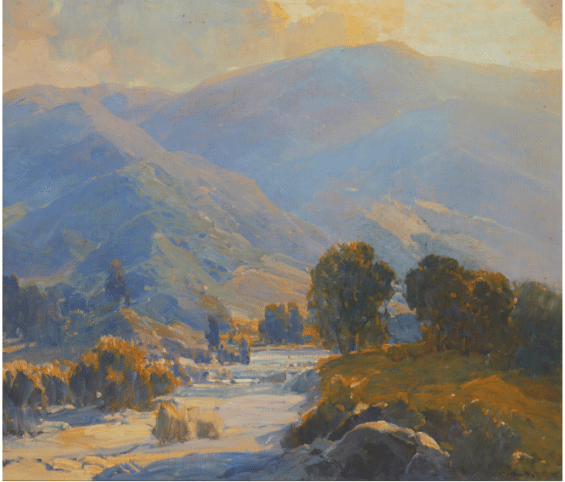
Hanson Duvall Puthuff, (1875-1972), Sunlit Arroyo, Oil on canvas, 34″ x 40″
Journals and newspapers lionized art club activities as hopeful evidence of the region’s rising cultural sophistication. As art writer Susan Landauer has noted, assessing the club’s activities for the Fine Arts Journal in 1913, one Everett C. Maxwell enthused:
“From a dozen different writers upon subjects pertaining to the development and trend of art in the west, the word has gone forth to the world that California, that land of golden light and purple shadows, is destined in the course of the next few years to give us a new school of landscape painting…Conditions seem right for a renaissance of art in California…If this art epoch of golden prophecy does not come to pass, it will not be the fault of the California Art Club.”
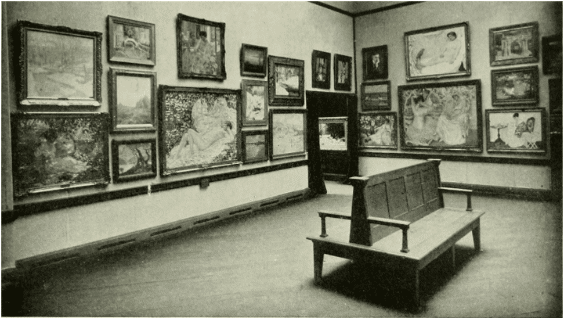
1915 Panama-Pacific International Exposition in San Francisco
The Panama-Pacific International Exposition introduced western artists to Impressionist works not previously seen outside of France with an influential exhibition in 1915. Hung “salon style,” the show made Impressionist painting accessible to new audiences.
From the start, the California Art Club grew quickly, not least because it took the unusual step of welcoming women into full membership, easel to easel with the men who founded it.
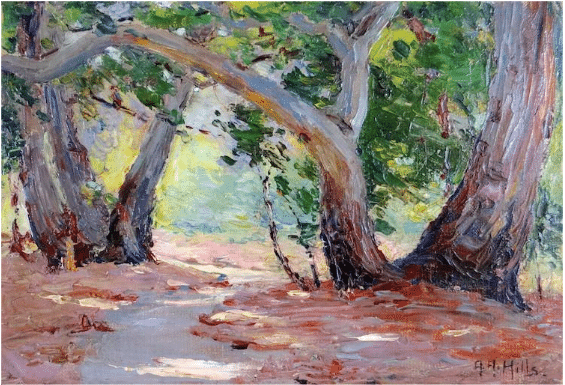
Anna Althea Hills, “Sunshine & Shadow-Orange Co. Park, California,” 1915 (Photo via Wikimedia Commons Public Domain)
Anna Althea Hills (January 28, 1882 – June 13, 1930) was among the first women to make a name for herself by specializing in plein air paintings of the Southern California coast. She studied at the Art Institute of Chicago and the Cooper Union for the Advancement of Science and Art in New York City. She worked with Arthur Wesley Dow for a spell before enrolling in Paris’ famous Academie Julian. Upon returning to the U.S., she opened a studio and atelier in Laguna Beach and switched from interior figures to the plein air landscape.
In addition to her membership in the California Art Club, Hills was president of the Laguna Beach Art Association (founded in 1918). In addition, Hills urged her friend, the respected artist and critic, Jennie V. Cannon, to create a similar organization and art gallery, which was eventually founded in 1927 as the Carmel Art Association and adopted verbatim the Laguna Beach preamble: “To advance the knowledge of and interest in art; to create a spirit of co-operation and fellowship between painter and public,” a dictum very much in line with the spirit of the California Art Club in Pasadena.
The following works by Southern California artists John Hubbard Rich and Frank Cuprien exemplify the refined aesthetic of the Club and the region at the time.
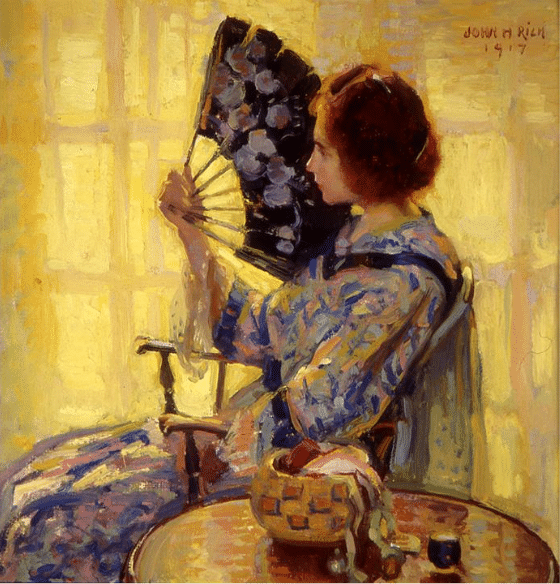
John Hubbard Rich (1876-1954), “The Idle Hour,” 1917; o/c, 14″ x 14″, Collection of the Irvine Museum
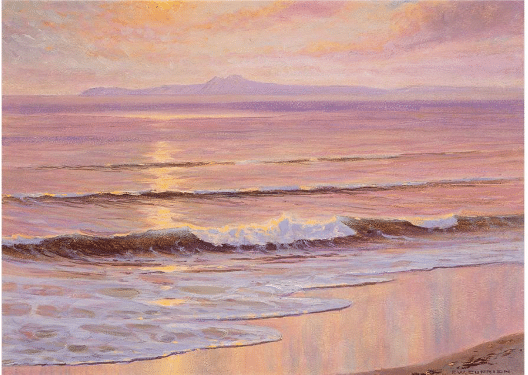
Frank Cuprien, Reflections of Evening, 1940. Oil on Masonite, 15 x 21 in. The Buck Collection.
Now in its 112th year, the California Art Club continues to support and promote contemporary-traditional fine art, not just to its regional audience but globally, via the Internet, helped by a fledgling video library.
The California Art Club’s silent auction starts November 12th and will run until December 3rd, the date for the Club’s annual holiday party at Pasadena’s Valley Hunt Club, where editor-in-chief of Fine Art Connoisseur Peter Trippi will receive the William and Julia Bracken Wendt Award
Anyone can bid on the art in the Club’s auction starting on Sunday at the following link: https://www.californiaartclub.org/holiday-auction-2023/
Chuckie’s Grand Adventure
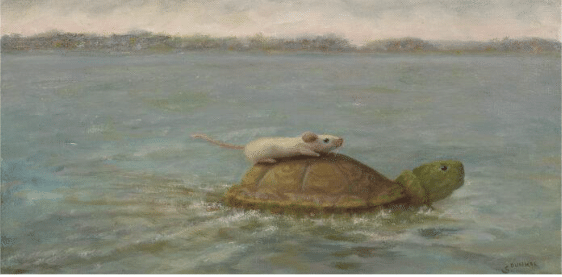
Stuart Dunkel, “Ferry,” Oil on panel, 10 x 20 inches
Rehs Contemporary has announced a solo exhibition featuring new works by artist Stuart Dunkel from November 10th through December 8th, 2023, with a special opening reception on Thursday, November 9th.
From the Gallery:
Prepare to embark on an enchanting journey alongside Stuart’s endearing muse, Chuckie the Mouse, as he tours the world and crosses paths with playful objects and quirky friends.
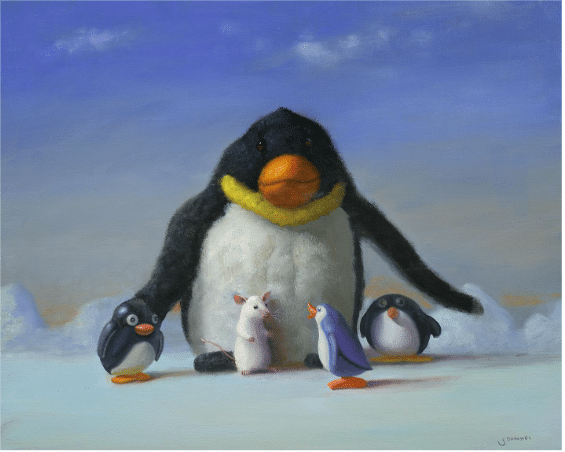
Stuart Dunkel, “Arctic Cousins,” Oil on panel, 16 x 20 Inches
Stuart Dunkel has gained recognition for his imaginative compositions that feature his beloved mouse, Chuckie. His ability to infuse humor and charm into each work has fostered a diverse audience of collectors and enthusiasts who are always waiting to see what comes next. As Dunkel himself says, “I believe in the power of art to transport us to a place of pure joy and wonder … Chuckie the Mouse has become a cherished companion to me, and I am thrilled to share his whimsical adventures with the world through this exhibition.”

Stuart Dunkel, “Best Choice,” Oil on panel, 6 x 12 inches
Some of the most anticipated paintings in “Chuckie’s Grand Adventure” include subjects that Dunkel has not explored previously. For instance, Chuckie will be doing some international traveling, visiting the Leaning Tower of Pisa in “Saving Pisa,” wherein the heroic rodent struggles with all his might to straighten the tower. In “Ferry,” he’s hitching a ride by turtleback across a river. Then there are more thoughtful approaches, albeit still quite comical… in one piece, Dunkel tackles Greek Mythology by having Chuckie roll his blueberry up a steep hill, evoking the tale of Sisyphus.
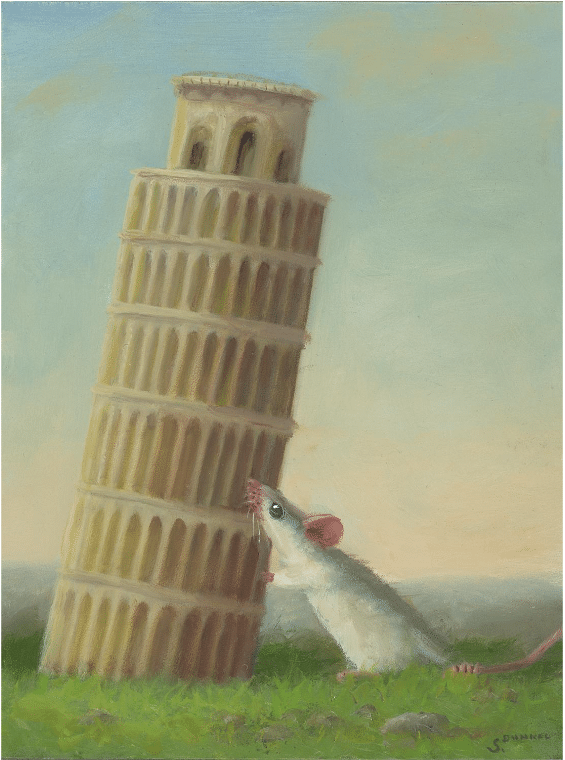
Stuart Dunkel, “Saving Pisa,” Oil on panel, 8 x 6 inches
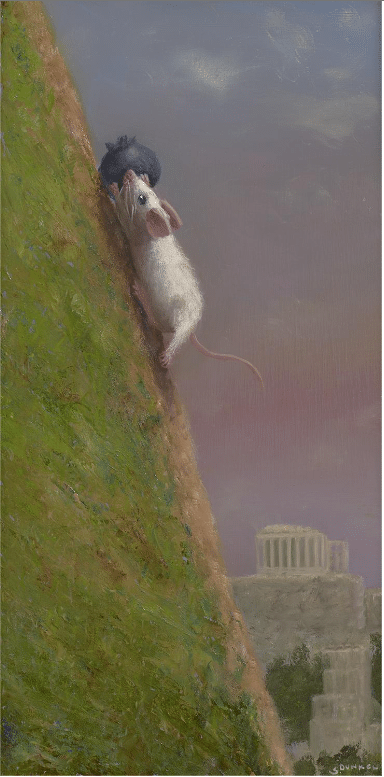
Stuart Dunkel, “Sisyphus, Oil on panel, 12 x 6 inches
“Chuckie’s Grand Adventure” is on now at Rehs Contemporary in New York City. This story appeared originally in Fine Art Connoisseur, View more fine art gallery exhibitions and more at FineArtConnoisseur.com.