I have a friend who likes to say that picking up a brush when you’re about to paint something is not the first step in the artistic process – it’s the last. What drives you to the easel with excitement and anticipation, he says, is something that started long ago; behind the first stroke of that brush, there’s a life (yours) that has tasted love, anger, sorrow, joy, frustration, adoration, and everything else that deepens our sense of what we’re doing here.
However, it’s not a conscious process. Painting is like poetry, at least as the English poet William Wordsworth defined it: “Poetry is the spontaneous overflow of powerful feelings: it takes its origin from emotion recollected in tranquility.” You feel it, though, as the powerful urge to make a certain painting.
Recollection meets spontaneity.
And if Wordsworth is correct, our most cherished works of art, masterworks by the greats (painters like Michelangelo, Rembrandt, Basho, Turner, Monet, van Gogh, Inness, Winslow Homer, Helen Frankenthaler or Andrew Wyeth, say) are forged in bygone moments of awe and wonder and other powerful responses to the world (how else could such felt images arise?). As such, they are also guideposts that deepen our capacity for living fuller and deeper lives ourselves.
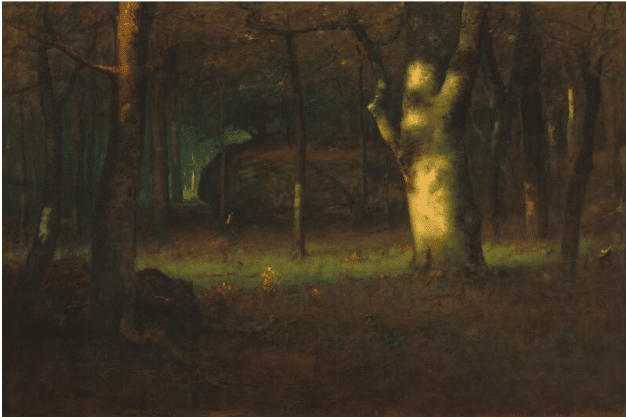
Sunset in the Woods, George Inness, Oil, 1891

Autumn, George Inness, “The true use of art is, first, to cultivate the artist’s own spiritual nature.” – George Inness
Artists, writers and musicians, if they’re sensitive, set great store in their experiences. They stay open to surprises and opportunities to feel things, many things, always: the smell of grass, evening clouds, the laughter in a child’s eyes, leafy treetops and crooked barn doors – but also hard to look at things like urban decay, brazen injustices, or the unyielding mystery that awaits us all at the end of life. And in their response the supreme eternal work gets done that elevates human life above more than mere survival: making meaning out of chaos, beauty out of sorrow.
“There was a child went forth,” Whitman writes, “every day, And the first thing object he looked upon, that object he became, / And that object became part of him for the day / Or a certain part of the day, / Or for many years and stretching cycles of years.”
The artist in us “goes forth” with that same childlike wonder, imagination, and insight, open and alive to “the spontaneous overflow of powerful feeling.” Whitman’s poems themselves serve as examples of it in motion: “Gather the welcome signs,” he writes elsewhere in Leaves of Grass, “as children with pebbles or stringing shells,”
“Put in April and May, the hylas croaking in the ponds, the elastic air,
Bees, butterflies, the sparrow with its simple notes,
Blue-bird and darting swallow, nor forget
The tranquil sunny haze, the shimmer of waters with fish in them…
The maple woods, the crisp February days and the sugar-making,
The robin where he hops, bright-eyed, brown-breasted…
The melted snow of March, the willow sending forth its yellow-green sprouts,
For spring-time is here! The summer is here! …let us be up and away!
O if one could but fly like a bird!
O to escape, to sail forth in a ship! …
The lilac-scent, the bushes with dark green heart-shaped leaves,
Wood-violets, the little delicate pale blossoms called innocence …
To sing with the birds,
A warble for joy of lilac-time, returning in reminiscence.”
Pedantry? Nonsense?
If so, give me nonsense every time.
A little nonsense now and then
Is relished by the wisest men.
“The thing of course, is to make yourself alive. Most people remain all of their lives in a stupor. The point of being an artist is that you may live.” – Sherwood Anderson,