Britain’s National Gallery has a nice collection of Corots digitized in high resolution on their website. You can’t beat it as a learning tool – you can zoom in and crawl all over these masterworks examining every brushstroke and nuance of color and value. Historically, painters never had such amazing tools for learning what they wanted to know.
https://www.nationalgallery.org.uk/artists/jean-baptiste-camille-corot
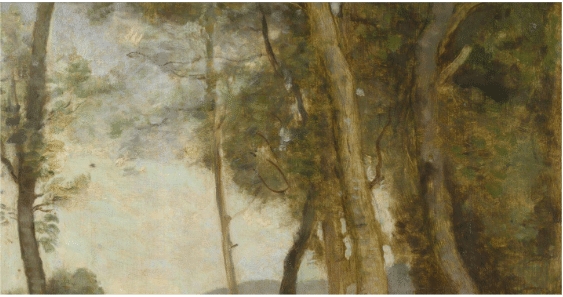
We broke down Corot’s palette in a previous post, and there we noted his method seems to be to have daubed in the darks first, then to lay-in a thinly painted sky, and then extend the branches out into it using a cool neutral gray in numerous little dabs of paint.
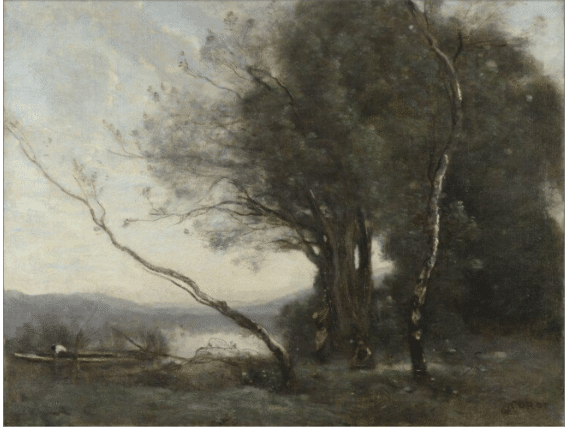
Jean Baptiste-Camille Corot, The Leaning Tree Trunk, oil on canvas, 49.7 × 60.7 cm (1865)
The closeup below is from The Leaning Tree Trunk, a high res version of which you can explore here.

Try painting Corot-like trees following these steps:
- Mix a gray green using ultramarine blue, burnt umber, yellow ochre and a tiny bit of alizarin crimson
- Apply the gray-green dark, full-strength (no white) to block in shadow areas of the foliage. Think in terms of bunches of branches, like dimensional shapes, rather than individual branches or leaves.
- Mix white and possibly a little more yellow ochre into the original gray-green on your palette and use it to add highlights that will give your branch-bunches a little three-dimensional form
- For the sticking-out branches on the edges, mix a super-light neutral gray, just a notch or two darker in value than the sky and apply in dabby strokes with a smallish brush
- Add very thin, curvy branches
(You can also reverse the order of 4 and 5, painting a few thin branches first and adding the neutral-gray foliage in dabs over and around them)
- Optional: Add a small number of small, darker dabs of paint for individual leaves – having a few distinct single leaves at the edges helps convince the viewer they’re seeing a whole tree full of them, when most of what’s there is shapeless texture (see below).

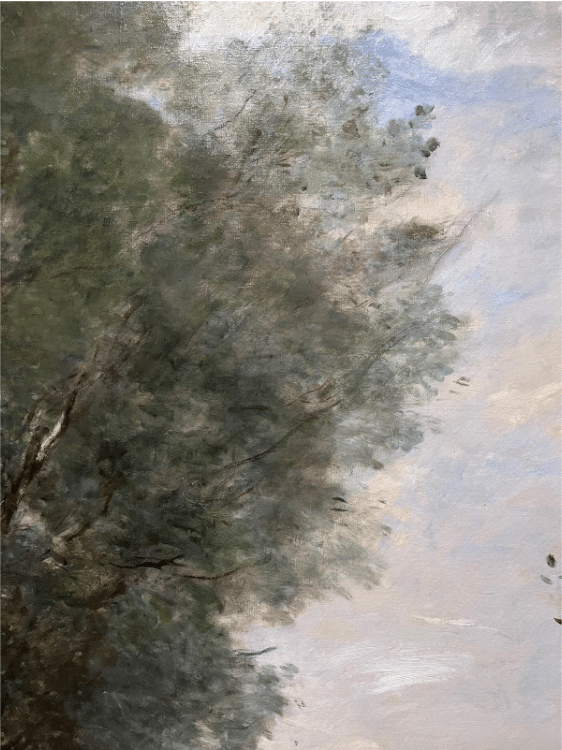
The diagram below shows an abbreviated, simpler version of the same approach – a few areas of shadow, masses of dabbed-in neutralized paint for the foliage, and a few very thin branches at select edges.

If you have difficulty painting believable trees, perhaps you’d like some solid back-to-basics, step-by-step instruction for painting them. If so, check out this video from Paul Kratter called Mastering Trees.
Birth of Impressionism Explored in Exhibition at Musée d’Orsay and National Gallery of Art, Washington
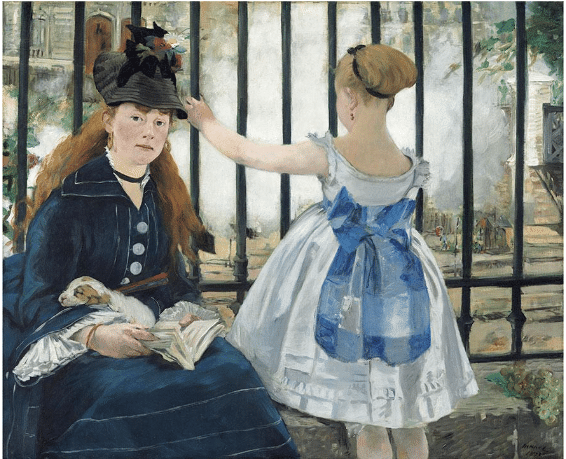
Édouard Manet The Railway, 1873, oil on canvas, overall: 93.3 x 111.5 cm (36 3/4 x 43 7/8 in.) National Gallery of Art, Washington. Gift of Horace Havemeyer in memory of his mother, Louisine W. Havemeyer
This winter and next fall, a landmark exhibition on Impressionism will take place on two continents, North America and France.
“This exhibition will closely reconstitute the very first impressionist exhibition,” noted Christophe Leribault, President of Orsay and Orangerie Museums, Paris. “It will invite visitors to immerse themselves in this decisive moment, a major rupture in the history of art, and help us understand its emergence and grasp its radicality.”
Paris 1874: The Impressionist Moment will be shown at the Musée d’Orsay, Paris, March 25–July 14, 2024 and then at the National Gallery of Art, Washington, September 8, 2024–January 19, 2025.
Look for future coverage of this outstanding exhibition here in a future edition of Inside Art.