
People used to say, “Is there anything in it?” to question if you could benefit from something or whether it was a waste of time. As in, “What do you do?” Oh, I work in the field of high-end pet insurance. “Really? Is there anything in it?”
I once interviewed an older abstract painter known to be a cagey subject, notorious for resisting publicity. Mid-interview, he turned the tables on me, and he started asking the questions. “You paint, do you?” he said. “Who do you like?” I dropped the name of an abstract expressionist I admired and still do – Franz Kline. “Kline, eh?” he replied. And after a moment’s pause he said, “Is there anything in it?”
It stopped me in my tracks.
Because I knew exactly what he meant. That simple idiomatic sentence contained a profound theory of painting. He used it to question not only the fundamental “worthwhile-ness” of any painting by Kline but also to ask about a painting’s relative fullness or emptiness of felt meaning: Not how skilled or how enjoyable, not how well drawn or how harmoniously colored, not how innovative, or how stunningly photorealistic or how abstract it is. In short, not, is it a “good” painting – but What did the artist put into it of his or herself?
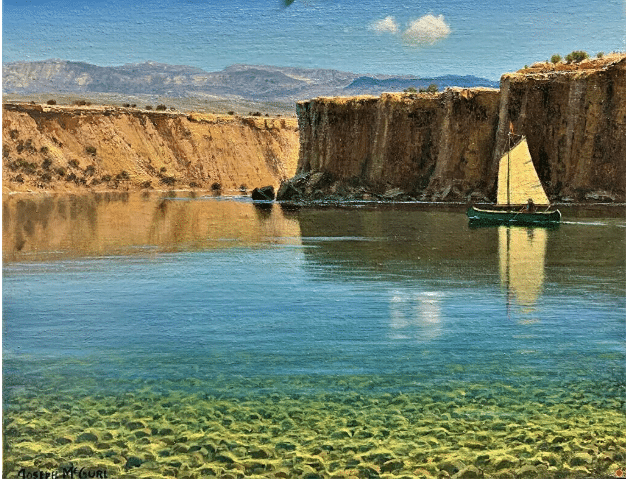
Joseph McGurl, Sailing Canoe, Becalmed, Oil on canvas, 11 14 in.
However elusive to define, this criterion, it turns out, is a very high standard indeed. It’s also the only one applicable to all the great and not so great works of art ever created, regardless of style, time period, this or that ism, or anything else. Is there anything in it? What’s in it for us, the viewers (even if we can’t put words or a name to it, but ony feel it)? What of themself did the artist invest into the work or consciously or not leave behind for us to find there?
I also knew he did not mean, Did the artist start with a sound concept and then make the painting to embody it? Rather, he meant it sort of the other way around: Did the artist surrender to and trust their deepest feelings regarding what life is all about, and did they allow those feelings to “get into” the work? Did the artist allow something of the joy, horror, or astonishment at the whole mysterious mass of existence that we all sometimes feel – some moment of heightened consciousness or connection, some unusual emotional state, some sense of wonder and awakening to the mystery of things – did they allow something real to seep into and direct the work’s making?
I realized on the spot, too, what to stop worrying about and what to start trying to do instead: It’s not about the tools or the medium or how abstract or how representational your work is that matters. An abstract painting can be powerful or it can be weak, exactly as a realistic painting can be powerful or can be weak. A photograph can be a better work of art than even a very good painting and vice versa. What matters is what the artist puts into it of themselves through the thousands of tiny decisions and counter-decisions every work of art entails.
Since then, I’ve stopped judging paintings in terms of style or technique. It’s so much easier to just look and see what a given painting makes you feel. Bottom line, you could say I’ve taken to seeing them in terms of substance (whether there’s “anything in it)” and how well (i.e. authentically, not using clichés) they seem to embody it. Abstraction vs. representation, color vs. monochrome, linearly detailed vs. wildly gestural – none of it matter in isolation.
“Representations will never be replaced,” social realist painter and author Philip Evergood (1901–1973) once said, “because new minds add phases to it, just as the violin will always remain an instrument because it supplies a need – a special beauty – a quality in music which nothing else can replace.”
I love abstract paintings that seem to channel the forces of nature and life. I love realist paintings that do the same. I love any work that communicates authentic insight about people, places, and things and what it’s like to live even for a moment with a fully open heart and mind.

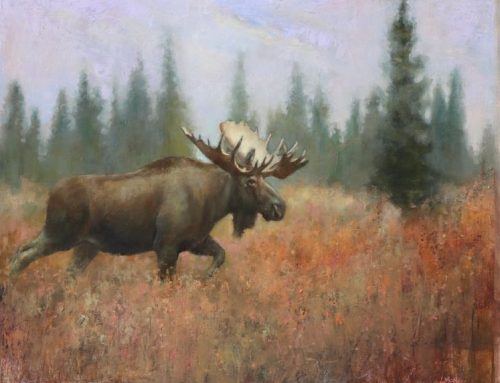
Douglas Fryer, “After the Storm,” oil on canvas, 30 x 30 in.
“I think that people will always be eager to see art that deals with the forms of nature,” Evergood said, “with man, with animals, with trees, art which tries to express the varying moods of nature, the human values and emotions.”
“Let the theorists theorize and the avant-garde-ists ‘lead.’ Let the monuments grow to the most stupendous and awe-inspiring dimensions which money and power can produce, fancifully fulfilling the aggrandizements of this or that sect in art. Any art which has imagination, has the “magic touch” and expresses universal truths which man can feel and understand, is valid – is Art. Only people and time will decide what is great.”*
You can waste a lot of mental energy worrying over whether your work is too abstract or too representational, too tight or too loose, too detailed or not realistic enough. I want to tell you to stop wasting your time. There’s nothing in it.
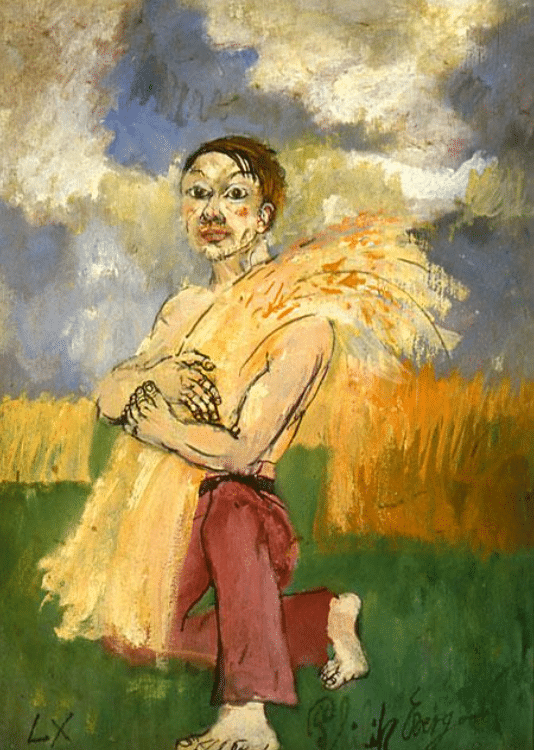
Philip Evergood, “Self Portrait,” c. 1960, Oil on canvas.
*Statements by Philip Evergood (1963, 1961) published in Painters on Painting by Eric Protter (originally published in 1971, available as a reprint from Dover Editions).
BTW, the three Streamline Artists we featured today all have high-quality teaching videos:
If you’re interested in learning the skill of capturing the “essence” of a beloved canine, check out Johanne Mangi’s “The Fine Art of Painting Dog Portraits.”
If landscape painting feels to you like a genre suitable for expressing your feeling for life, have a look at Joseph McGurl’s “Painting Light and Atmosphere” or Douglas Fryer’s “Painting with Intuition.”