Level Up #3. STOP
To get better, intermediate painters (which I count as anyone with more than, say, a dozen or so canvases under their belt) must go beyond the beginners’ basics of composition and color mixing that confront everyone at the start. Go deeper and avoid the not-so-obvious gaffs we’re covering in this three-part series. Part 3: STOP.
Every painting comes with a little invisible DEMON DUDE who only emerges in the final stretch, when it’s probably already past time to put down the brush and be done. He may be small, but he’s almost impossible to ignore – you hear his voice in your head saying you’re ALMOST there – but you need to fix just ONE MORE THING.
And then you look up and it’s 2:30 a.m.

It’s frustrating getting to a point of diminishing returns and still being dissatisfied. So, you paint on, fiddling with this and fussing with that, under the misguided idea that if you just keep going you’ll eventually “save” the painting. You’re chasing the fantasy that there will be a moment when you step back and marvel at your own magnificence, eureka-rays of light bursting from your brush and head like the Grinch who suddenly understands Christmas. Sadly, however, it usually results in digging yourself deeper and deeper into a hole.
Part of it’s learning to let the paint be the paint. Contemporary artist Joseph Gyurcsak seldom loads his paintings with fussy details. He puts it on and leaves it on in a way that causes envy in control nuts but delights collectors.
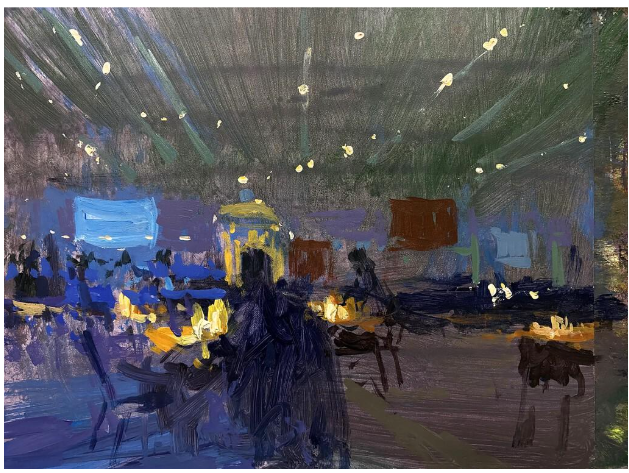
Look at his “Blue Lounge” painting in acrylic at the top of the page – it’s an intense, radiant and atmospheric meditation on a contemporary interior, yet what are some of those things? The chairs are barely there, and whole areas of the painting are loose, nearly non-representational brush strokes. And yet it works!
Or take “Two Painters in the Sunlight” (below). He could have spent hours trying to get the facial expression of that plein air painter right – but he didn’t have to. He “said it” (“it” being the essential “attitude” of the plein air devotee at the easel) and let it be. Walked away. Moved on. Done.
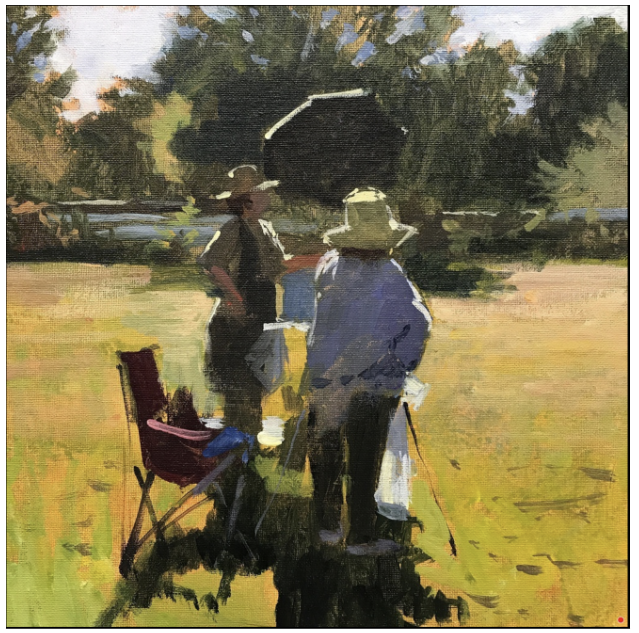
Joseph Gyurcsak, “Two Painters in the Sunlight,” Acrylic on canvas, 12 x 12 in.
But letting go of the railing and leaving a painting in such a seemingly “messy” or “chaotic” state – even though those are words I would never apply to these paintings – they said as much about Monet – is something most of us find difficult to do.
Q: How many painters does it take to finish a painting?
A: Two. One to clutch wildly at the brush and another to hit him over the head with a hammer.
“Stop at the thought of stopping,” says contemporary colorist Ken Kewley. In other words, when you think you’re 95% done, put down the brush – because you’re probably already 20 minutes past the proper stopping point. But there’s no one answer.
All you can see are the flaws.
You already know that fussing with things or adding more detail will never save a lackluster painting. That’s when, they say, it’s time to walk away. Come back to it later with “fresh eyes.” But in the moment, it sure feels like defeat!
Few of us want to spend our time in a tizzy, adding this, taking out that, putting it back in and trying to fix the mess we’ve just made. One trick to try: when you find yourself fussing with seemingly insignificant passages, just stop – consciously force your attention onto the bigger picture. Consider accentuating values and maximizing expression in the work – things that make a real difference in the final work anyway.
There’s a school of thought that says the key to knowing when it’s finished is to consider your painting a tool not just for replication but also for expression, a feeling-rich aesthetic object. For this you must mentally return to a painting’s surface, to see overall both the rendering (i.e. the “picture”) and the deeper content, what’s “in” the work, (i.e., not what it’s a painting of, but a sense of the intention, the feeling). If you allow it have a life of its own, the thinking goes, the thing will be said, and the painting will tell you when it’s time to leave the easel.
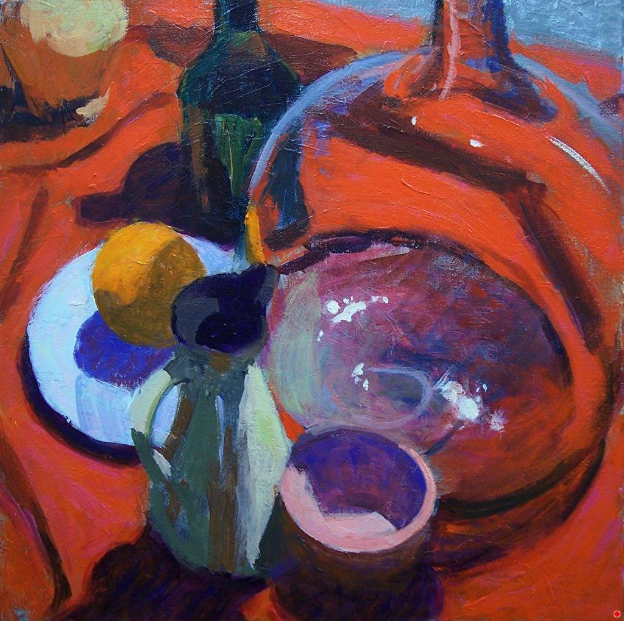
Joseph Gyurcsak, “Valencia,” acrylic on canvas, 20 x 20 in.
“Finishing a painting provokes the question of when it becomes independent, and why,” says British artist Christopher Le Brun “When you’ve uncovered something that the painting itself wants to project, when it reaches the surface, the painting says, ‘Hold. This is the ideal condition.’”
Or just follow the old artist’s advice: Touch any painting as few times as you can!
This issue’s featured artist, Joseph Gyurcsak, will be teaching during this month’s Acrylic Live online learning event. Learn more and register here!