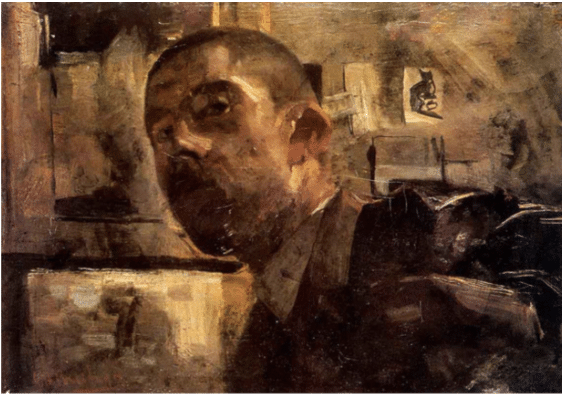
Art historians call George Hendrik Breitner (1857-1923) one of the leading “Amsterdam Impressionists.” However, his paintings don’t align with the kind of artwork we commonly associate with Impressionism.
That’s because Breitner and his peers ignored the evolution of Impressionism into the exuberant celebration of color and light that we associate with French artists such as Monet, Renoir, and Pissarro. Instead, Breitner kept to the movement’s application of literal realism, applied in a very modern way.

Students of the Rijksacademie Amsterdam (1882/83)
Breitner is the most well-known of the two-dozen or so young painters in Holland who identified with the Amsterdam Impressionist movement.
He was born in Rotterdamin in 1857 and in 1875 he enrolled at the academy in The Hague. Later, he worked at Willem Maris’s studio. In this early period he was especially influenced by the painters of the Hague School.
When painting the figure, he preferred actual working-class models: laborers, servant girls and people from lower-class neighborhoods. He saw himself as ‘le peintre du peuple’, the people’s painter.
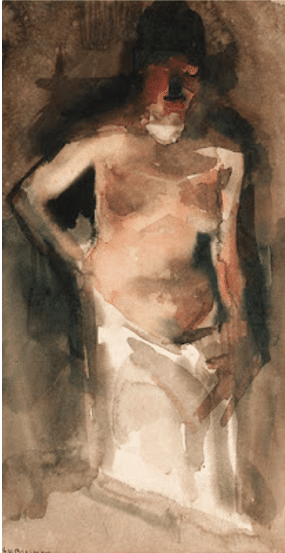
Figure (watercolor) by Breitner
In 1886, he moved to Amsterdam, where he recorded the life of the city in sketches, paintings and photos. Sometimes he made several pictures of the same subject, from different angles or in different weather conditions. The photos might serve as an example for a painting or as general reference material. Conservative critics called his style of capturing an impression on canvas with rapid, visible strokes of the brush ‘unfinished,’ just as they said of the Impressionists in France at the time.

Breitner, city canal, c. 1880
Breitner and his followers never wavered from Impressionism’s initial guiding principles (inherited from the Barbizon painters of the 1830s) – the direct, observational (and in his case wholly un-idealized) depiction of contemporary life. In other words, he took from the founding painters the early mission from which the Impressionists eventually strayed: to establish the gritty, unromantic, working-class world as a suitable subject for serious art.
By the time the French and American Impressionists were painting lyrical landscapes and the leisure activities of the middle- and upper-classes, Breitner and others coming out of the Hague school dedicated themselves to the Real world (Real with a capital R) – the one which the vast majority of the population would have known and recognized as their own.

George Hendrik Breitner, Laborers Pulling a Heavily Laden Cart on Jacob van Lennepkade, Amsterdam, c. 1888.
When Breitner made this painting of workers pulling a large cart piled with coal (see above), he deliberately used a dark, sooty-looking palette of grays and browns for most of it. The workers’ faces are indistinct, rudimentary, reflecting the disappearance of their individual personalities into their roles as “cogs in a machine.” In the distance you can see two new buildings going up (notice the scaffolding); it’s as if Breitner is saying, Yes I’m painting the “progress” of modern life, but I want to show you the human cos right up front let you forget.
Dutch painting has a long history of realism – the paintings looked different over time but the basis in the observable world never changed. Breitner, like some of the others in the Dutch Hague School, digested the basic premise of painting life as at is really lived and seen and rejected the technical flash and polish of the French school as too sophisticated or even elitist for portraying contemporary life in all its jumbled, dirty reality. It takes the right frame of mind to appreciate them, but the paintings he made remain startlingly fresh because they are so unconventional and authentically true both to reality and to the artist’s singular vision.

It would take a rebel art movement in America, some 20 years later and a continent away, for the “Ashcan School” to rediscover the importance of art of and for the people.
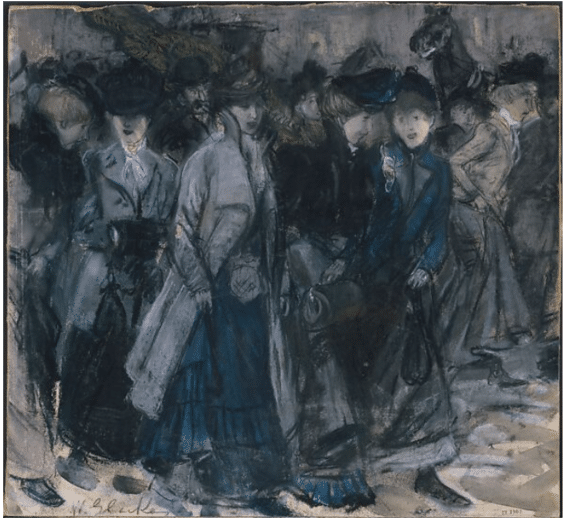
William James Glackens (American), Shop Girls, c. 1900
If the realism of the city intrigues you as an artist, there are some very good starting points you might find helpful in several teaching videos on urban landscape painting in oils, pastels, watercolor – the works. Check them out here.