The first comprehensive, international loan exhibition of works by Raphael in the United States is coming to New York next year.
This one is going to be a blockbuster – Raphael is generally considered one of the greatest painters of all time. “Raphael: Sublime Poetry” will be on view at the Metropolitan Museum of Art from March 29 to June 28, 2026.
The survey exhibition will bring together more than 200 of the Italian Renaissance genius’s greatest masterpieces and rarely seen treasures to illuminate the brilliance of Raphael’s extraordinary creativity. Visitors will be treated to a sweeping view of the artist’s creative development and colorful career, from his early days in Urbino to his “rock star” status in Florence, where he was the popular favorite among the greats of the High Renaissance, including Leonardo da Vinci and Michelangelo.
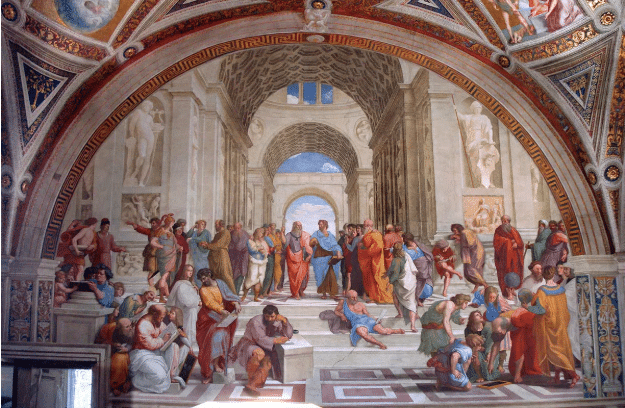
Raphael’s most famous painting, The School of Athens, 1509–1511, fresco at the Raphael Rooms, Apostolic Palace, Vatican City, Vatican Museum
The latter, art historians say, hated Raphael for stealing his thunder (and, according to Michelangelo, his style) while he was busy painting the Sistine Chapel’s ceiling. The way-better-good-looking Raphael responded by painting him into “The School of Athens” (above) as the dejected and disheveled looking loner slouching, head in hand, in the foreground. Michelangelo was incensed.
Raphael remained a busy artist, producing dozens of “Madonna and Child” paintings and tackling hugely ambitious projects, including enormous wall and celling frescoes in four big rooms at the Vatican. His prolific career was cut short in 1520, when he died of an illness at the age of 37.
Along with his Renaissance peers, Raphael changed artistic and cultural history by establishing humanism, which we might describe as the infusion of Christian and “historical” iconography with the classical approach of idealizing the earthly beauty of living human models. In his many Madonna-and-child paintings or his “Three Graces” (below), Raphael depicted living models who stayed human, despite titles framing them as Biblical or mythological figures. He moved art away from strictly symbolic or sanctioned religious function toward realism and a celebration of the human, as did Michelangelo with his “David” of 1504 or Botticelli with his “Birth of Venus” of the mid-1480s.
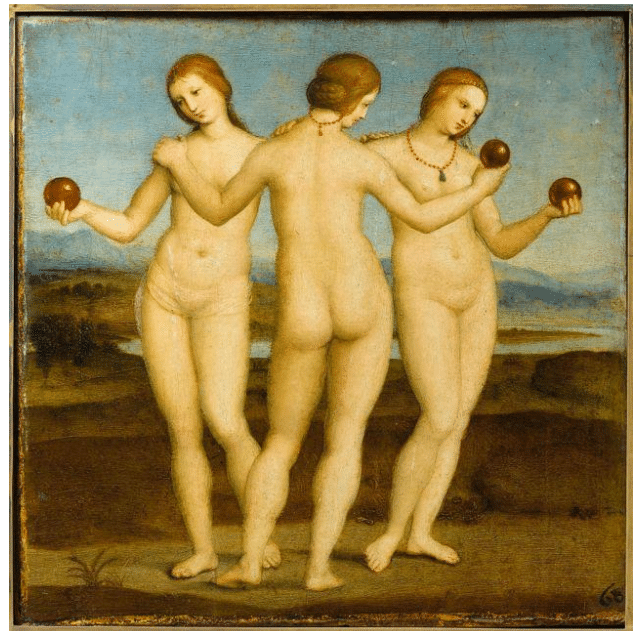
One of Raphael’s most famous works, The Three Graces, 1504-1505, Conti of Chantilly museum.
“The son of a painter and poet, Raphael engaged with the foremost writers and thinkers of his age in Rome, displaying a poetic sensibility that captivated his peers and generations that followed,” say the show’s curators.
“To underscore the range of his genius, this presentation brings together important drawings, paintings, and tapestries from public and private collections across Europe and the United States, many of which have never been shown together. With particular attention to Raphael’s portrayal of women—from his use of nude female models for the first time in Western art to his tender depictions of the Madonna and Child—and recent scientific discoveries made using state-of-the-art technology, this exhibition offers a rare opportunity to experience the genius of an artist who helped shape the course of art history.”
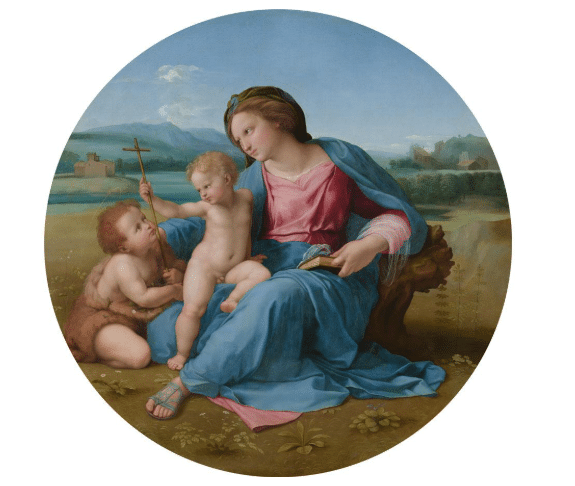
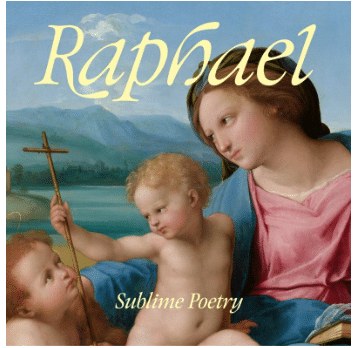
Raphael, The Virgin and Child with Infant Saint John the Baptist in a Landscape (The Alba Madonna), ca. 1509-11. NATIONAL GALLERY OF ART, WASHINGTON, D.C.
Captivated by the classics? Juliette Aristides’ teaches the techniques of the old masters in her video, “Secrets of Classical Painting.”