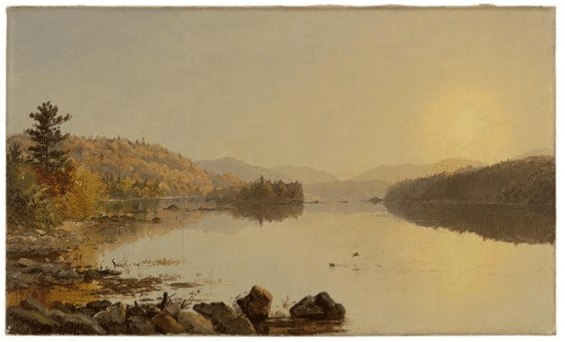
We hear a lot about “getting light into your painting” but there was an entire movement of American landscape painting in the nineteenth-century that made it practically the whole subject of their work.
Less a self-proclaimed “movement” and more a tendency or trend, the Luminists, as they are known today, created images of nature suffused with atmosphere and light. Luminist light is often atmospheric, sometimes cool, almost palpable, but it can also sometimes be hard and brilliant. The paintings have a still, suspended quality, as if a breath might break their spells.
This was the era of transcendentalism, in which Nature was thought to be a manifestation of God, so there’s justification for seeing in these glowing landscapes a kind of Divine Illumination.

Fitz Henry Lane , Lumber Schooners at Evening on Penobscot Bay, 1863, National Gallery of Art
At the time these folks painted (1850s-1870s), the idea was in the air: oneness with Nature could uplift sensitive souls to spiritual transcendence. The paintings, then, to some degree “illustrate” an idea found in American writers (such as Walt Whitman, Ralph Waldo Emerson, and Henry David Thoreau): that nature points toward a singular, benign force of creation embodied in the unending progress of life, death, and rebirth. In this view, even a single “leaf” of grass holds the infinite promise of Eternity:
“The smallest sprout shows there is really no death,
And if ever there was it led forward life, and does not wait at the end
to arrest it,
And ceased the moment life appeared.”
(Walt Whitman, Leaves of Grass)
Classic American art and literature contain treasure troves of meaning and beauty. It would be a shame, in the process of learning what painting is and how to do it, to leave this rich inheritance sitting on the table.

Martin Johnson Heade
Exploring the art of the past teaches you why people paint as they do, as well as how you can as well. Familiarity with historical greatness enriches your knowledge and informs your skillset. These works still have power to touch and inspire you if you let them.
Luminism exemplifies a particularly beautiful way that realism can embody artistic vision and express something deeply felt about the world we share. It can be achieved through a meticulous layering and glazing process or directly, simply by blending fields of subtly graded values and colors.
For an inspiring change of pace, create a painting in which you render the light as a uniform glow that infuses the entire scene. Pay attention to slight tonal modulations, and not brushstrokes, to create the effect of radiant light.
Most painters think of light as falling upon objects from a single “directional” source. Of course, this is correct but just for fun, is there any way to push this envelope, so that light takes on a luminous, incandescent quality, as if to some extent it radiates from the subject as well as bouncing off it?

Frederic Edwin Church, Autumn, oil, 24.02″ x 15.51″ (1875)

Sanford Robinson Gifford, The Wilderness (1860)
A Contemporary Take on Luminism

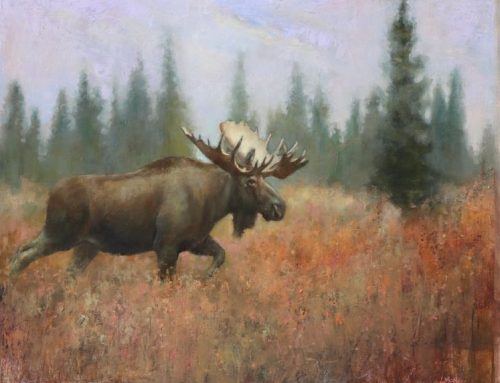
Lori McNee, Western Winter, oil, 19” x 43” (2019)
Contemporary painter Lori McNee believes the American Luminists still have much to teach us.
“Their goal was not merely to illustrate nature’s radiance, but also to interpret the landscape with a spiritual meaning,” she says. “William Keith’s words could apply to this earlier generation: “What a landscape painter wants to render is not the natural landscape, but the state of feeling which the landscape produces in himself.”
McNee’s work demonstrates how being influenced by the best of the past can strengthen one’s work and help to form a personal painting style. Her paintings masterfully embody the task of creating an overall luminosity in the landscape, where the light infuses the entire surface as if from within. Her subjects and compositions are contemporary and her own – not imitations of nineteenth-century arrangements of old world flora and fauna.
Lori shares her technique using water-mixable oils in her video Luminous Landscape Painting.
Something Truly Fiendish is Happening at the Royal Academy of Art!
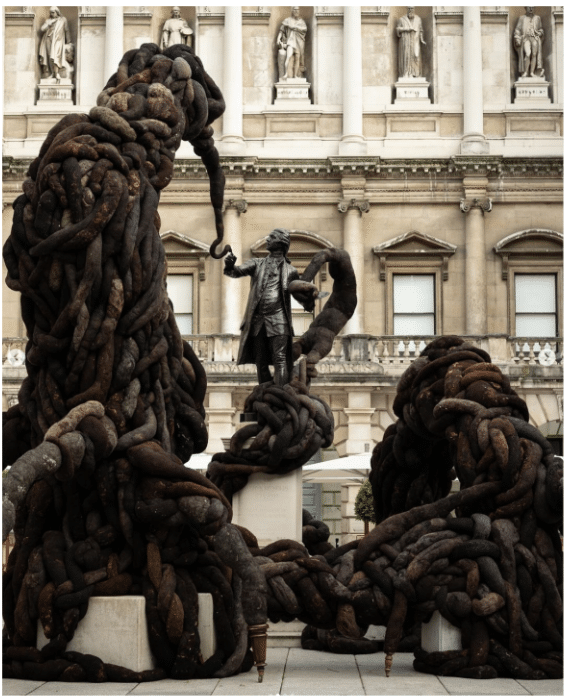
Nicolas Turner, The Meddling Fiend, wool, wax, horsehair, netting, in the courtyard of the Royal Academy in London.
London’s Royal Academy of art was founded through a personal act of King George III on 10 December 1768 with a mission “to establish a school or academy of design for the use of students in the arts” with an annual exhibition. Its first president was Joshua Reynolds, a major nineteenth-century British painter who specialized in portraits and other work in the “grand manner” of idealized perfection.
Something from the other end of the spectrum recently invaded the courtyard of the venerable institution and seems to have approached and reached out to the heroic statue of the artist that stands there.
The strange, darkly surging sculpture installation by Nicolas Turner is part of the Academy’s 2024 Summer Exhibition. It’s called “The Meddling Fiend” and is basically a mashup of a 1798 painting by Reynolds of serpents attaching the infant Hercules, combined with a 21st century take on the idea that Reynolds was himself a master of borrowing from other artists, adapting as he saw fit and creating new work.

Nicolas Turner, The Meddling Fiend, 2024
The artist explains:
“‘The Infant Hercules Strangling Serpents in his Cradle’, painted in 1798, was a subject chosen by Reynolds himself, as a commission for Catherine The Great, whose only stipulation was for it to be a history painting. Apparently, Reynolds spent more time working on it than on any other work he created. He was frustrated he was not recognised as a history painter so this must have been a welcome commission.”

Joshua Reynolds, The Infant Hercules Strangling Snakes in his Cradle, oil, 1798.
“Reynolds’ painting is based on a version of the story by the Greek poet Pindar (translation made by the 17th century English poet Abraham Cowley, whom Reynolds admired). Reynolds depicts Hercules, Zeus’s illegitimate child, as a baby fighting off the two snakes sent by Hera, Zeus’s wife. The dark mass extending from the drawn sword combines clouds, fur, feathers, skin and folding fabric that encircles Hercules. There is a powerful, engulfing, volatile, circular motion of mass that I drew on for my site response.”

Nicolas Turner, The Meddling Fiend

Joshua Reynolds, Self Portrait at Age 24. “Good Heavens, what on God’s green hill doth approacheth from the future!” Wikimedia.