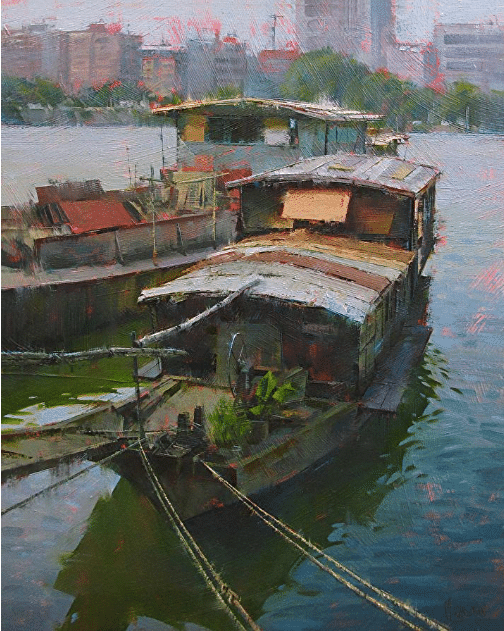
Jennifer leads you through this exact painting in her Streamline teaching video, “Painting with Style.”
To get better, intermediate painters (which I count as anyone with more than, say, a dozen or so canvases under their belt) must go beyond the beginners’ basics of composition and color mixing that confront everyone at the start. Go deeper and avoid the not-so-obvious gaffs we’re covering in this three-part series. Our first installment was Part 1.on brightening up your painting using value. This one, Part 2, is about making design and composition work for you by paying attention to shapes.
Level Up #2. Shapes
Thinking about your painting purely in terms of shapes helps distance you from the minutia so you can see the big picture and determine how well the composition is working on the larger scale.
Intermediate painters realize struggling with details too soon obscures the big, simple shapes on which the underlying composition depends. For beginners this is about getting foreground and background forms to work together as a whole.
For intermediates it goes beyond the division of space. Don’t worry until later about what individual things are “supposed to look like.” Can you make yourself stop thinking of your trees as trees (with branches and leaves and etc), or your clouds as clouds, or your figures as figures? Because what they are is shapes. Paintings are two-dimensional arrangements of colors and shapes!
Of course, “shapes” here means not the shapes of the things you’re painting, but the geometric forms they assume and, crucially, how they all fit together – that is, how the shapes relate to the space around them and to each other.
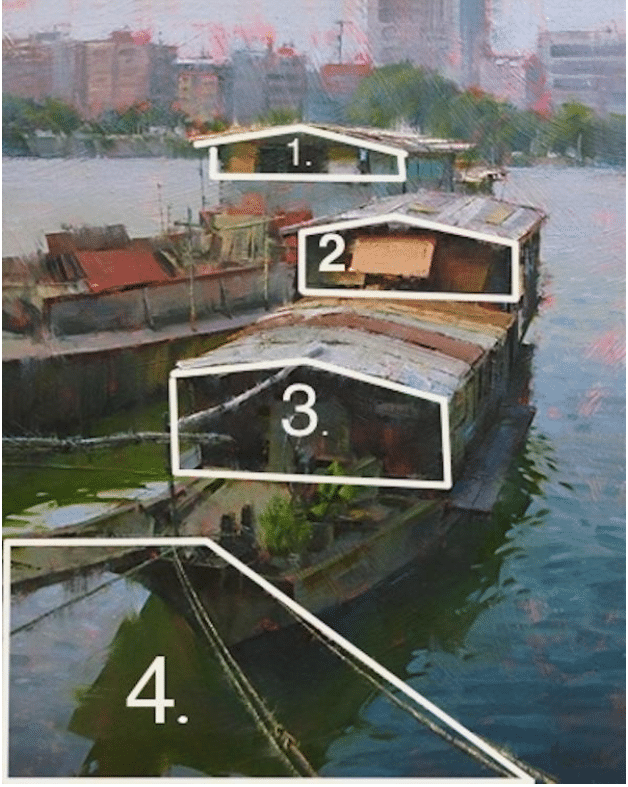
For a real world example, let’s look at the painting by Jennifer McChristian at the top of the page, titled “Catalyst.” There’s something very subtle and very interesting going on with the shapes in this painting.
 ‘
‘
McChristian has given us a series of triangles that recede into the painterly space. They’re numbered here in terms of size, but compositionally they move us back into the painting (strung in the order of 4-3-2-1) like a series of stepping stones. The largest shape, the one in the foreground, opens wide and narrows in, pointing to the next “rhymed” triangular shape, which leads to the next and to the next because the shapes, though diminishing in size, are basically the same.
It’s not intuitive for representational painters to do this. In fact, the only way to see this in your painting at all is to train yourself to see the things you’re painting NOT as the things they represent but only as shapes that relate to each other.
It’s just as important, if not more so, than training yourself to see and judge value apart from color. Of course, you also need to study the common qualities of successful compositions and designs to know what and what not to do with those shapes.
Here’s a figural painting by the same artist.
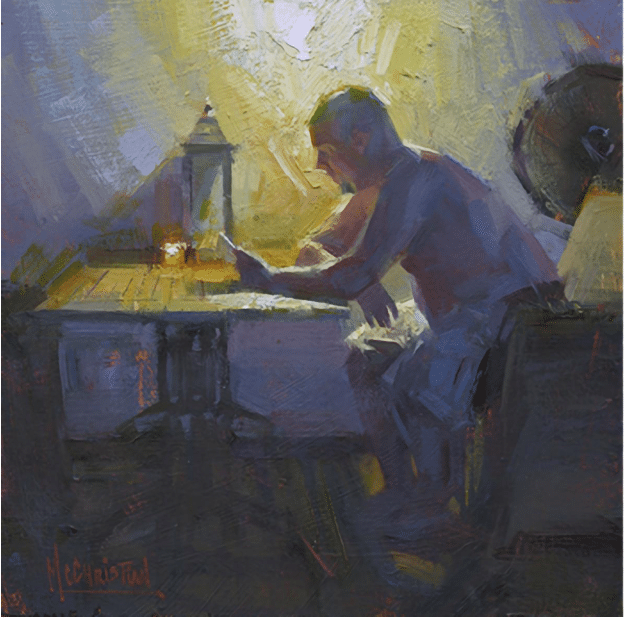
Jennifer McChristian, “Night Owl,” Oil on panel, 8 x 8 in.
Here’s how I’d break this down into shapes:
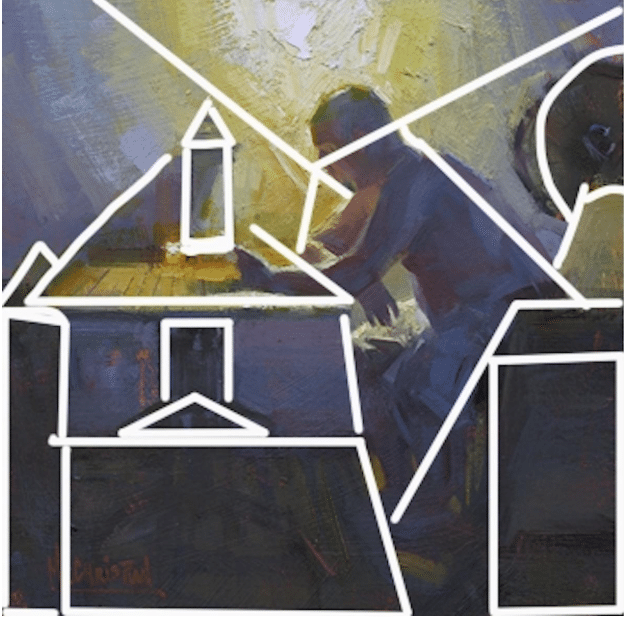
Looks complicated, but it’s mostly an arrangement of triangles and rectangles with some connecting lines that fit them all together like a jigsaw puzzle. Without such a strong and connected underlying design, this painting would cease to cohere – it would become a more or less random assortment of unrelated shapes. In short, it would fall apart. What we get here though is the opposite of that.
The diagonals of the upside-down triangle on top point downward, toward the center of the painting. The next largest shapes are the big rectangular shapes in the foreground, which form a kind of base for the smaller intervening shapes in the middle. McChristian interests the eye with a “visual rhyme” between the smaller repeated (or stacked) upright rectangles with small triangles attached to them. The whole thing “works” geometrically – that is, it adds up to a strongly coherent whole – because of how the artist relates all these shapes to each other.
Level up your own work by actively seeing your paintings not in terms of what they’re paintings of, but as arrangements of shapes that must hold everything together as they relate to each other.
Today’s post features two very well designed paintings by contemporary artist Jennifer McChristian. To learn her method step by step, check out her video, “Painting with Style.”