“James Abbott McNeill Whistler (1834–1903) was one of the most deliberately contentious, witty, and fiercely independent artists of his generation.” With this, the Carnegie Museum of Art opened a 2012 exhibition of works by Whistler by highlighting an aspect of the Victorian artist’s personality – his flamboyant, radical, iconoclastic flair – that, while seemingly absent from the tranquil, dreamy nocturnes he’s famous for, is nonetheless vital to understanding his work.
“America’s first great master of the night,” as he’s been called, Whistler’s “Nocturnes” haunt us still, for many reasons. As writer Adam Heardman sees it, the famous series changed America’s vision of itself forever.” Whistler’s nighttime views of the Thames at Battersea between 1870 and the mid-1880s, he wrote, “strongly capture the contemporary cloud of human feeling at the end of a long century, and the shivering mix of excitement and fear with which Western humans moved into the modern technological age. Because your vision is veiled at night, it is equal parts “fraught with danger” and “rich with possibility.” Whistler understood this deeply.
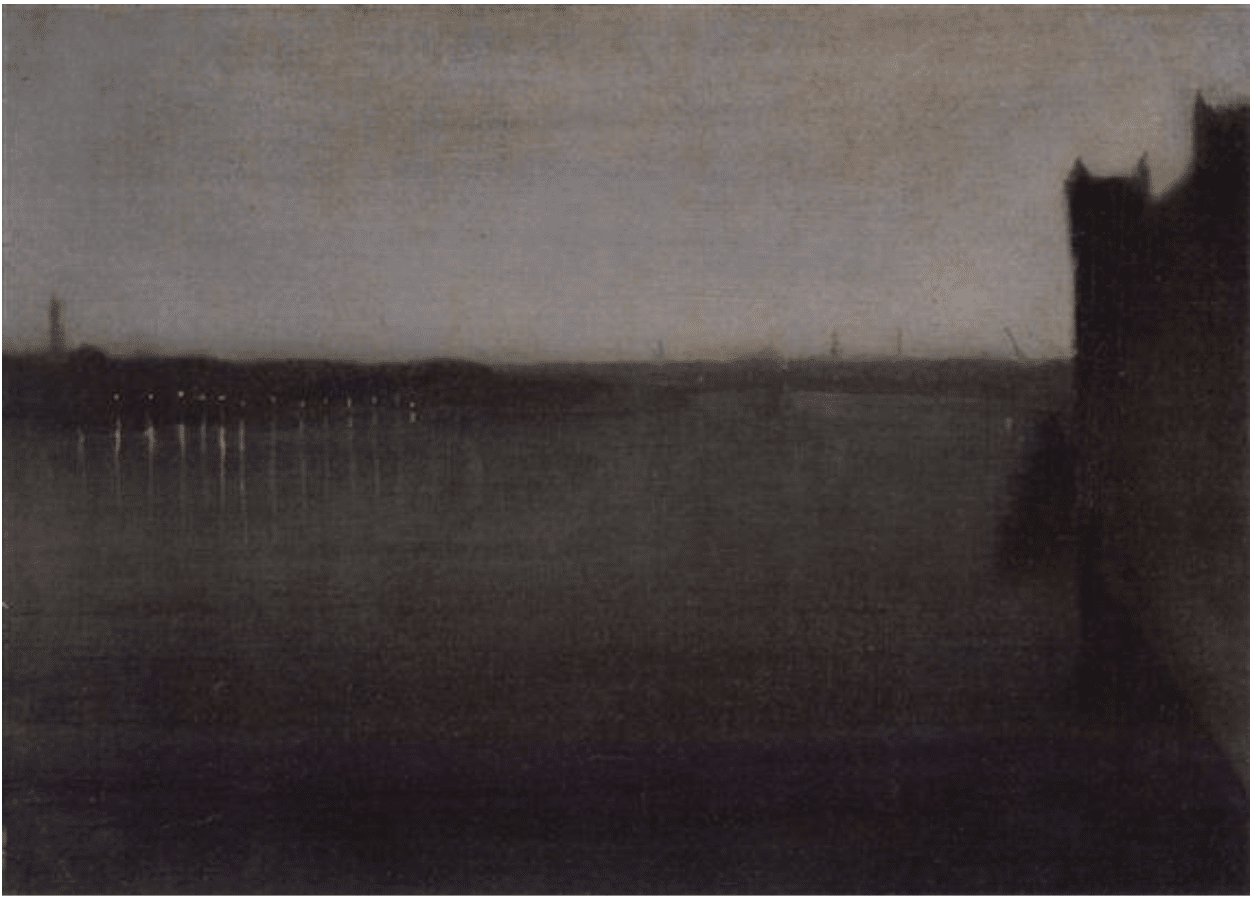
James McNeill Whistler, Nocturne in Grey and Gold, Westminster Bridge (1871-1874)
Perhaps the reason his work doesn’t look iconoclastic to us now is that we’re used to seeing and understanding work by artists in the several genres and movements his work helped to create – notably the nocturne and even Impressionism, which wasn’t born officially until 1874.
Whistler invented the “nocturne” as such, a title borrowed from the Romantic piano meditations of Chopin. The first to adopt musical terms for his titles – arrangements, symphonies, harmonies, compositions – in 1872 he defined painting as “the exact correlative of music, as vague, as purely emotional, as released from all functions of representation.”
He was echoing influential essayist and art critic Walter Pater (sometime mentor/associate of Oscar Wilde’s), who famously said, “all art constantly aspires to the condition of music.” The idea was that art didn’t have to be religious or morally uplifting or even strongly representational so long as it has its own internal drive toward beauty and meaning.
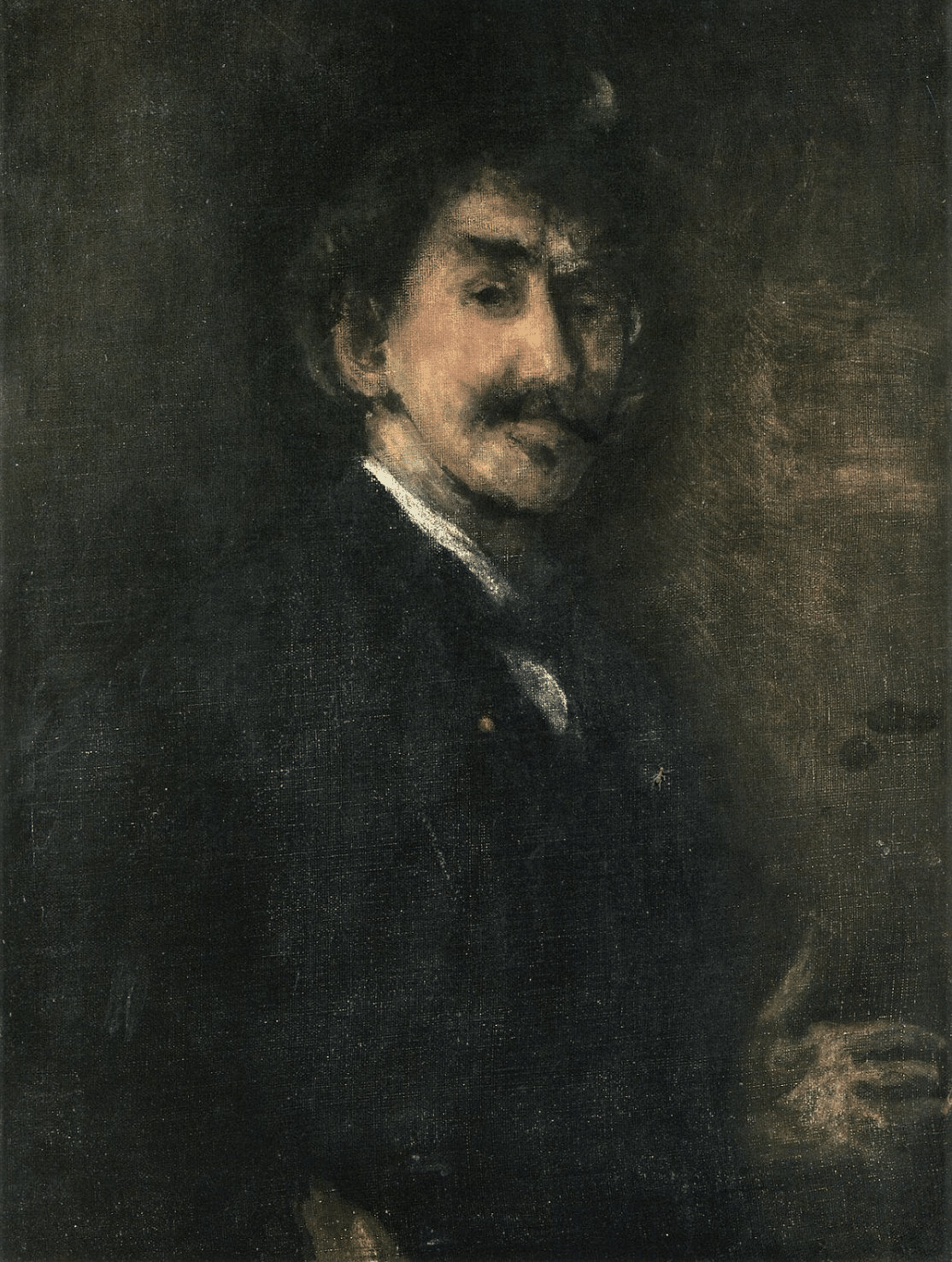
James MacNeill Whistler, Gold and Brown – Self Portrait, oil on canvas, 18 x 24 in., 1896-1898
Whistler cultivated a public image of himself as a “flamboyant Bohemian,” as his mother put it. “Charming, combative, and convinced of his own genius,” as the Terra Foundation for American art put it, “Whistler was a flamboyant and even outrageous personality, as provocative as his art. Born in Lowell, Mass., he was the elegant, expatriate bull-in-the-Victorian-China-shop of European classicism. “As a link between European and American art worlds,” Terra says, “he laid the foundations for modernism in his art and writings.”
As one of the nineteenth century’s most innovative, influential, and controversial artists, Whistler’s work inaugurated a new paradigm of art and experience. In his paintings and hundreds of etchings and other prints, we see feeling transmuted through an amalgam of classical training, knowledge of art history, imagination, reinvention, and improvisation. It all added up to a very un-Victorian and liberated version of life. As English critic Walter Pater wrote in a movement-defining paragraph, we only live once: “we have an interval,” Pater wrote, “and then our place knows us no more.” Why not spend it “in art and song”?
“For our one chance lies in expanding that interval, in getting as many pulsations as possible into the given time. Great passions may give us this quickened sense of life, ecstasy and sorrow of love … the poetic passion, the desire of beauty, the love of art for art’s sake…. for art comes to you professing frankly to give nothing but the highest quality to your moments as they pass, and simply for those moments’ sake.” ― Walter Pater
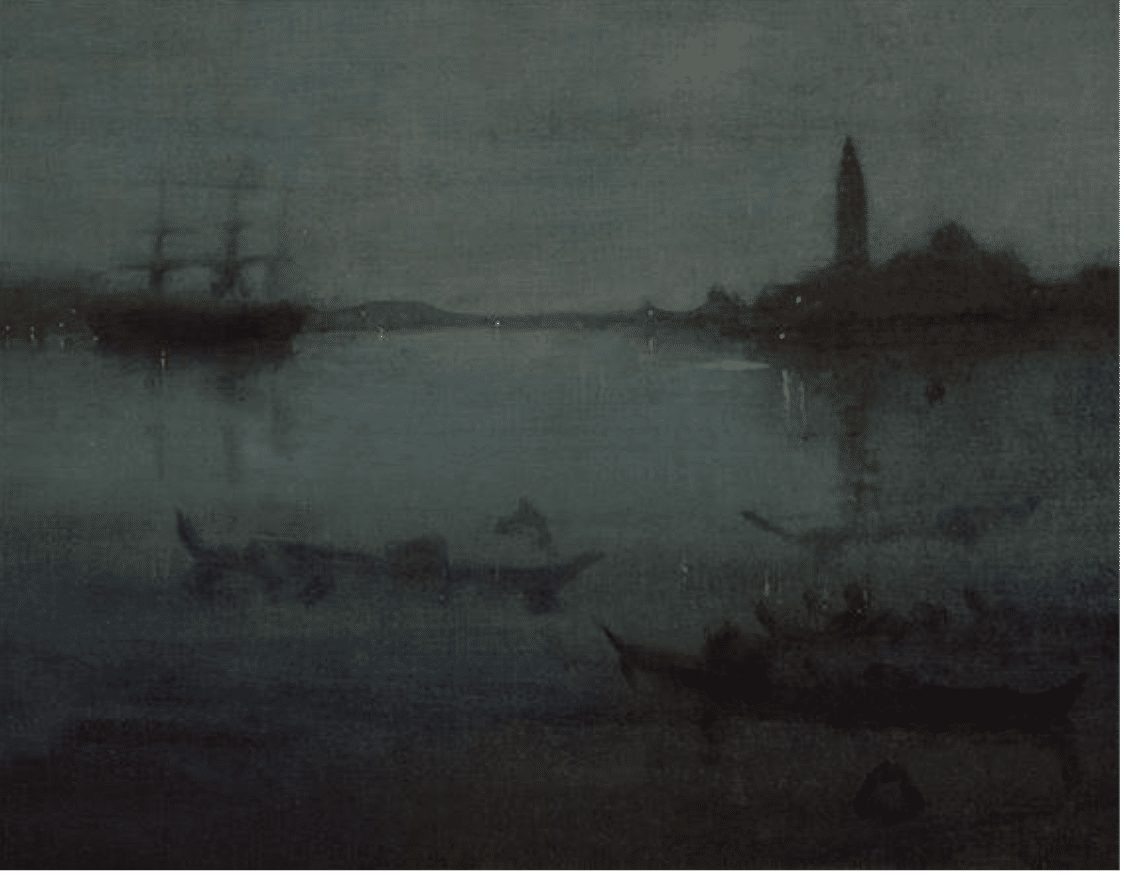
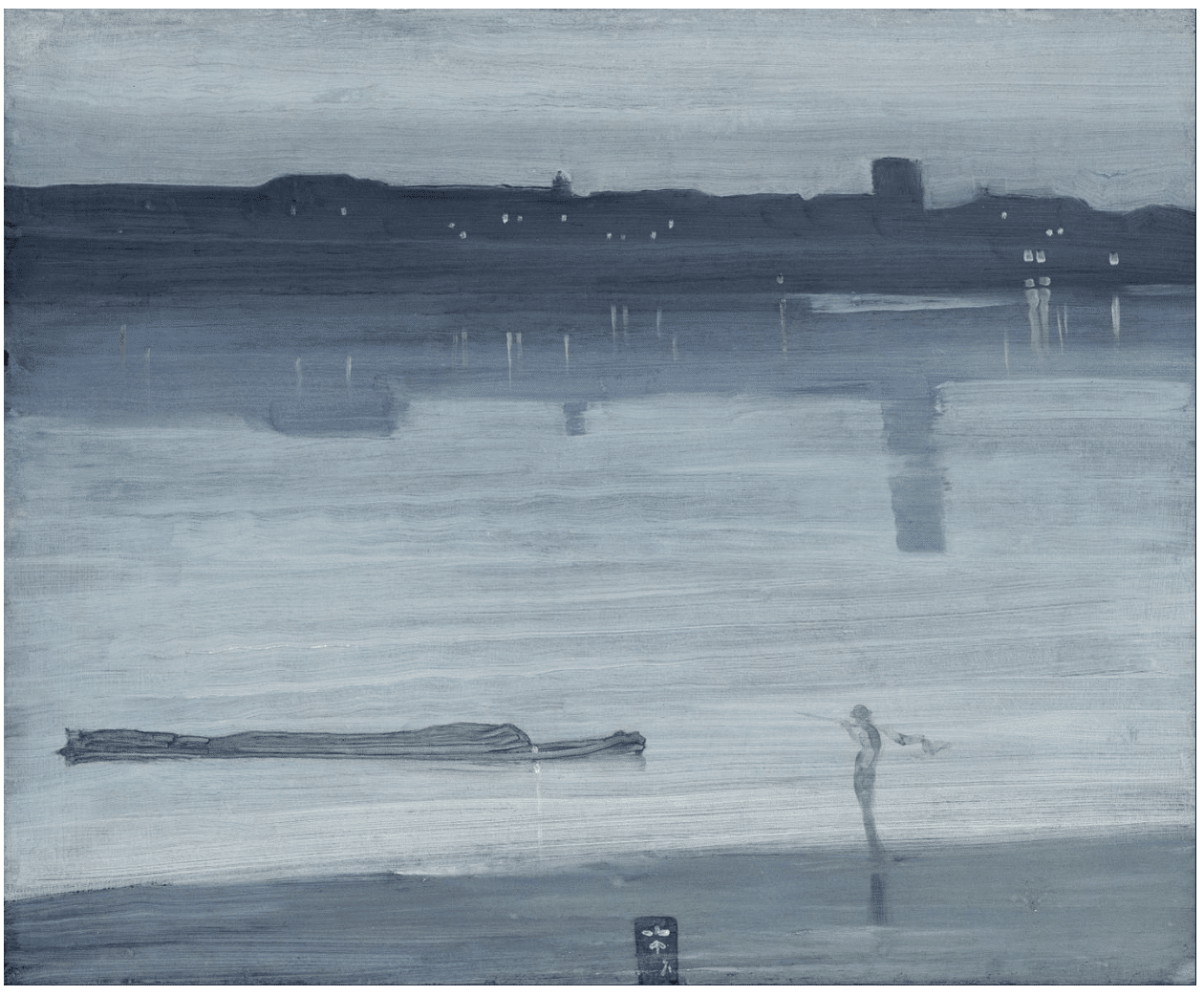
James McNeill Whistler, Nocturne in Blue and Silver, The Lagoon, Venice (1879-1880)
As to how it that was to be done, Whistler invented a new technique learned from studying Japanese watercolors and ink paintings.
“Paint should not be applied thick,” Whistler once said. “It should be like breath on the surface of a pane of glass.” Through applications of “veils” of paint, Whistler created his deceptively simple canvases that yet convey “images of shimmering transience, visions suggested rather than delineated,” in the words of the curators at the Clark Art Institute in Williamstown, Mass.
In his influential “Ten O’Clock” lecture of 1885:
Nature contains the elements, in color and form, of all pictures, as the keyboard contains the notes of all music … the artist is born to pick and choose… as the musician gathers his notes, and forms his chords, until he brings forth from chaos glorious harmony.”
“By using the word ‘nocturne,’” Whistler later explained, “I wished to indicate an artistic interest alone, divesting the picture of any outside anecdotal interest which might have been otherwise attached to it. A nocturne is an arrangement of line, form, and color first.”
(Sidenote on the artist’s role in “gathering his notes, and forming his chords”: It’s still said in some advanced painting workshops, perhaps controversially: “Pay more attention to what’s happening on your easel than what you’re looking at ‘out there’.” One way to think of this is once the technical skills are in place, one is free to engage feeling and imagination. In other words, the artist is free to depart from copying the thing seen so as to render it using his or her “vision” of it, meaning not eyesight but a felt idea compounded of observation, imagination, memory, and the desire for meaningful expression.)
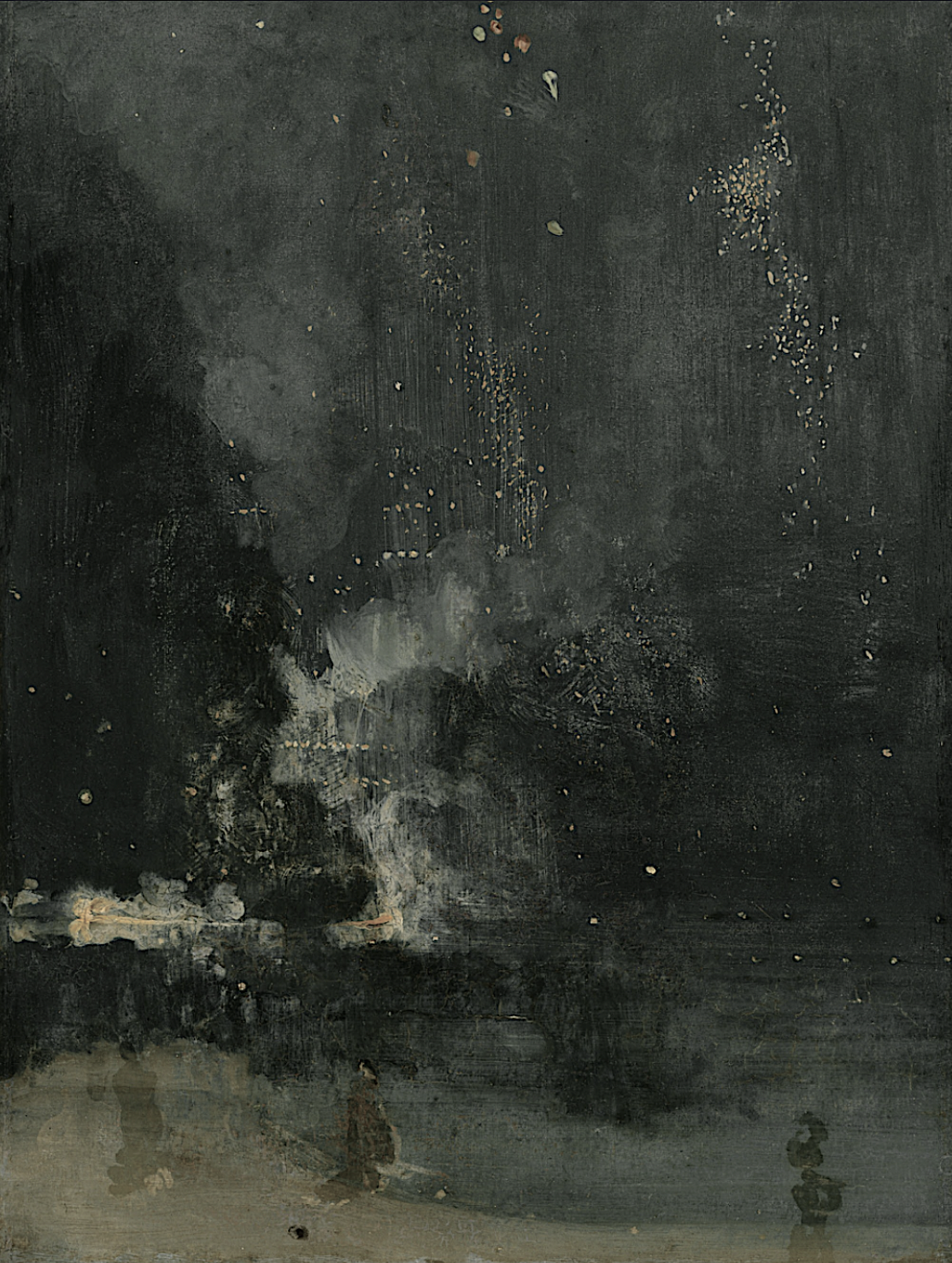
James MacNeill Whistler, Nocturne in Black and Gold – the Falling Rocket, 1875, oil on board, 36 x 60 cm., Detroit Institute of Arts, Detroit, MI. Source
In Part 2, we’ll look at Whistler’s “The Falling Rocket” above and dig in to why it became Exhibit A in the most sensational art trial in modern history.
By the way, the title of this piece and the best source for Whistler’s importance and technical methods, as well as those of the Tonalists who followed him, is the book, Like Breath on Glass, Whistler, Inness, and the Art of Painting Softly.
If you are a fan of the nocturne, the genre that Whistler inspired, consider checking out a couple relevant teaching videos, including Carl Bretzke’s “
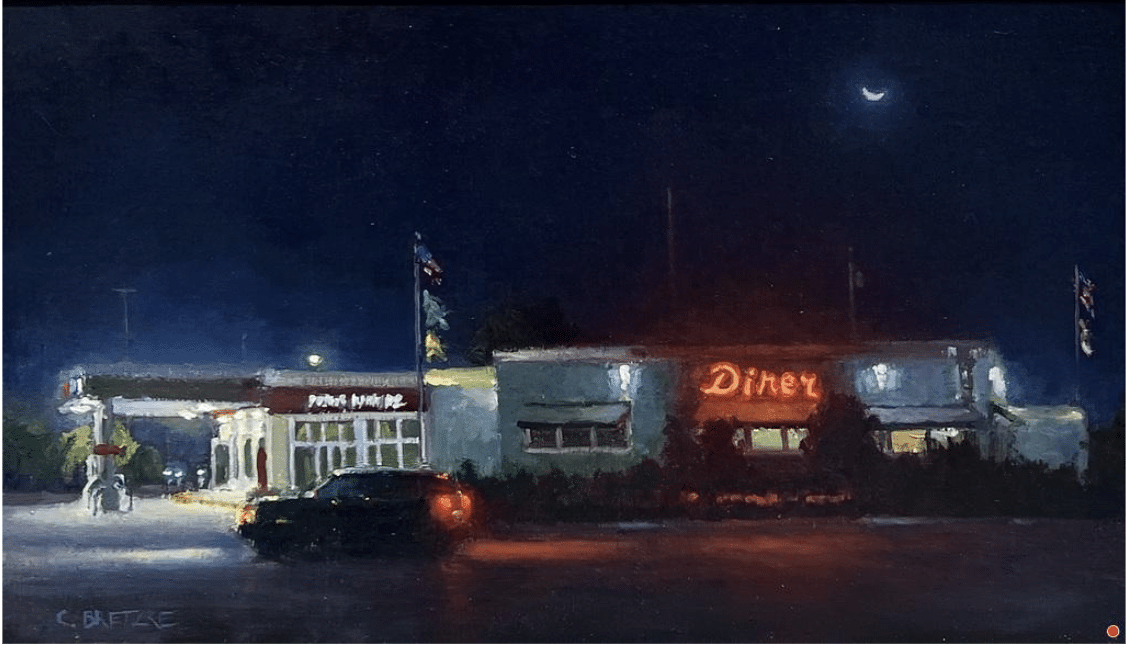
Carl Bretzke, “Diner after Dark (Lighthouse Plein Air 2025,” Oil, 12 x 20 in.
”