“Art does not reproduce the visible, rather, it makes visible.”
– Paul Klee
Art and artists live in two worlds, a visible one and an invisible one. Art makes invisible visible.
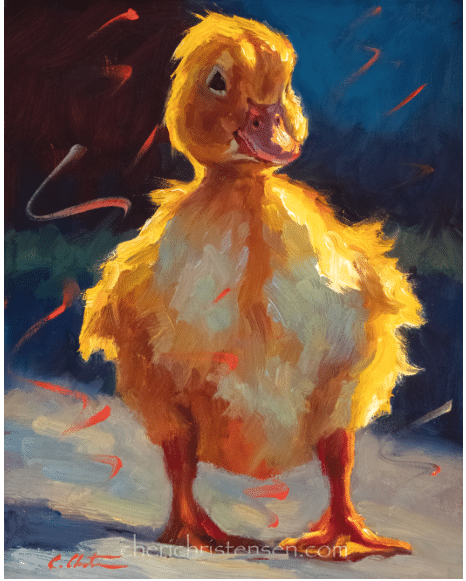
When an imaginative artist paints a duckling, she isn’t just accurately depicting a wild animal. Rather, she’s making visible a whole world of the mind and heart. Take two of Cheri Christensen’s oil paintings of ducklings, “Feathered Whimsy” and “Beyond the Water’s Edge.”
“Feathered Whimsy” (top of the page) makes visible the quality referred to in the title, whimsy, a sense of the playful and maybe something slightly surprising, a little unpredictable. It’s partly the little duckling’s expression but it doesn’t stop there.
It’s in the pigeon-toed feet, the plucky alertness and off-kilter energy, magnified by the movement in the brushwork, the hot-orange squiggles surrounding and flying around the critter, the frizzy, tousled plumage, the unstable gait. A painting like this happens only with “artistic license.” The result is an eye-catching painting that’s fresh, playful, and charming.
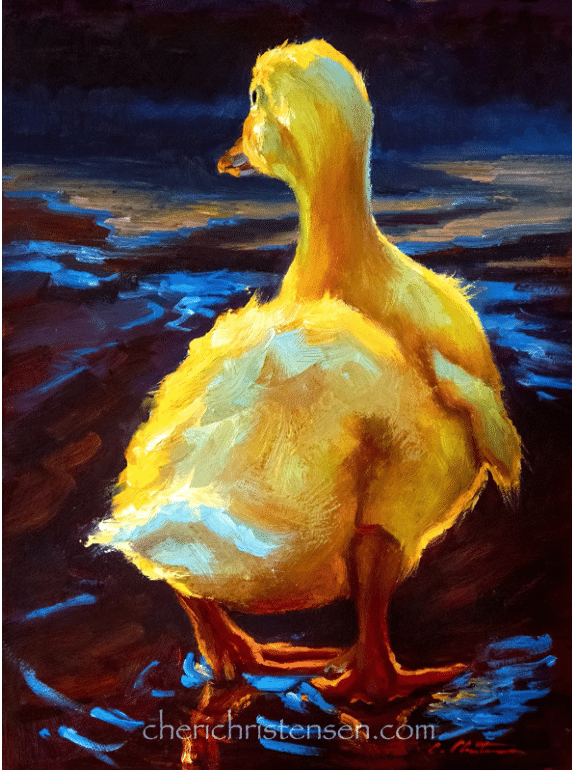
Cheri Christensen, Beyond the Water’s Edge ‐ oil, 10 x 8 in.
Changing gears a little, we find a similar inventiveness in Christensen’s painting, “Beyond the Water’s Edge,” (above) though the feeling in this one is different. Here, our protagonist, the backlit yellow duckling, wades into dark water beneath an even darker sky. Presumably it’s night, and our little guy is facing the shadowy unknown, alone, as every young life must someday do.
Cheri teaches her technique in her video, “Brushwork and Backlight”.
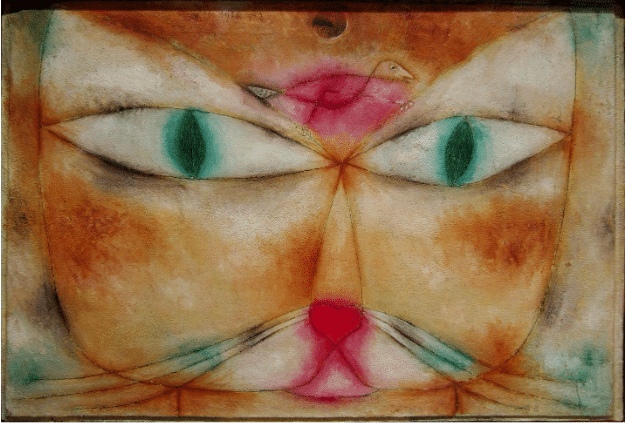
Paul Klee, Cat and Bird, oil and ink on wood, 38.1 cm × 53.2 cm (15.0 in × 20.9 in), MoMA. Klee wanted to let simple lines, shapes, and colors work for themselves.
When Klee wrote “Art does not reproduce the visible, rather, it makes visible” around 1920, artists were becoming interested in expressing their thoughts and feelings about a subject rather than accurately reproducing it. Most good art mixes both.
Modern artists like Klee look for the “truth.” Klee, who was a theorist and published a famous treatise on modern art, was also aware of a very simple principle: meaning is not in appearances – it’s in how we perceive and what we do with them.
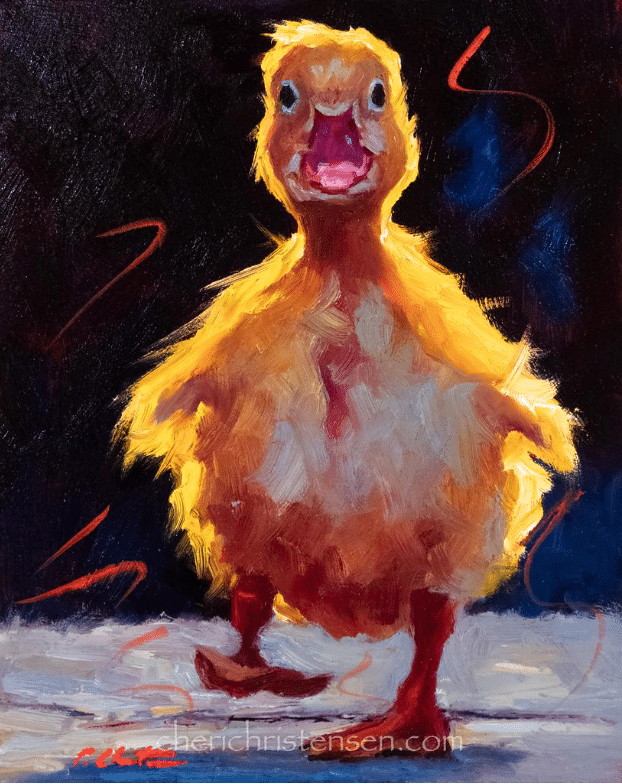
Cheri Christensen, Quirky Quack, oil, 10 x 8 in.
In the Off-Chance You Didn’t Know About These Art Scam Emails
We all know that art scam emails have been around since email became a thing in the 1990s, when I was in college and the biggest inconvenience in this regard was getting paper junk mail. Now, of course, we have to be diligent. In the fifteen years or so that I’ve been an Online Editor for the arts, I’ve seen various scams targeting artists, which I then share with you to keep you, your money, and your art safe.
Just recently I received yet another spammy email, which tells me that some artists are still falling for them because otherwise, the scammers would move on to a different method. We saw this recently with the false text messages about drivers owing money for highway tolls. The news reported that so many innocent people were continuing to receive these because there were enough people falling for it.
So I’m sharing this now, not for the first time and not for the last time, I’m sure. The following is a screenshot of the most recent art scam email I received, with the indicators highlighted:
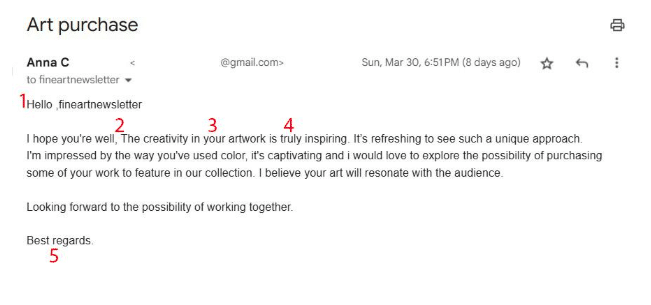
- The punctuation is wrong in the greeting, and they used “fineartnewsletter” as my name.
- Another punctuation error (more to come, but I’ll stop pointing them out – you get it by now).
- I can tell this is spam because they’re complimenting my artwork, when I’m never the artist featured here. (My art is writing, hence my career here as a writer / editor.)
- Which leads us to the highly complimentary nature of the email. These are usually over the top with their praise, so don’t let your ego be stroked to the point that you fail to question the source.
- No signature, only “Best regards.”
I removed the sender’s last name and email address just in case they used the real name of an innocent person and somehow spoofed* an email address.
*What is email spoofing? It’s when a scammer makes it look like an email is coming from a legitimate address, when it’s really not.
What should you do when you receive art scam emails? Block the sender and delete the email. Take it a step further by sharing a screenshot of it on social media to warn your friends.
Discover more art business advice with these free articles at RealismToday.com.