By GUEST CONTRIBUTOR Julie Gilbert Pollard
I’m always looking to loosen-up my painting technique – and because splatter is so random-looking it lends itself nicely to that goal. Sometimes, however, it is TOO random and goes everywhere, not necessarily where we want it to go. There are ways to splatter that are less out of control than others and we can even use stencils to curb its enthusiasm. These methods, however, can sometimes take away from the random spontaneous appearance and look contrived. Because I like to splatter in an intuitive manner and still have it land where I intend, I continue to practice my splattering skills even though I’ve been doing it for years.
Because the paint has to leave the brush and fly through the air to its intended landing place, I call it “target practice”.
For the splatter target practice lesson I present in classes and workshops, I have the participants first sketch 3 targets, each with a bull’s eye of course. We now switch from thinking “target” to “white donut,” and we have to keep that donut white. We are working with “transparent” watercolor, so we don’t paint the donut, we paint everything BUT the donut, giving the edges of the shapes of the donut hole and the surface upon which the donut rests a splattered edge. No worries if the donut has some “sprinkles” – as long as the donut shape is made evident by the shapes and value contrast that define it.
Now to define the shape of that donut.
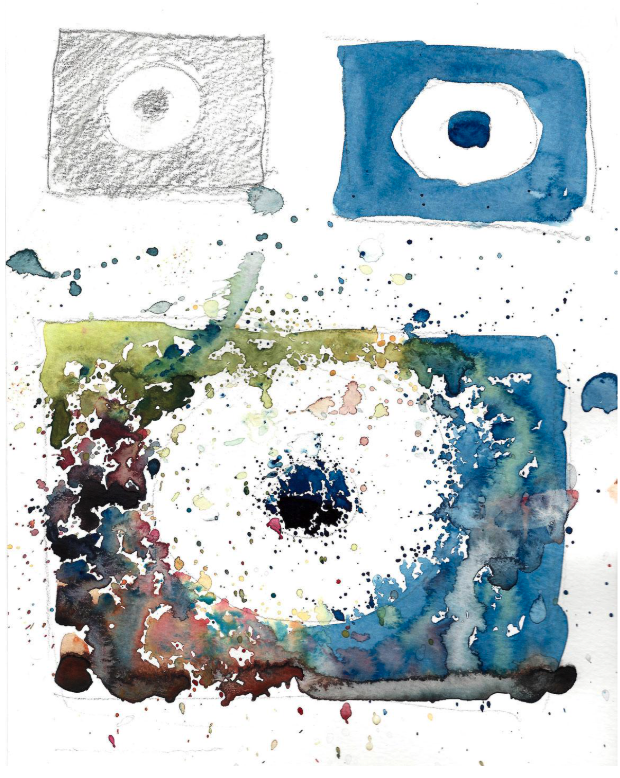
Because the paint must leave the brush and fly through the air before landing on the paper, I call this study TARGET PRACTICE!
First, we use pencil only. We have used a pencil for so many years that it is a familiar tool – and the target shapes are so simple that we begin without anxiety.
Next, I have them paint the second target with one dark color. As you can see, we are working our way gently toward the more anxiety-producing brush and paint, not to mention an unfamiliar brushwork method.
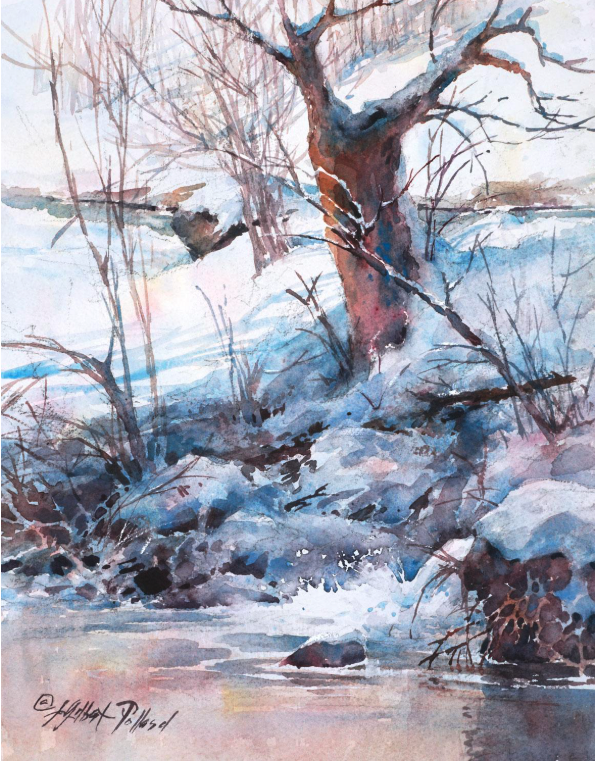
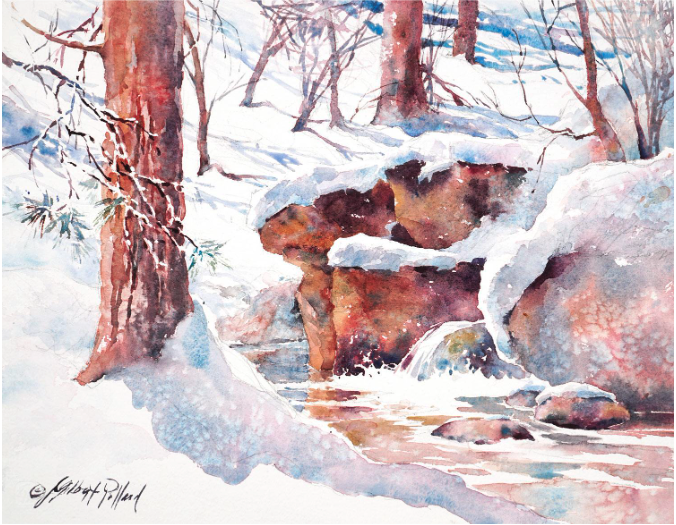
Julie Gilbert Pollard, “Frosty Oak Creek,” 14×11 in. watercolor (negative splatter was used for the whitewater)
Now for the splattered target! We use the same dark color already on our palette and now we begin to splatter away. Until one gets the hang of it, the splatters are truly wild. But we get there eventually the same way we would get to Carnegie Hall!
I have them begin splattering with one color only – usually a dark blue for good value contrast between the donut and the areas around the donut. After demonstrating the various methods, which include pulling the paint puddles together to help create the desired negative shapes, I add color.
There is method to this “madness”. When introduced to a new idea for putting paint onto the paper, thinking in negative shapes, unfamiliar brushwork technique, and then adding color to the mix, one can find this to be brain-taxing. So, I have them creep up on the idea, first through the pencil, then paint, then splatter, then color, etc., as described.
This is negative painting using splatter to give the edge of the shape a “lacy” appearance. When using this technique to indicate white water splashing in front of a rock the water is the white donut. Just a different shape.
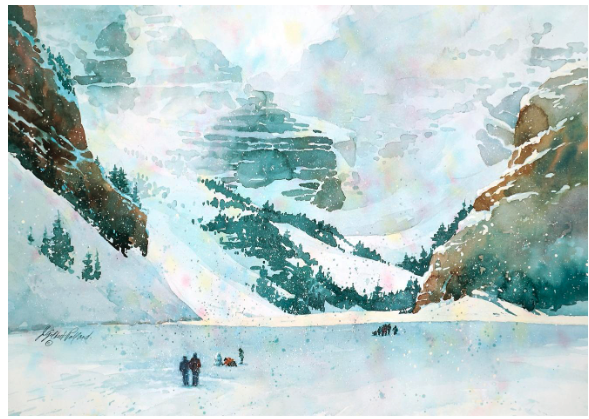
Julie Gilbert Pollard, “Sun & Snow on Lake Louise.” 15×21 watercolor (for this painting, however, positive splatter rather than negative splatter was used for the falling snow and primary color prismatic underpainting)
Tools: I recommend a brush that holds a lot of liquid, and not one that is too stiff nor too floppy. It might be hard to find one that is “just right”. I advise finding 2 or 3 in your brush assortment that more-or-less seem like they would be right for the job. I use a #8 round sable. But I splattered for years before acquiring sable brushes. So it isn’t necessary to have a sable brush.
What you DO need to do is to try out a couple, pick the best of those, then practice with THAT brush. You need to train yourself on that particular tool. I once had a student who said she wanted me to train her brush for her!
Julie Gilbert Pollard teaches her watercolor and acrylic techniques in five different professional instructional videos, all of which are available here.