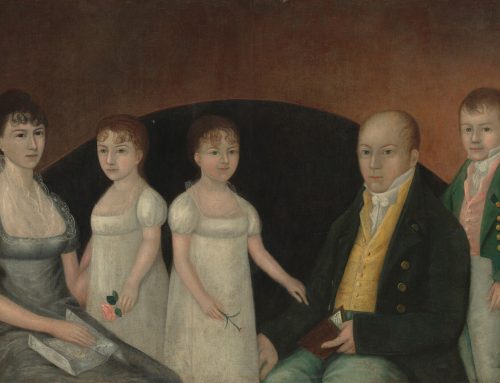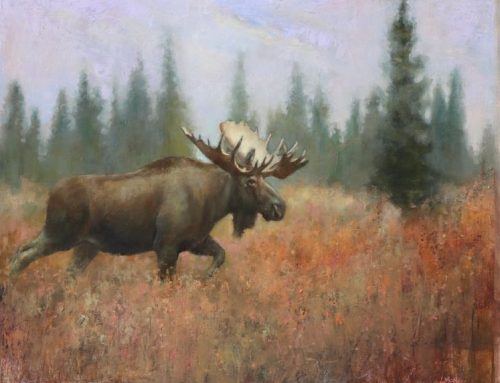
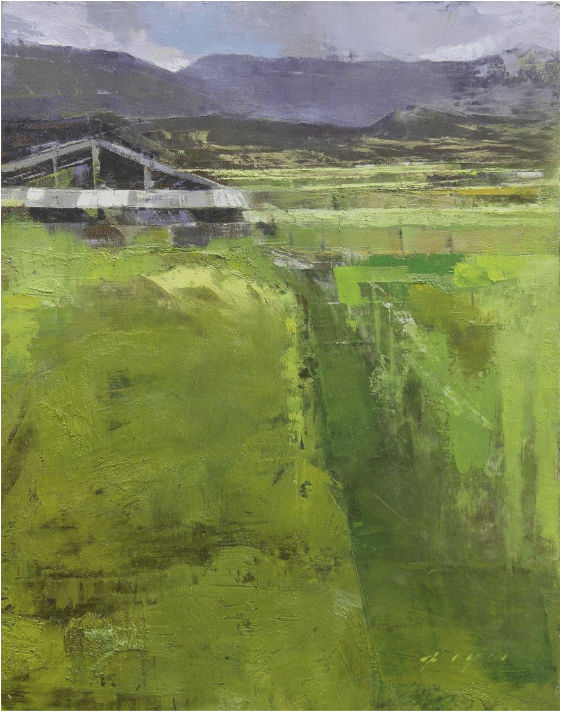
How does he do it? Well, sometimes he trades a brush for a squeegee. Learn how from his instructional video, Painting with Intuition.
“Loose as ashes,” a friend of mine, Don Oulette used to say. That’s how he described paintings done in big, breezy brush strokes that convey a sense of spontaneity, freedom, and ease of technique.
If looser painting is on your to-do list, here’ a little piece of advice: “Swing a bigger brush – you don’t know what fun you are missing.”
So wrote Charles Hawthorne in a little gem of a book that should be on every painter’s shelf, “Hawthorne on Painting.”
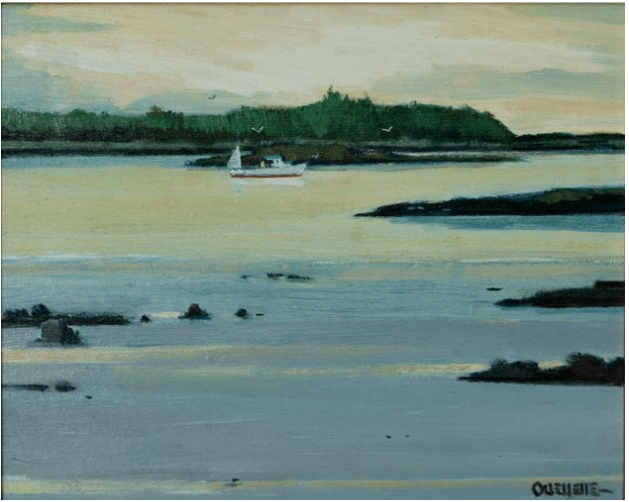
Don Oulette, Pulling Traps, 8 x 10 in., oil.
But be careful what you wish for! Many an artist yearning to be freer rejects their looser work out of hand for its supposed inelegance, inaccuracies, and apparent evidence of insufficient skill.
There’s a little bit of a “grass is greener” thing going on here: What looks to you like a painting done by a someone else that does so much in a few dashing strokes, looks, when it’s on their own easel, like “something a little kid would do.”
It may just be a matter of degrees – perhaps you just need to dial back the madness a notch. When you look closely at a painting by Sargent, you see it’s both airy and seemingly loose and causal AND it’s tight where it needs to be – as in the portrait below, where the sitter’s face is sharply in focus and everything else is more or less a brushy blur. But still, if you want a pet tiger, you must accept that it really is a wild animal.
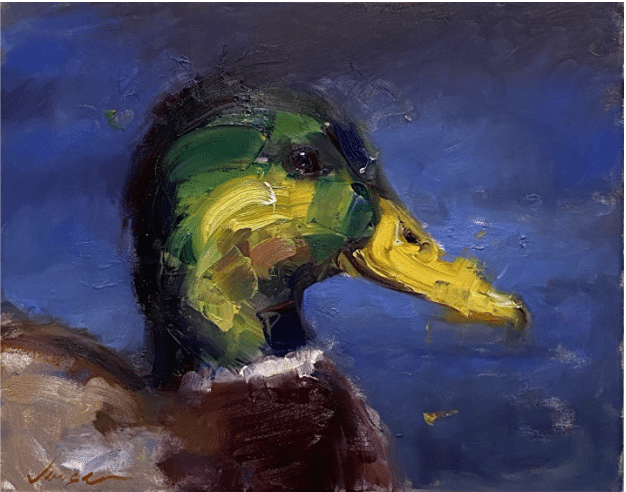
Ryan Jensen, Mallard, 16 x 20 in., oil on canvas. Ryan Jensen teaches his techniques for painting loosely in his video, Loosen Up your Paintings
For many artists, the first and most important step to a looser style is a mental one. Our “left brains” like things neat, planned out, painted by the rules and colored between the lines. Painting loosely requires not being perfect and being willing to let go and to play.
In practical terms, loose painting asks you to distance yourself from the surface of your painting and let the paint be the paint. That means letting go of “getting it right” – to whatever degree you can stand, anyway.
Technically, this comes down to trying just three or four things (BESIDES CONFIDENCE!):
- Use A BIGGER brush and load it big with MORE PAINT – the more you do, the less perfectionism will hold you back. Put out more paint than you need, cost be damned, just this once. And don’t just dab into it – scoop it up onto the side of the brush (instead of the tip).
- Put it on and leave it on – tilt the brush sidewise, nearly parallel to the canvas, and gently pull the stroke, twirling the brush handle, feeling the paint leaving the bristles and joining the canvas.
- Mix carefully on the palette, not the canvas – give yourself one or at most two strokes per brush-load – if it looks wrong, scrape it off and go back and mix a better color-value – but in any case, put it on and leave it on (don’t fuss with it) or keep trying to make it work in vain (it won’t).
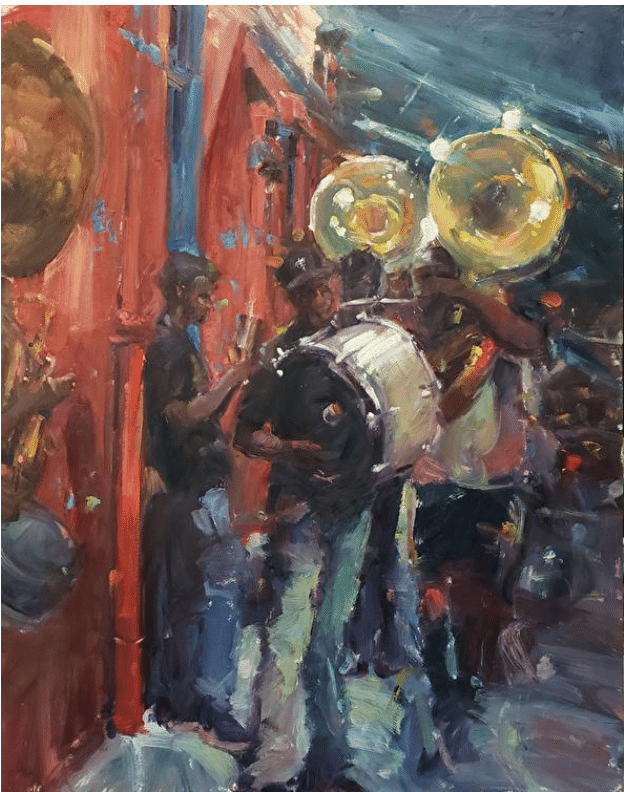
Robin Cheers, Frenchman St. Brass Band, 20 x 16 in., oil on panel=. Robin Cheers teaches her loose painting technique in the video Brushwork Secrets Unleashed
A big brush keeps you from getting too fussy too soon. “It is the large spot of color that tells the story,” Hawthorne says. “Make the big tone and make it true…Don’t look up at nature and consider an inch at a time.”
Working small and working with a big brush forces you to simplify, which is something every painter must learn to some extent. In painting, unless you’re a hyperrealist, detail is beside the point; making a strong, readable statement with a unified field of expressive shapes and colors is the goal.
Hawthorne believed that “painting big” is akin to “seeing big” (aka “seeing like an artist”) and can help you put more of yourself into the work. “The big painter is one who looks and does, the little painter is always tickling with a camel’s hair brush,” Hawthorne says. “My plea is for something big and fine and honest.”
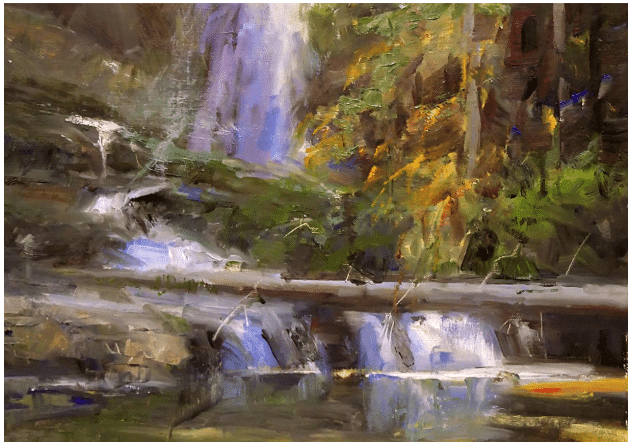
SPOTS OF COLOR: Howard Friedland, Virginia Falls Revisited (detail).
Howard Friedland is the painter of “Virgina Falls Revisited” a detail of which is shown above. One could say that Friedland’s method, and Robin Cheers’ too, lines up with Woodbury’s “spots of color” approach. Friedland has a video in which he applies his method in painting a waterfall, which you can check out here.
Big brushes help you get there by freeing you from trying to “get it right.” Giving yourself the freedom to throw some paint around is a wonderful way to connect what you’re doing on the canvas not just what you’re seeing (or think you are) but with what you’re feeling, which nearly any successful painter who’s been at it a while will tell you is what it’s all about.