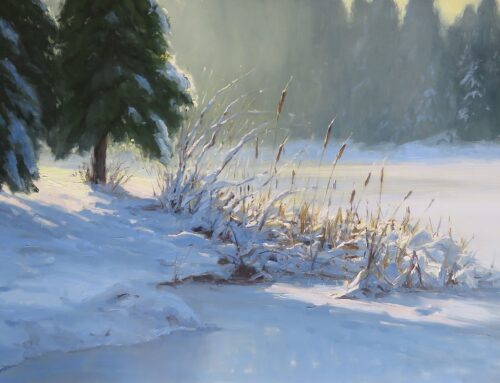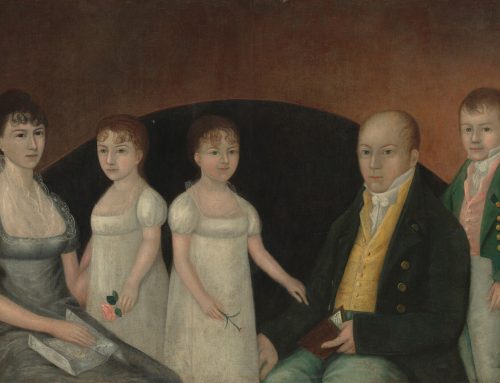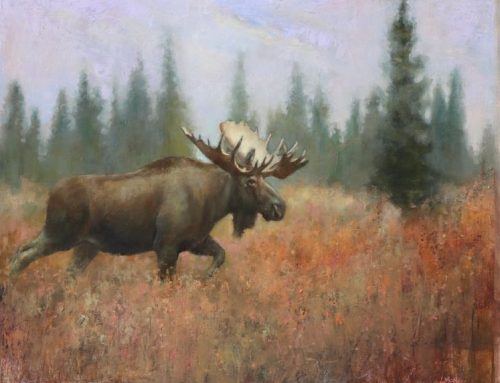
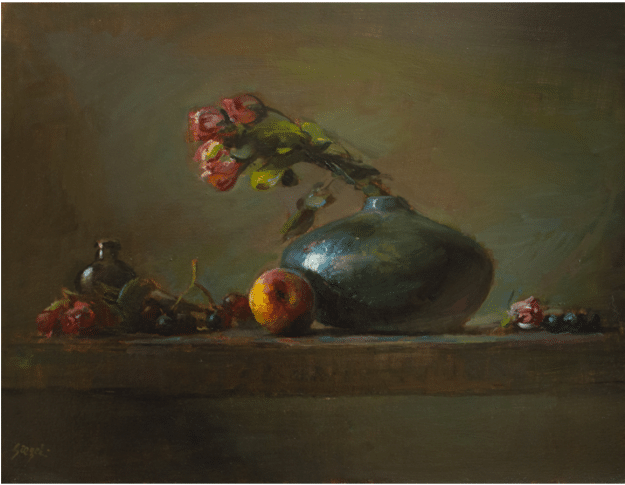
Some artists create paintings that are like love letters to the visible world. Maybe it happens like this: The creative imagination receives a gift from nature in the shape of an apple, a bowl, a careworn brow, a wave. And the artist responds with a gift in turn, with his or her own visible declaration of love.
“When we are in love with someone or something, there is no separation between ourselves and the person or thing we love,” says Buddhist teacher Thich Nhat Han. “We do whatever we can for them, and this brings us great joy and nourishment….That is the relationship each of us must have with the Earth if the Earth is to survive, and if we are to survive as well.”
We long for connection to the Earth, he writes. Along the same lines, connecting to a place, a person, or a beautiful object – “seeing like an artist” perhaps – is a sort of involuntary act of radical attention: we notice something, unexpectedly, with a leap of the heart and a feeling not unlike making eye contact across a crowded room. We really see.
True vision: Beyond observation or accuracy, seeing with the heart as much as they eye. The radical act of attention becomes an act of connection; the separation between “subject” and “object” dissolves, there is a brief merging of being and world, a moment in which we can no longer “tell the dancer from the dance.”
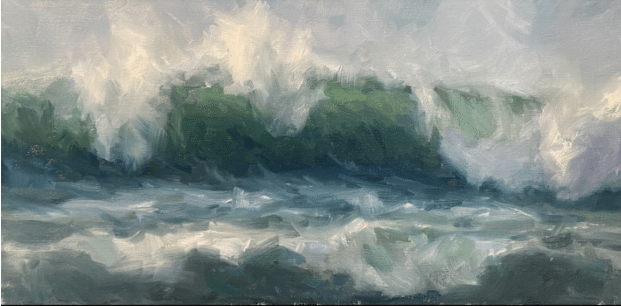
Scott Hamill, “Ocean Energy,” Oil on canvas, 12 x 24 in.
“There was a child went forth every day,” writes Walt Whitman in Leaves of Grass. “And the first object he looked upon and received with wonder or pity or love or dread, that object he became.” Whitman’s child meets the world with fresh eyes every morning. The child’s clear mind allows it to bond with the world with unguarded imagination and feeling. “That is the meaning of love: to be as one,” says Thich Nhat Hanh. What would it be like to paint from that place?
“What is the reason that humans love nature so much?” When someone posted this question on a Web site forum, people answered with a wonderful assortment of possibilities, a few of them quite poetic.
“A human might give you happiness at times, but he or she cannot give you happiness every time. But if you are friends with nature, it will never disappoint you. It will give you happiness every single time. By its sunshine, its sun sets, its birds, its animals, its waters, its clouds, its rains, its lakes, its sea, its mountains, its hues, its shades, its nights and its days.”
Another wrote, “it’s because nature represents life and love, It is the beauty and the purpose that we all see. We have a sense of calm when we are enjoying nature. It is an open invitation to see for yourself how it represents the growing and cycle of life.”
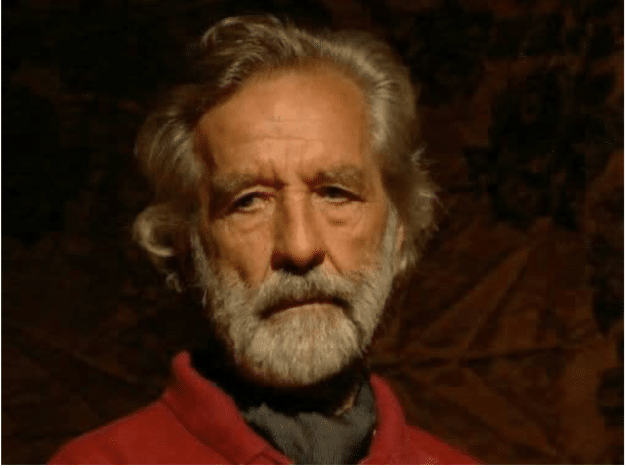
Richard Schmid, “The Captain,” oil on canvas.
“It’s hardwired into us,” offered another, and if we allow it, jt washes over us completely. “That feeling of tranquility that emerges to the surface when you’re surrounded by various shades of green. The constant anxiety that suddenly disappears when you’re listening to the sound of a waterfall, or a creek. Or how about the stimulation of cold, fresh air as it travels through your nostrils and into your body? These are universal experiences that all humans can relate to while in nature. That is the effect that takes place when one steps away from a man-made environment, and steps into the natural world.”
Artists are people willing to “step away from a man-made environment, and step into the natural world.” Will we, as a society, figure out at last how to build a more beautiful world, the one we know in our hearts is possible? “Real change will happen only when we fall in love with our planet,” says Thich Nhat Hanh. “Only love can show us how to live in harmony with nature and with each other.”
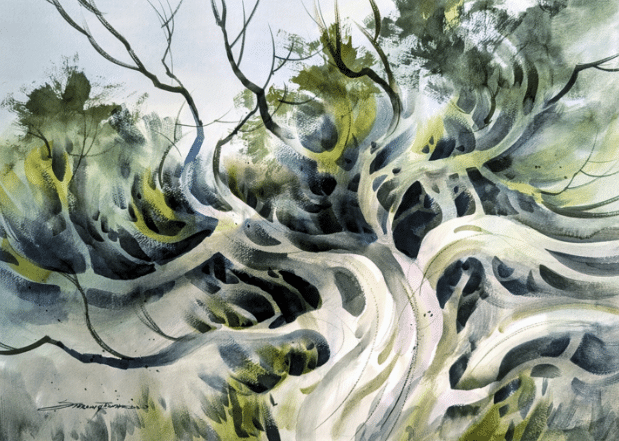
Sterling Edwards, “A Tree Grows in Utah … Untamed,” watercolor on paper, 22 x 30
If any of the four paintings in this edition interested you, consider these teaching videos by the artists: The Essence of Still Life, with Michael Siegel; Crashing Waves and Bold Strokes – Dynamic Seascapes in Oil with Scott Hamill; The Captain’ss Portrait with Richard Schmid or Spring Landscape, Luminous Watercolor with Sterling Edwards.