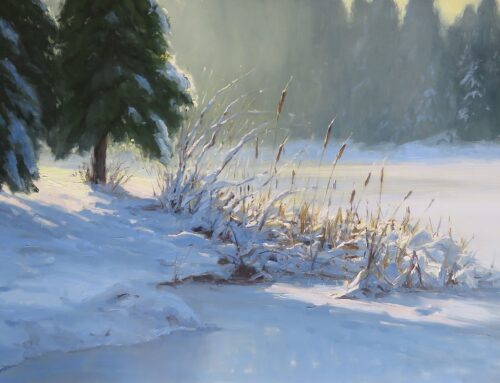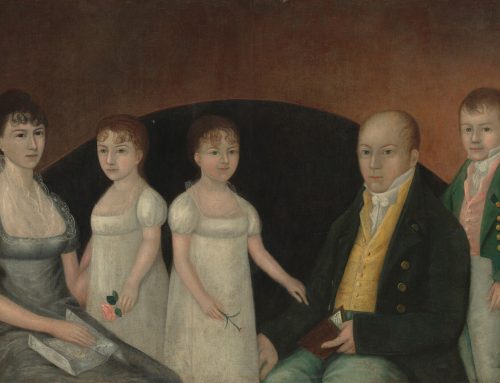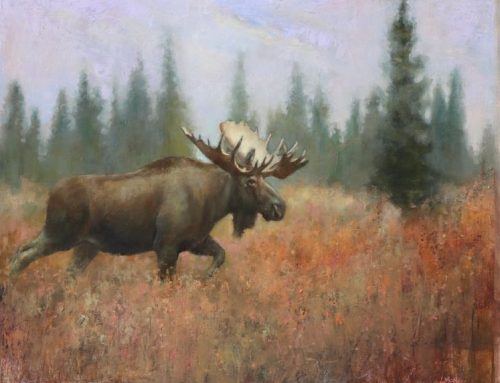

For a long time, acrylics had its devotees and its detractors – either you loved them or you avoided them, mostly because they dry super-fast. However, newer trends have enabled acrylics to behave more like oils and with advantages, like long-term stability, that oils don’t have. Representational artists have been noticing. Brenda Hozjan’s acrylic paintings of wildlife take advantage of the water-based medium’s ever-improving flexibility.
Brenda Hozjan demonstrated her use of acrylics as part of the inaugural Acrylic Live event in 2025. Acrylic Live is three days of premium art instruction from 20+ of the world’s best acrylic artists, something you can’t get in one place anywhere else. Sign up for the next one here.
What’s Not to Like?
The issue is the quick drying time, perceived as working against age-old oil techniques like blending, color-mixing on canvas, and representations of things with soft edges, such as blurred backgrounds, distant foliage, and feathers. Not so, says Brenda.
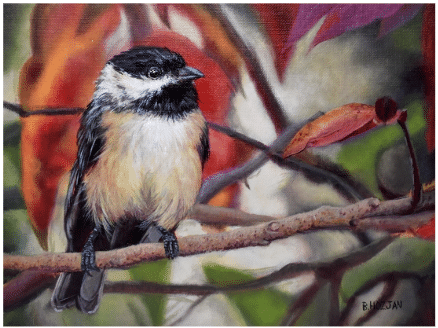
Brenda Hozjan, “Chickadee in Fall,” acrylic
“Acrylics are really quite versatile,” she says. “While many people don’t like that acrylics dry quickly, in my practice I use that to my advantage. Most people expect the caveat to their quick drying nature to be that you can’t get a soft look to acrylics because you can’t “blend” them. This is true, if you are looking to treat them like oil paints which you can physically mix a few hours/days after you’ve applied them. But you don’t require extended periods of drying time to achieve a soft look.”
There are plenty of ways to create soft edges and blends with acrylics, she notes. “You can blend them physically, by mixing them on your palette or by working wet into wet on your painting as you paint. Or you can let them blend optically by dry-brushing opaque layers, applying transparent layers of glazes/colors, or by placing colors side by side and letting the eyes blend them when you step back.”
Newly available mediums and formulations, including “open acrylics,” enable the paint to stay wet longer even in outdoor conditions for extended periods of time. Acrylics’ improved versatility allows artists to explore a wider range of techniques that rely on softening, shading, glazing, and creating fine detail. And because they resist oxidation, acrylic paints over time are thought to be less prone to cracking, yellowing, and color fading than casually applied oils.
For Brenda, the medium is secondary to what painting itself offers both artist and viewer. “There is inherent value both in the viewing and in the creating of art,” she says. “As artists, we spend a great deal of time getting to know our subject matter when we paint or draw things. We learn about the nature of our subject and of its place in the world. For example, we watch how light hits an object and interacts with it, and how the subject is affected by that light and by the objects that surround it.”

Brenda Hozjan, “Summer Tanager,” acrylic, 12” x 9.” Original Reference Photo by Mike Blevins
“When we are successful as artists, when we are able to translate that beauty and our understanding and appreciation for the world around us, the viewer picks up on that and our work resonates with them,” she says. “The viewer then, in turn, develops their own understanding and appreciation for the world.”
Few people know that Brenda Hozjan earned a third degree black belt in Karate in Kyoto, Japan. And a lot of the lessons she I learned on the dojo floor, she says, “are actually lessons that I bring to the studio and my art practice.” Chief among them are staying process- not end-product focused, and taking time to focus, which means practice and discipline.
“Martial artists value consistent practice and the discipline which results. Through practice, students are able to take the same basic techniques that they learn (which have been handed down for hundreds of years to students all over the world), and to make those techniques their own. This is referred to as ‘Shuhari.’ Art is the same. Learn the basics by reading, by studying paintings, by taking classes, by watching other people paint. When you put in enough time at the easel practicing these basics, you will be able to take what you’ve learned and to make those techniques your own.”
Entire Free Art History Video Course Online!

Art Through Time: A Global View, a free, complete online art history course, examines themes connecting works of art created around the world in different eras. The thirteen-part series explores diverse cultural perspectives on shared human experiences.
Says the course description: Take a trip across the world and back through the ages to experience the art of many cultures and historical periods. Thirteen themes encompass hundreds of paintings, drawings, sculptures, photos, and works in non-traditional media in this vibrant approach to the study and appreciation of art.
International artists, scholars and curators from major museums and specialized collections guide the viewer through the millennia of human thought and expression while contemporary artists and their work bring the forms into the present day. An extensive website includes sortable images of more than 250 works, as well as online text helping viewers to explore the works and topics in greater depth.
The series, text, and web resources can be used to supplement art history courses, or for individual learning and enrichment. examines themes connecting works of art created around the world in different eras. The free thirteen-part series explores diverse cultural perspectives on shared human experiences.