By daring big leaps from one plateau to the next, Dwight Tryon (1849-1925) became a famous early 20th century Tonalist, a poet-in-paint of the raw New England countryside.
Like his fellow Tonalists (most of whom were also based in New England but didn’t identify as part of “movement” or “school”) Tryon followed in the footsteps of George Inness (whom we’ve written about here.)
When he died at Bridge of Allan, Scotland in 1894, Inness was the most celebrated American landscapist. Like him, the Tonalists devoted themselves to a post-Barbizon landscape approach steeped in both mysticism and materiality, evocation, suggestions, atmosphere and mood.
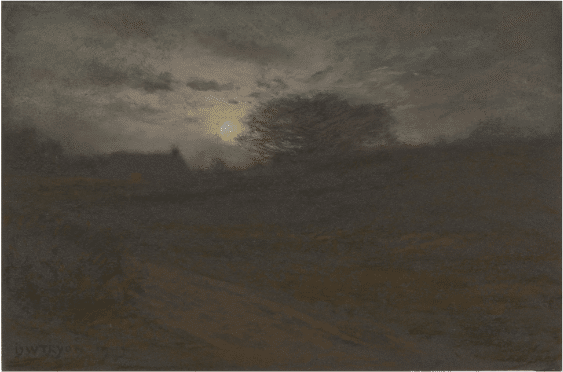
Dwight William Tryon, Early Night, 1903
A prime example, Tryon’s Early Night of 1903 is a gorgeously moody pastel. The subtle colors slide from cool gray strands of cloud to a yellow cloudy and luminous moon. One red window in the dusky farmhouse smolders like a glowing coal. It could easily have slid into cliché, but somehow Tryon’s paintings, no matter how emotional or poetic, never do. Here, the truly deep tones evoke a somber silence while the composition keeps everything dynamic from the zigzagging path and tilted hillside to the counterbalancing diagonals of the clouds.
Tryon grew up in Connecticut, where, as a young man, he got a job in a bookstore where he read instruction manuals on art and drawing. Without formal training, he sold his first painting in 1870, aged 21, and three years later successfully exhibited at the prestigious National Academy of Design in New York City. With early success under his belt, he married, quit his job, and went all in on art. In 1876 he decided his skills needed sharpening in formal study. He sold all of his paintings at auction and, with the help of a benefactor, traveled to France with his wife. There he studied with leading teachers until, upon returning, he set up shop, painting and teaching landscapes, in New York.
Tryon’s work fits perfectly into the best definition of Tonalism I’ve encountered: “a generation of artists using tone as a distinct means of expression in its own right. Having jettisoned narrative content, tone became a new language, a signifier of mood, of mystery and uncertainty, and stood for the searching spirit of the age.” (David A., Cleveland’s A History of American Tonalism, p. 273).
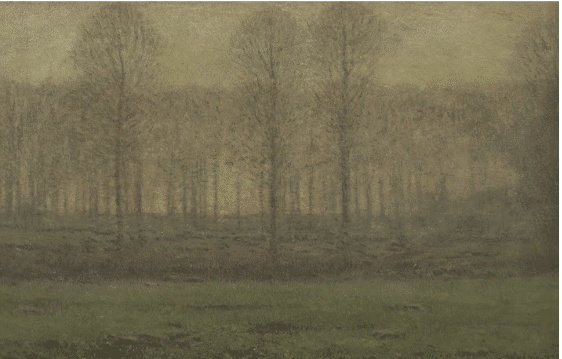
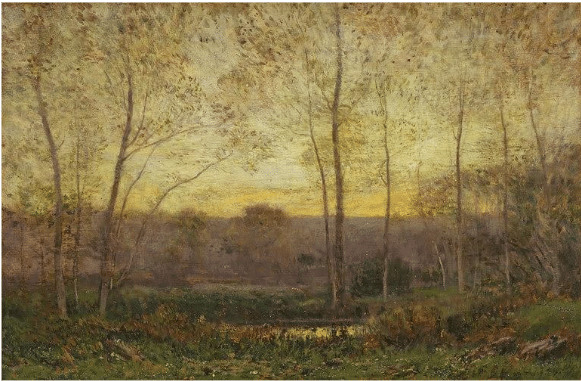
Dwight Tryon, Sunrise: April, 1897-1899
“The less imitation the more suggestion and hence more poetry,” the artist noted. For Tryon, of course, it wasn’t about style – just as it wasn’t for Inness. For these artists, painting was almost a form of mysticism, a means of envisioning a spiritual connection to nature. Their main motif was the suffusion of the material world with the immaterial realm. In their paintings, the world of trees, ground, stones is half here and half dissolving into the half-light of transitional states in nature, specifically evenings and dawns in springtime and autumn.
They got there partly through New England’s Transcendentalist interpreters, Ralph Waldo Emerson and Henry David Thoreau. If as Emerson said, God could be found in nature, Tryon and his peers reasoned, then the sensitive artistic soul could attune to it and, as he put it, the “mood or special phase of nature,” by which he meant the sense of the Infinite, could be shadowed forth on canvas.
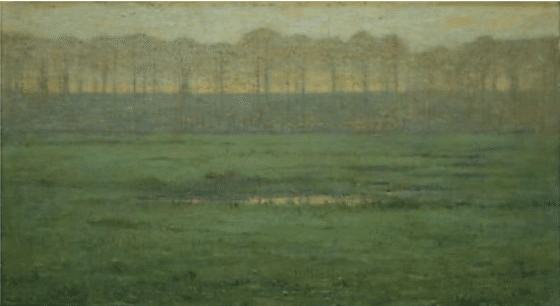
As Tryon elaborated, it was all about feeling. “Mystery, infinity. A painter who feels these truths in nature is humble. He frankly acknowledges there is something that cannot be painted. But this draws him on, and the highest and most lasting things are these suggestions.”
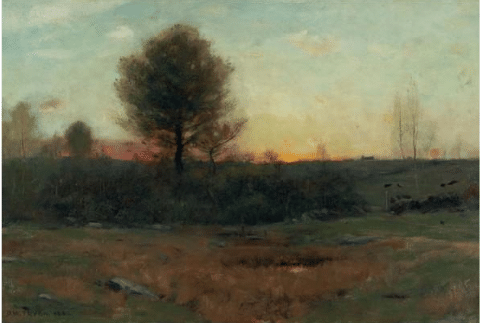
Dwight Tryon, Evening
It was a vision of the spiritual embodied in the material, the concrete as symbol “of what we do not know, but may believe in.”
A perceptive critic observed in 1902 that Tryon followed Whistler’s identification of painting with evocative music, distilling from nature rather than transcribing it: “Tryon’s pictures . . . are almost, literally speaking, musical in their effect, not unlike the pizzicato notes on the A string of a violin. . . .He composes his pictures as a composer does his score. His parallelism of horizontal and vertical lines is like melodic phrasing.”
Tryon painted what he considered “the nearest to a masterpiece of any I have produced” in 1906 in Ogunquit, Maine. He’d received a commission to produce a moonlit seascape, and at that time in history, Ogunquit had a thriving art colony producing seascapes of national renown. Also a passionate fisherman, Tryon probably came for the pollock to be had as much as for the views.
The resulting painting, The Sea: Evening is indeed a masterpiece of Tonalism. As aptly described by the curators of the Freer Gallery where the painting resides:
“Tryon’s use of color reflects a cold austerity not expressed in his other seascapes. The subtle gradations of dark blues and greys in the sky, accented by the faded golds of the setting sun, elegantly complement the violet and lavender pigments of the ocean. The work’s horizontal orientation and smooth, wavy brushstrokes suggest the movement of the waves; the delicately layered palette combined with the painting’s large scale evokes an overwhelming feeling of calm.”
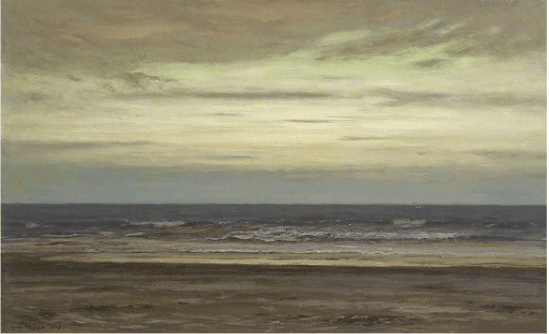
Dwight Tryon, The Sea, Evening, 1907, 70” x 127”
The low-chroma colors and restricted palette leave the emotive work to the tonalities – the gradations between light and dark. It’s almost a blueprint for future color field painting (such as Rothko’s), what with its scale and its flowing, loosely handled horizontal bands of melting tonal color harmonies free from aggressive verticals.
Tryon’s magical week in Ogunquit (he was so visually enchanted by it that he proclaimed all other exotic locales “nowhere to this wonderful place”) also inspired another gorgeous pastel. This one, likely done en plein air, shows the moon peering from behind clouds, its light reflected by the waves.
Even on a small, improvisational scale, Tryon’s work exemplifies some of the best qualities of Tonalism’s ability to tap into “the power and vastness of the sea and sky as elemental forces.”
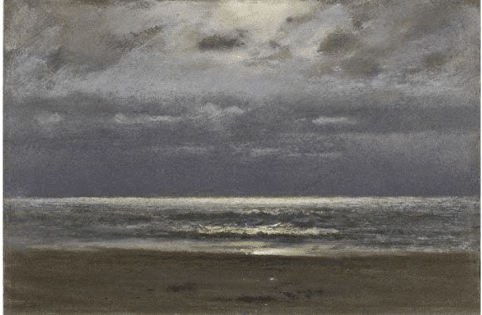
Dwight Tryon, The Sea, Night, 1915
5 Common Painting Mistakes – And How to Fix Them
By John Pototschnik
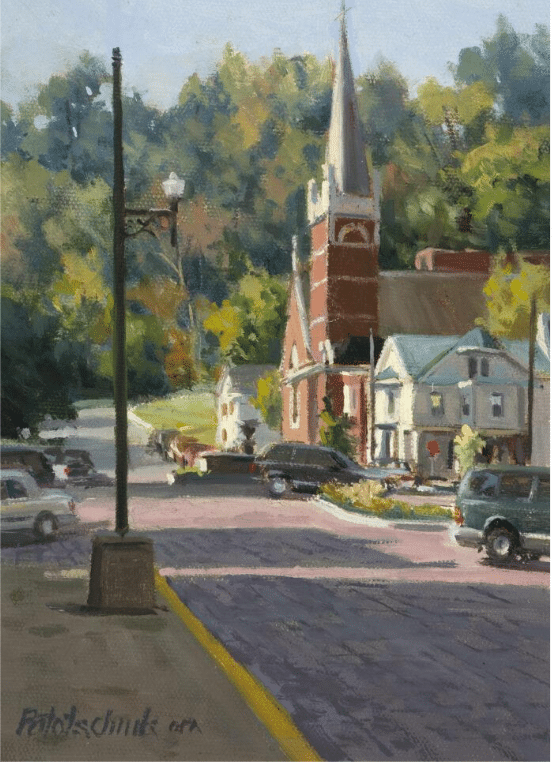
John Pototschnik, “Maysville Church,” 8.88 x 6 in.
When you’ve been painting as long as John Pototschnik, you come across common mistakes that less experienced artists are prone to make. Here, John shares what those mistakes are, and how to fix them so you can improve your art, starting now.
The following is part of a series that features the best artists who are teaching others how to paint through online workshops at PaintTube.tv.
5 Common Painting Mistakes That Students Make
by John Pototschnik
- They can’t draw, don’t understand linear or aerial perspective, and do not consider eye level/horizon line.
The fix: Get a book on perspective, start at page one, and work through it page by page, recreating all the drawings shown. Don’t move to page two until everything is understood on page one.
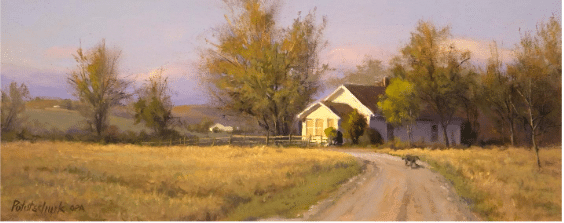
John Pototschnik, “Take Me Home Country Road,” 7 x 17 in.
- They’re fixated on color, not value.
The fix: Work on location using only black and white.
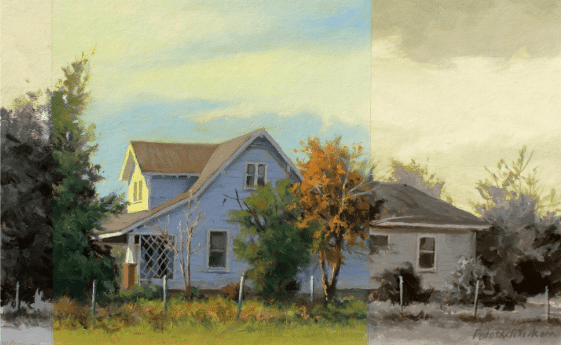
Value comparison; John Pototschnik, “Transitions Series, Afternoon,” 10 x 16 in.
- There are way too many tube colors on the palette.
The fix: Limit the palette to just the three primaries + white.
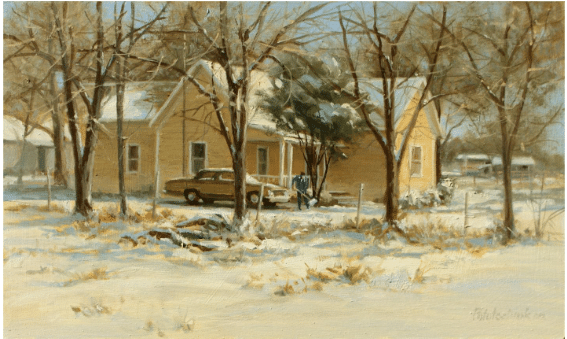
John Pototschnik, “Morning Surprise,” 10 x 16 in.
- Using poor quality paints and brushes, none of which is kept clean.
The fix: Buy the best paint and brushes you can afford. Clean the paint off gunked-up tubes. Thoroughly clean brushes at the end of each day.
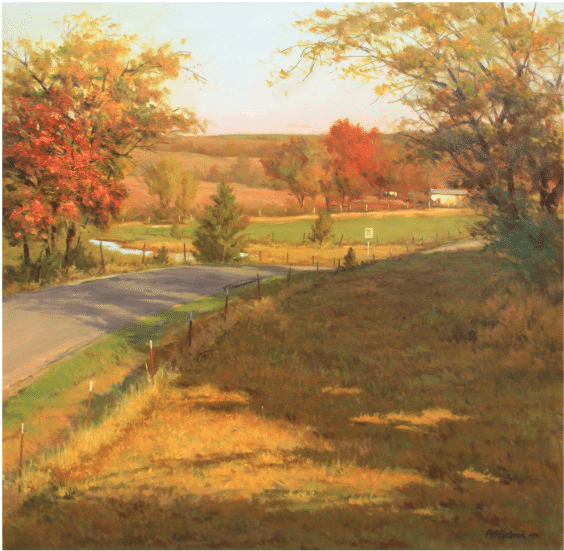
John Pototschnik, “Road Trip,” 30 x 30 in.
- Being disorganized and taking way too much stuff into the field.
The fix: Simplify, simplify. Limit your tube colors to only three; that alone will save a lot of space and weight.
How to Paint Landscapes: A New Video Workshop
Internationally renowned artist John Pototschnik is going to share with you how to enhance the mood of any of your paintings with one simple shift that most artists get wrong.
It’s the “Monochromatic Secret” to emotionally moving, soul-stirring paintings.
Inside the art video workshop “Painting Values & Color,” John Pototschnik will uncover the seemingly “backward” approach that many artists overlook: It’s not just about color, it’s about value. Learn more about how to paint realistic landscapes here!