Norman Rockwell’s work will be the subject of a 2026 exhibition at Vermont’s Shelbourne Museum June 20 – October 25, 2026.
Norman Rockwell: At Home in Vermont will explore how Rockwell (1894–1978) shaped an idealized vision of Vermont—nostalgic, resilient, and mythic—during his prolific “Arlington years” (1939–1953).
“Norman Rockwell becomes Norman Rockwell in Vermont,” according to a spokesperson for the New England Historical Society. It was after his move to Arlington, Vermont, where he moved with his family in 1939 that he found his inspiration in his neighbors’ everyday life. There he produced iconic works like “The Runaway” (with the kid being comforted by a cop at a soda shop), “The Four Freedoms,” including the famous Thanksgiving painting, “Freedom from Want,” and many Saturday Evening Post covers. It’s these depictions of idealized American life that he’s best known for, though he also addressed social issues like discrimination and civil rights.
“In a time marked by the Great Depression and World War II, his images offered a reassuring portrait of American life,” commented the curator of At Home in Vermont. “The exhibition places Rockwell within the vibrant Arlington artist circle—including Mead Schaeffer (1898–1980), John Atherton (1900–1952), and Gene Pelham (1909–2004)—whose work helped mythologize Vermont as democracy’s ‘granite-strong refuge.’”
The exhibition will also consider Rockwell’s public friendship with Anna Mary Robertson, better known as “Grandma” Moses, as part of the broader crafting of New England as “authentic” – as well as marketable. Featuring newly acquired Rockwell paintings celebrating Vermont’s granite industry, the exhibition will focus not only his imagery but on the intentional mythmaking that embedded Vermont at the heart of Rockwell’s nationalistic vision.

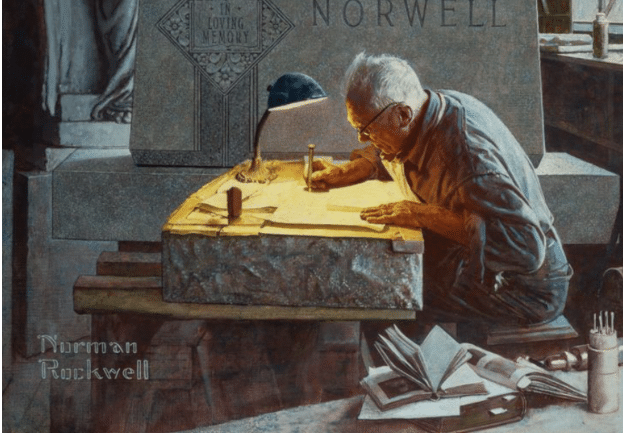
Norman Rockwell, “The Craftsman”
One of Norman Rockwell’s impressive Vermont paintings, “The Craftsman” (above) is notable for its deceivingly simple treatment of deeper themes such as life and death (the man is working on plans for a cemetery memorial) and the role of creativity in the “big picture.” Switching some traditional symbolism, the cemetery angel, which Rockwell has included in full, remains stubbornly gray and earthly, decidedly mundane, drenched in shadow, though its arms are positioned in blessing. Below the angel, the artificial light by which the solitary artist hunches over absorbed in his work, as if in prayer, glows with golden light like divine illumination. Another shade of meaning emerges when the viewer discovers that the name chiseled on the gravestone (made of marble quarried in Vermont of course) is “Norwell,” a combination (elision) of the artist’s first and last names.
There’s a poem by American poet Galway Kinnell that works with similar imagery.
Cemetery Angels
On these cold days
they stand over
our dead, who will
erupt into flower as soon
as memory and human shape
rot out of them, each bent
forward and with wings
partly opened as though
warming itself at a fire.
–Galway Kinnell
Communicating the ‘Character of Place’ in Paint
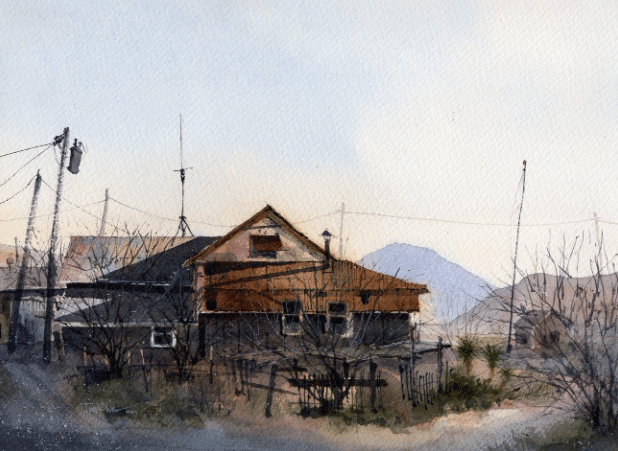
“Terlingua Trading Post Vista” (watercolor, 10 x 14 in.)
First introduced to watercolor by a friend in college, Tim Oliver fell in love with the transparency and color-blending qualities of the medium. A landscape architect by trade, he also has a reputation as a top-notch plein air watercolor painter, describing his style as “sloppy representationalism.”
Kelly Kane: How do you feel your day job in landscape architecture impacts your plein air work? What are the sensibilities that crossover?
Tim Oliver: Being in a design profession, I’m accustomed to drawing and sketching, so I’ve always felt very comfortable communicating graphically with a pencil and paper. I think I was actually drawn to landscape architecture for the graphic component of the job; it certainly wasn’t the technical side — the math and all that. I believe there’s a shared skill set in being able to see context in a place. In my landscape architecture, I’m trying to communicate the character of a place that I’m designing. With my watercolors, I’m interpreting an existing landscape in a fine art context. Both relate to conveying a sense of place.
Read the rest of Kelly’s interview with Tim in American Watercolor.
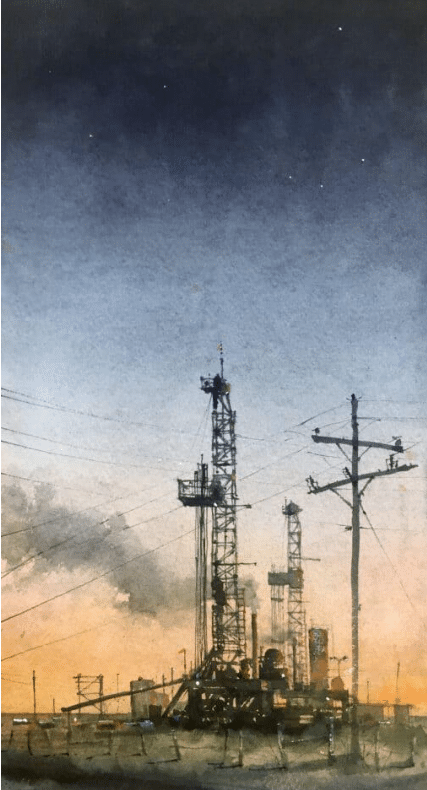
Tim Oliver, “Evening Shift North of Midland” (watercolor, 20 x 10 in.