
Late in his career, American painter Winslow Homer moved to a remote spot next to the ocean, where he painted the turbulent weather and remorseless waves near his home and studio in Prouts Neck, Maine. By 1894, he was feeling finished with the genre scenes that had made his name. He turned away from the figure and made paintings that captured the impersonal forces of the natural world.
Weatherbeaten depicts a wave crashing on rocks and emitting a delicate spray that seems to diffuse into the atmosphere. In the foreground, roiling surf sweeps along the rocky shoreline. It’s not just a realistic seascape though; it’s brooding, stormy, not particularly beautiful or picturesque, and the rocks are a harsh jumble of dark debris – they don’t as much invite us in as bar our way. All four corners of this painting are dark.
Maine was considered a frontier then, a semi-wild place, and Homer embraced that. Unlike much of his earlier work, these elemental seascapes exclude figures entirely. Instead, Homer places us on the forbidding shoreline, leaving us in front of the booming ocean to contemplate its power. We are the (implied) figure, through which Homer suggests the struggle between humanity and “nature,” including perhaps the darker forces of human nature (something he’d seen plenty of while documenting the Civil War).
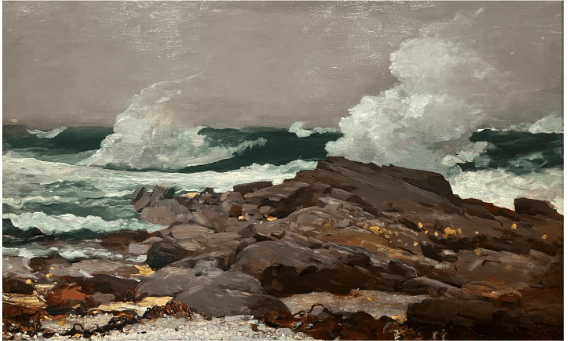
Winslow Homer, Eastern Point, 1900, oil on canvas, approx.. 20 x 40 inches. Clark Institute of Art
Homer completed Eastern Point (above) in a month’s time. The surf, vigorously painted in deep blue green and opaque white, churns beneath another flat, ominous gray sky. Rocks jut from the kelp-strewn beach, their uneven surfaces described with touches of red, ochre, and yellow. When this painting was exhibited in 1901, a New York critic hailed it as “quite the next thing to a brisk tramp along the shore on a stormy day.” It’s more than that though, as the intervening years have made clear.
“Winslow Homer came to Maine and looked outward into the infinite. What he saw when he arrived at land’s end changed not only his personal perspective of the world and his mortal place in it, but also the course of American art,” wrote Maine writer Bob Keyes in a story about the 2015 restoration of Homer’s Prouts Neck studio published in the Portland Herald.
“From a simple, austere painting studio at Prouts Neck just south of Portland,” wrote Keyes, “the Boston-born painter cast his vision to the sea and established a reputation as the most important American painter of his generation and for generations to come.”
The eminent American art historian John Wilmerding said of this period of Homer’s life and work: “In that studio, Homer was able to face the infinite as his own life moved into the older years. That landscape gave him the sustenance to face the largest questions of life and the imminence of death itself.”

Detail, Winslow Homer, Eastern Point
The sureness of Homer’s brushstrokes, clearly visible in the closeup above, testify to the resolute vision of raw nature that inspired him, as well as to his familiarity with the marine motif and his technical prowess with the medium.

Winslow Homer, Summer Squall, 1904, oil on canvas. Clark Institute of Art
Summer Squall (above) was inspired by a sudden storm near the Prouts Neck studio. Thick ropes of white paint suggest the foaming water violently surging over and around the flat rock in the foreground, which in better weather was one of Homer’s favorite fishing spots. The solitary sailboat dangerously tossing in the distance only serves to enhance the painting’s drama, evoking the human struggle with the forces of nature that permeate these last, triumphant, and uncompromising paintings.
“At Prouts Neck, Homer created powerful seascapes and contemplated the force and role of nature in a society grappling with technological change,” Keyes says. “The paintings he made there reached for something more than mere narrative descriptions that defined his earlier work, and suggested existential themes that resonated with and influenced his modernist descendants of the early 20th century.”
“He began to reconcile his own mortality and infused modernist themes in his representational works. In doing so, he made it possible for the next generation of artists to take those ideas to new levels. American art changed with Homer. And Homer changed it while in Maine.”
So does a painting always have to suggest Big Ideas, like man vs. nature? Nope, not at all. It’s just that doing so is one of the things that distinguishes truly great art. As we’ve written on this previously, your work might simply be “about” an old barn, the light on an orange, or a place you saw on vacation, and that’s fine too. We need more art (a lot more actually!) that humbly wishes only to make the world a more beautiful place.
If you love dramatic seascapes though, have a peek at a masterful how-to video by artist Jean Perry. Jean’s a distinguished and accomplished artist with major awards and publications to her credit, including features in PleinAir™ Magazine and Outdoorpainter.com. Her work’s bee in numerous shows from New York to California.