“I prefer winter and fall, when you feel the bone structure of the landscape – the loneliness of it, the dead feeling of winter. Something waits beneath it, the whole story doesn’t show.”
-Andrew Wyeth
Damp gray mists and yellow grasses, denuded branches lacing smoldering skies: November has its own bare-bones charm for the artist with a willing eye.
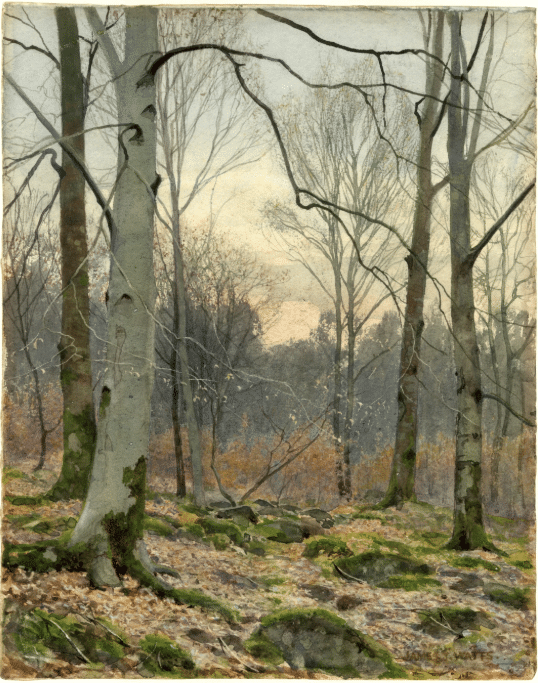
The work at the top of the page by English watercolorist John Thomas Watts invites us to a quiet contemplation of the seasonal transition from green to gray, warm to cold. It seems temperature (color temperature, that is) plays an important role in attempts to paint November. Here, the green, warmth-tipped mosses convince us easily that life is far from in abeyance. The faint glow of warm light at the horizon brings out the rusty ochres in the mid-range groundcover of young trees. Separating them is a cool mauve band of misty evergreens.
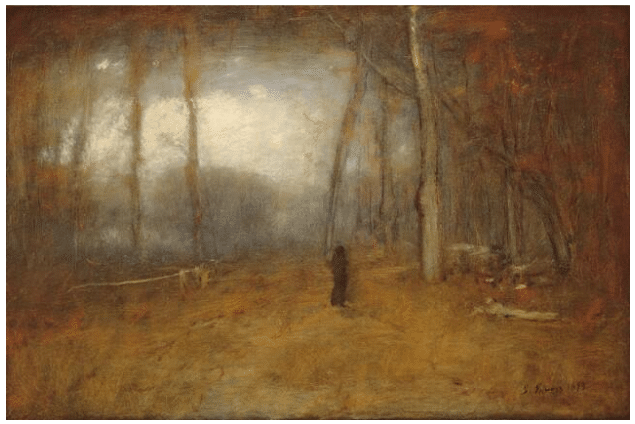
George Inness (1824-1894), November Montclair, 1893, oil on canvas, 30 x 45 1/16 inches. Brigham Young University Museum of Art, gift of Joseph Riggio, 1977.
We find a similar play of warm and cool colors (in the foreground hill and trees and the background sky, respectively) in this seldom seen painting by nineteenth-century American master George Inness. Not that it matters, but “This hazy autumnal November landscape was painted near George Inness’s home in Montclair, New Jersey,” the Brigham Young University Museum of Art informs us. “A lone figure wanders in a clearing, dwarfed amid the heaven-reaching trees.”
It’s in the following that the Brigham curators approach what really fascinates us in this and other Innesses: “The artist’s style of loose brushstrokes and less defined forms reflect the influence of 18th-century Swedish theologian Emanuel Swedenborg. Inness embraced Swedenborg’s belief that physical creation had a corresponding spiritual reality. This enveloping misty atmosphere blurs detail to suggest a metaphysical reality, which Inness considered to be the most significant realm.” The work was most recently shown in a 2019 exhibition titled Rend the Heavens Intersections Between the Human and Divine.
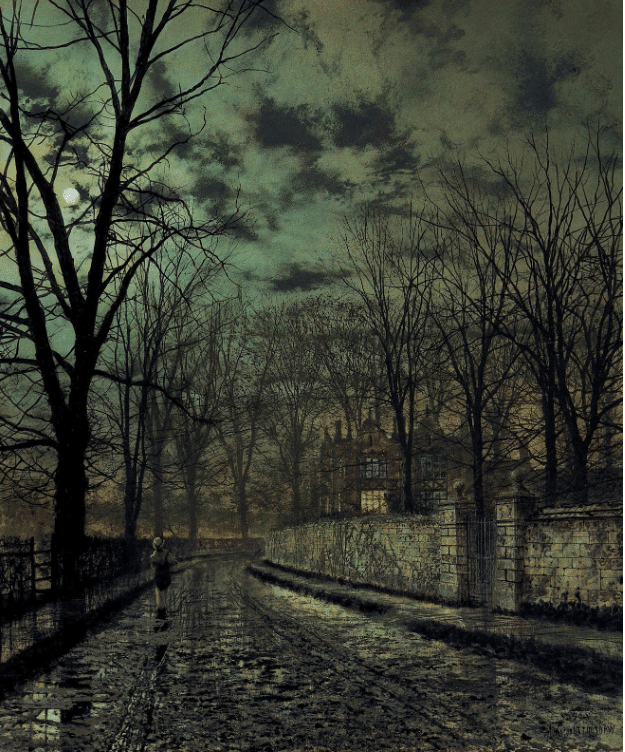
November | John Atkinson Grimshaw | 1879
We get a less mystical and a more decidedly, well, damp take on the month in “November” by John Atkinson Grimshaw (above). It’s later in the evening now, and the moon has risen as the dregs of the day go down. A phantasmagoric sky waxes entangled with a dense network of stark nude branches. A lone female figure with her back to us (seemingly dressed in a manner rather at odds with the scene), is nearly subsumed by the gloaming, as she stands or treads the wet rutted drive before an estate, where a single first floor (drawing room?) window glows.
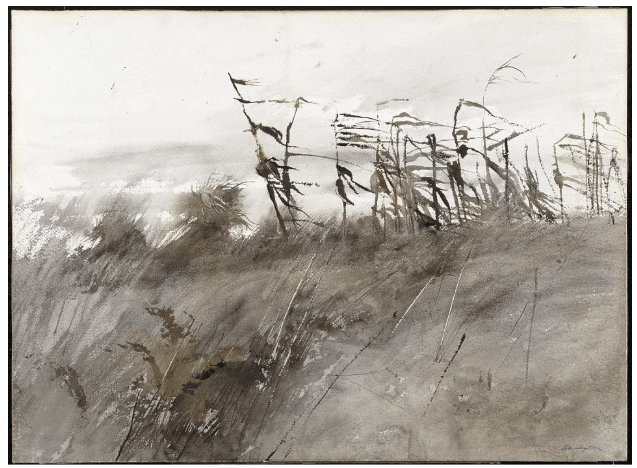
Andrew Wyeth, November First, 1950, watercolor on paper mounted on paperboard, sheet and mount: 21 3⁄4 x 29 5⁄8 in. (55.2 x 75.4 cm), Smithsonian American Art Museum, Bequest of Winifred M. Jacobson, 1990.55
The greatest of these is surely Andrew Wyeth’s “November First” of 1950 (above). No warm-cool fussiness, no honeyed clouds, glowing mosses, half-lit mansions, or golden forest floors here. We get neither the semi-urban gloom of a Grimshaw (what a name!), the spiritual vision of an Inness, nor the semi-wooded lucidity of a Watts. No, in this desolated cornfield Wyeth gives us the merciless cycle of life itself, as written in the raw book of a Nature, a nonfiction story that apparently doesn’t include us except perhaps as a footnote.
“Depicting tattered cornstalks in a harvested field, November First captures the cold damp of late autumn, portraying the inevitable cycles of decay and renewal,” says the Smithsonian Museum, which owns the picture. “Wyeth steadfastly maintained his dedication to painting the people and places that were familiar to him in Chadds Ford, Pennsylvania, and Cushing, Maine. The cornfield shown in this watercolor was located near his studio in Chadds Ford, behind the house of Dr. Margaret Handy, the pediatrician who cared for Wyeth’s two children.”
Thanks, but again, who cares where he painted? Great landscapes transcend place. However, it is tempting to imagine Wyatt glancing sidelong at the withered field near his house while walking a sick child to the doctor’s door. Incidentally, this painting was the subject of a different article that we’ll likely reprint later this month.
So how does one capture genuine emotion in a landscape? Contemporary painter John MacDonald has an answer:
“We can learn to keep a beginner’s mind and an open eye—looking intently and freshly at the visual information in front of us—even while our mind is in panic mode and is throwing a fit,” he says.
“Managing our fears and trusting in the process is no guarantee that the painting will succeed, but it does guarantee that we’ll have an opportunity to learn and come out of the experience as a better painter.”
John MacDonald teaches the principles of standout landscape painting in his video, Creating Dynamic Landscapes.
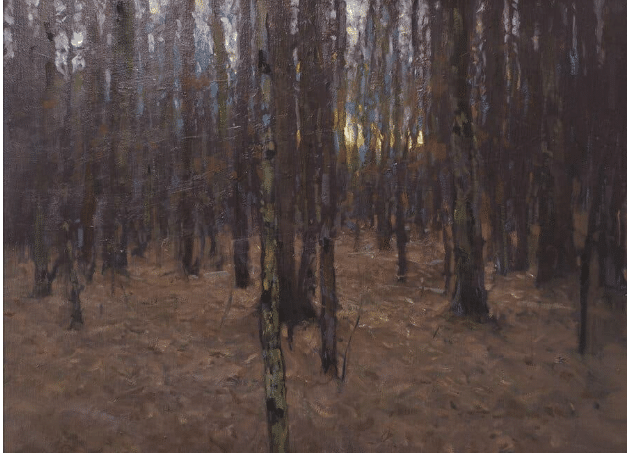
John MacDonald, Woods, November Sunset, 12×16 inches. Learn to paint along with John with his video, Dynamic Landscapes.
No tally of Novemberish paintings would be complete without at least one from the icy brush of German Romantic artist Casper David Freidrich. I can’t verify the actual month depicted in it, but his painting of a strange procession of monks heading into a ruined abbey in the mountains seems doubly appropriate since we’ve just passed Halloween.
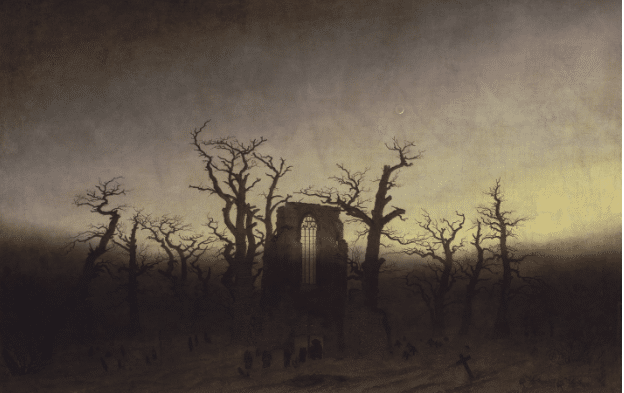
Casper David Friedrich, Abbey Among Oak Trees, Oil, 1809/1810, w171.0 x h110.4 cm
Of this picture the Berlin museum, which owns the work, says the following: Monks carry a coffin into a deserted Gothic ruin to hold a requiem mass under the cross. The graveyard with its crooked, sunken tombstones is equally deserted. Bare oaks reach up into the sky as though in complaint. The first light of dawn is appearing over the horizon like an ocher-yellow veil, outshining the tender curve of the crescent moon. The visionary gleam of the heavenly realm is completely detached from the earthly regions, which are still sunk in darkness. One sign of hope is in the two single lights on the crucifix. For the painter Carl Gustav Carus, who was also a friend of Friedrich’s, this painting was “of all recent landscapes, possibly the most deeply poetic work of art.” This is one painting I would REALLY like to see in person.
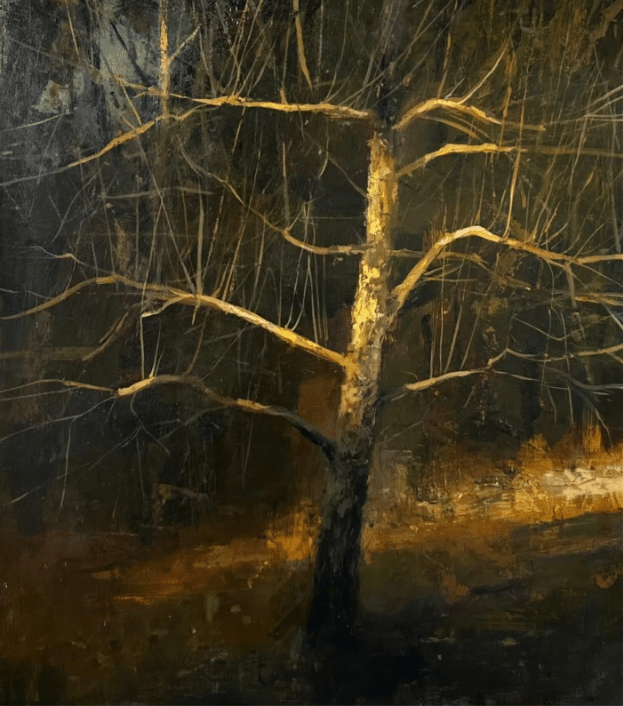
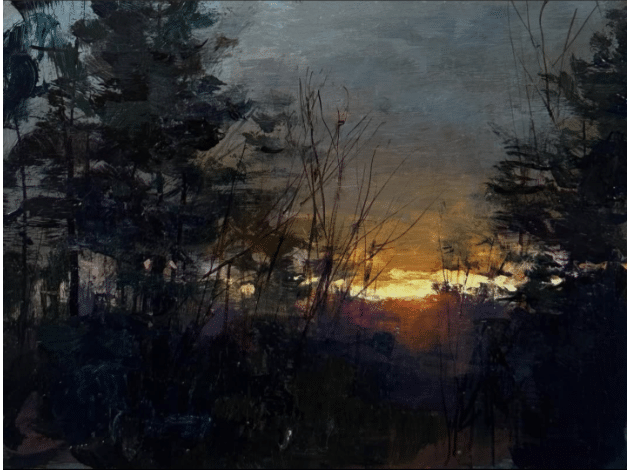
We conclude with two small love letters to the season by contemporary landscapist Jeremy Miranda. Says this prolific painter, “I love the transition from the green to the gloom.”