
This striking painting by Georgia O’Keeffe strikes one as a near-total abstraction. It’s severe, mysterious, threatening – one thinks of the skin of some prehistoric creature, a spine and ribcage, a whale ballet, heaps and arches of ash, an alien landscape conjured from the artist’s dreamy imagination.
If you take it on its own terms, as a landscape painting of terrain in New Mexico, you are invited to consider that this landscape, and by contagion every other place on this planet we call home, can be stranger, more primal, and more protean than we generally give it credit for: a literal and metaphorical “black place,” where mysterious forces undergo a continual process of enfoldment, emergence, and collision.
So, it’s kind of wild to discover that this is a real place, and it really does look like this.
O’Keeffe was one of those rare artists able to combine close observational painting from life with an original, conceptual interpretation and stylistic treatment of the motif. She needed both, subject and object, so she had to choose her motifs carefully. One of her favorites was the Bisti Badlands, where the winters are cold and windy, the summers are hot and dry, and the few water sources that exist are normally muddy and unsafe to drink.

It’s out there: The Bisti/De-Na-Zin Wilderness, New Mexico. The strange natural beauty of the Bisti Badlands is quite real.
The Bisti/De-Na-Zin Wilderness is a 45,000-acre wilderness area located in San Juan County, New Mexico. Established in 1984, the Wilderness is a desolate area of steeply eroded badlands managed by the Bureau of Land Management, except three parcels of private Navajo land within its boundaries.
“O’Keeffe called the Bisti/De-Na-Zin Wilderness the “Black Place.” To her it looked like ‘a mile of elephants – gray hills all about the same size with almost white sand at their feet,’ she wrote. The area became one of her favorite places to paint.” (This is from the wall text that accompanies this painting at the San Francisco Museum of Modern Art.)
“After she learned to drive in 1929, O’Keeffe bought a Model A Ford which she used as a mobile studio. In the 1940s, she frequently traveled to the Black Place with Maria Chabot, an aspiring writer and indigenous arts advocate who helped manage the O’Keeffe’s property. They often stayed for days camping and exploring on foot.”
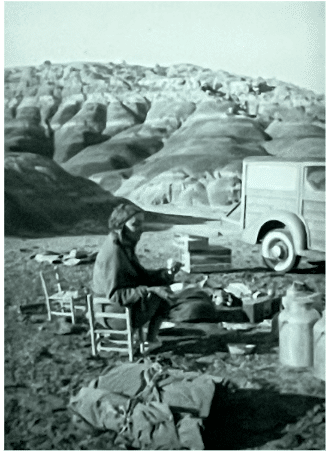
Georgia O’Keeffe having breakfast at “The Black Place” in 1944. Photo by Maria Chabot. And as it turns out, an extinct species of rhinoceros once inhabited it.
“O’Keeffe ignored rock pinnacles and other unusual formations, using the eroded striated cliffs as her starting point. Some of paintings are recognizable landscapes, with a strip of sky at the top to help situate the viewer. Others zoom in, exploring depth and color, their overlapping ridges becoming surface patterns that seem to advance and recede in space.”

Georgia O’Keeffe, “Gray Hills,” 1944 oil on canvas. San Francisco Museum of Modern Art. Photo by Lindy Walch.
All artists “editorialize” their subjects to some degree – that’s what makes their work more than simply a photographic record. Contemporary artist Amery Bohling is a case in point. At the most literal level, you need to paint en plein air (as did O’Keeffe) to see the true colors in nature. “Photos are wonderful references,” Bohling says, “when you understand color.”
Bohling is well known for her vivid depictions of the American West, her light-infused work ranging from the seascapes of Cabo San Lucas to the granite cliffs and waterfalls of Monterey Bay, California. Her favorite subject, however – and the one for which she is most famous – is the Grand Canyon.
She finds the canyon endlessly fascinating for its vastness, complexity, and transcendent light. She has painted the Canyon many times, finding challenges in capturing the timelessness of the rocks, the ephemeral quality of the light and sky, and the fiery reds and brilliant blues that dominate that unique landscape.

Amery Bohling, “The Guardian,” oil on canvas, 26 x 47 in.

Amery Bohling, “Nearing Golden Hour at Hermit’s Rest,” Oil, 24 x 30 in
If you’ve ever dreamed of painting the forms and colors of the picturesque American West, you can learn almost everything you need to know from her video, How to Paint the Grand Canyon.
Overcome the Fear of Selling
Eric Rhoads to host Art Business Mastery online learning event

Streamline Publisher Eric Rhoads is offering an online learning event he’s calling the Art Business Mastery Intensive, designed to unleash your art’s earning potential and transform your art into a thriving business in 2025.
Start the new year with a new perspective on your career and join in on this one-day online event, January 10, 2025.
At the Art Business Mastery Intensive, you’ll discover the effective systems and strategies top artists use to:
- Price your work for maximum profitability
- Build a loyal base of dedicated collectors
- Generate consistent monthly art income
- Develop a rock-solid 2025 marketing plan
According to Eric, experts predict a historic economic boom starting in 2025. Eric is a five-time Inc. Magazine “Fastest Growing Companies” nominee and may well be the foremost art marketing expert in America.
He is the author of the best-selling book: Make More Money Selling Your Art: Turning Your Passion Into Profit. He’s taught thousands of artists how to find success, and now he’s ready to share his proven strategies online with a hands-on practical approach anyone can do.
Attending the Art Market Mastery online event will leave you with an actionable plan to capitalize on the opportunity including overcoming the fear of business, selling & marketing, crafting a step-by-step 2025 success blueprint, building an audience, mastering social media and email marketing, developing powerful gallery relationships, and creating a customized 90-day action plan.