We know there’s all kinds of good magic in art. Maybe that’s partly why artists over the centuries have created such richly imagined and beguiling scenes of mythological wizards, witches and magicians doing their magical things in beautiful settings.
The wonderful thing about great art, not unlike tales of holy men and women, mysticism and magic, is how it eludes our overburdened everyday conscious minds and engages our imaginations. A good painting casts a kind of spell Art’s ability to make us feel and think reminds us there’s more at work in life than the part we can see, touch, or measure.
An important link between mythology, fables, magic, and art is that all of them, whether acknowledging it or not, make strong use of symbols. “A symbol is an image that operates in two worlds,” according to mythologist Joesph Campbell. What does that mean?
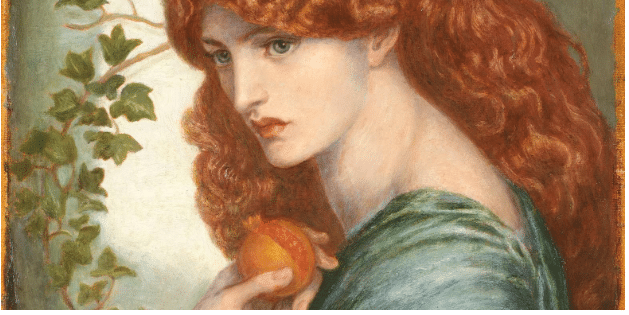
Detail, Dante Gabriel Rossetti, “Proserpine,” 1881-82. Birmingham Museum and Art Gallery.
Symbols are images around which cluster multiple ideas and associations. In the above crop of Rosetti’s “Proserpine” (classical goddess associated with seasons and the Underworld), the ivy and the pomegranate, even her sensual mouth and intense gaze – all carry associations and convey meaning: they are physical objects that operate in a mental as well as a physical world.
(Proserpina, aka Persephone, you may recall, had to remain in the Underworld as the queen of Hades for the same number of months each year for each pomegranate seed she consumed while first imprisoned there. As the air turns cool with the arrival of autumn in the Western hemisphere, Proserpine returns to Hades in the Underworld.)
There is the outer world, the one we can touch, see, and hear, and that one’s practical. And there is the inner world, the one that allows to process and create new things from what we experience, and that one’s of the mind. Moreover, “the mind” is far more than a computer-like instrument that we use to tally facts about what’s “out there.”
Those who live a life of the mind, remaining open to imagination and spirit, live in two worlds, as St. Augustine wrote, a material and an immaterial world, the one fixed, the other in flux. The thing that artists learn is that both “worlds” interpenetrate (a painting partakes of both). In fact, the inner and outer worlds are neither wholly false nor fully real without the other. And art and imagination are among the most important ways we mediate between them.
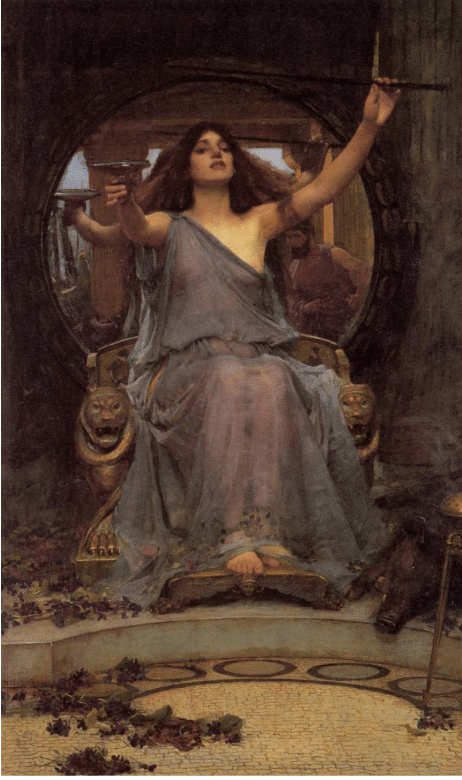
John William Waterhouse, “Circe Offering the Cup to Odysseus,” Oil, 58 in. x 36 in.
A life in art teaches us that, despite what our commercially based “STEM” culture (science, technology, engineering, and mathematics) would teach us, imagination and creativity are key to living well.
In the fantastical worlds of Greek mythology, Hecate is the goddess of magic, but Circe is the more storied enchantress. Some say Hecate was Circe’s mother, others that Circe was the daughter of the Sun god Helios and a water nymph named Perse, one of the 3,000 Oceanids, or daughters of Oceanus.
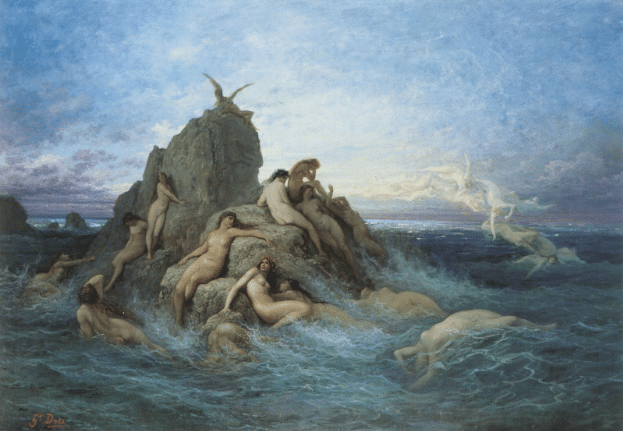
Gustave Dore, “The Oceanids,” circa 1864, Oil, 50 x 73 in.
Circe was renowned for her knowledge and expertise in magical potions and herbs. She was known to transform enemies, or those who offended her, into animals.
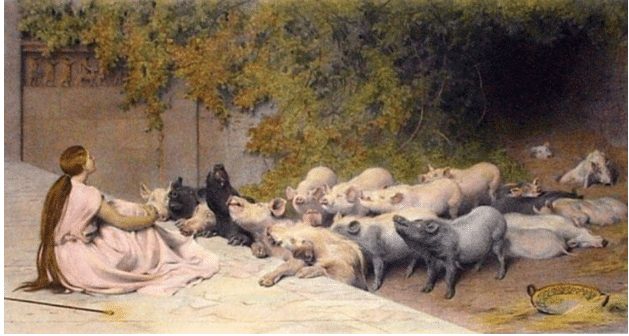
Briton Rivière, “Circe and her Swine” (before 1896)
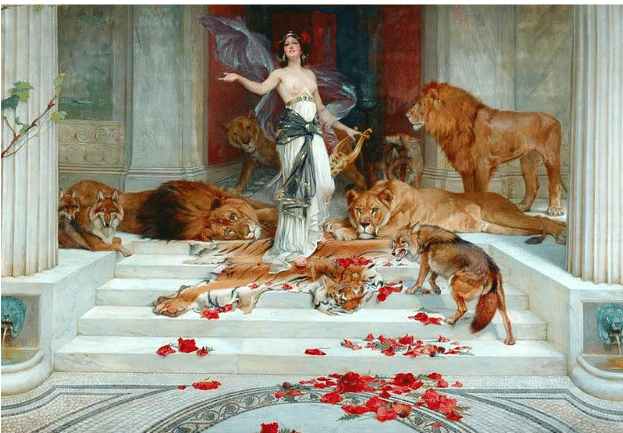
Wright Barker, Circe.
From the minute quantum dimension to the universal continuum, a vital and untamed Creative Force carries forward all things in a great rhythm of becoming. As creators, consciously or not, you and I already participate in its flow. Everything is connected and the world can be magical, not just in art, but in life.
Fate and Magic: The Art of Maureen McCabe
–
Fine Art Exhibition
“Fate and Magic: The Art of Maureen McCabe”
William Benton Museum of Art
Storrs, Connecticut
benton.uconn.edu
through December 14, 2025
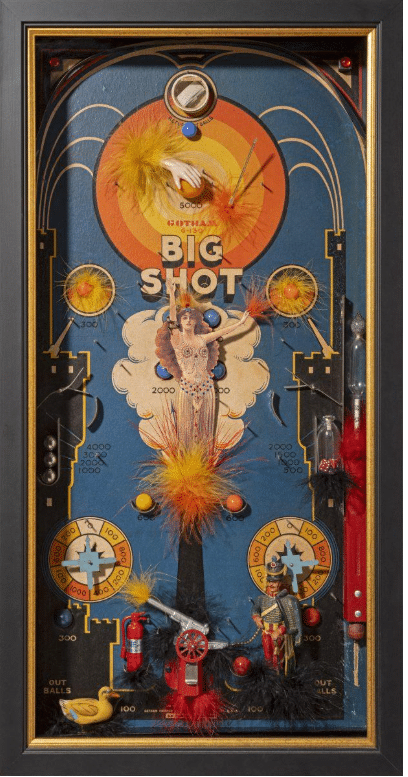
Maureen McCabe, “Blue Ionia” (2013), Mixed media on game board, Courtesy of the artist. Photography credit: Paul Mutino
Maureen McCabe taught art for 40 years at Connecticut College in New London, but now her retrospective, “Fate and Magic: The Art of Maureen McCabe,” is on view at another educational institution, the University of Connecticut’s William Benton Museum of Art. Through her assemblages and installations, this artist has returned repeatedly to the themes of fate and magic, creating playful yet carefully composed works that weave imagery from ancient and contemporary cultures, always informed by folklore, literature, spiritualism, and myth. Game boards, tarot cards, dice, birds, fortune tellers, and constellations populate McCabe’s works, prompting age-old questions about control over our power to shape our own destinies.
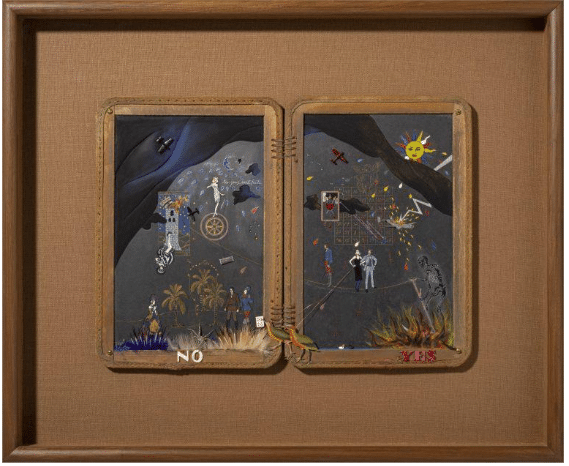
Maureen McCabe, “Les Jeux Sont Faits,” (1978), Mixed media on slate, Courtesy of the artist. Photography credit: Paul Mutino.
Much of McCabe’s art has the same sense of wonder, awe, and sleight of hand found in a magician’s performance, so the exhibition presents not only finished artworks from private collections and her studio, but also the magic paraphernalia she has acquired, including rapping hands, magic numbers, cups and balls, Ouija boards, and posters.
In the insightful essay she contributed to the show’s catalogue, Benton curator Amanda A. Douberley writes that McCabe “maps specific references on the back of each piece, pasting newspaper clippings and magazine articles, dedications, quotes, and other miscellany. She also includes a list of materials used, down to the brand of archival glue and the exact start and end dates for the work.”
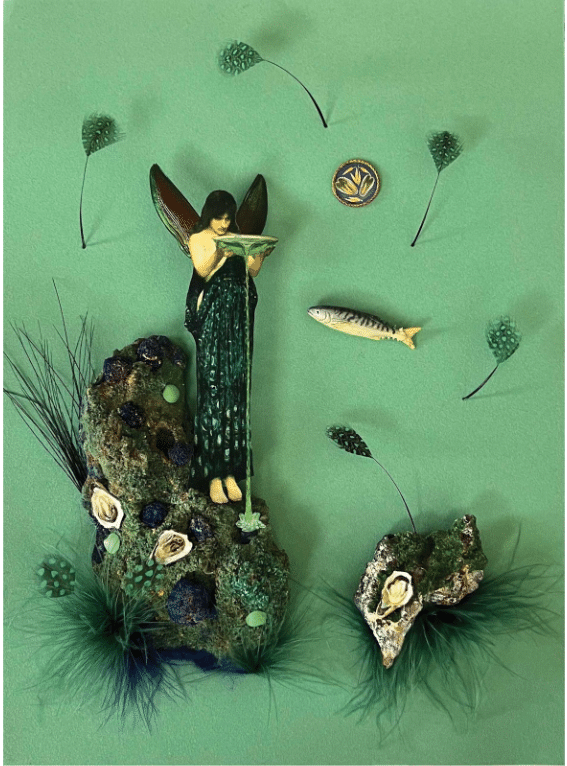
Maureen McCabe (b. 1947), “Circe (with Oysters and a Mackerel),” 2024, mixed media on velour paper, 13 x 10 x 3 in., collection of the artist; photo: Paul Mutino
Illustrated above is a superb example of McCabe’s vision. It shows Circe, an enchantress in Greek mythology, holding a potion that will turn her rival, Scylla, into a sea monster. McCabe’s femme fatale is drawn from J.W. Waterhouse’s painting “Circe Invidiosa” (1892), but — Douberley notes — “she has added beetle wings to the figure and placed her atop a chunk of malachite, the stone of transformation, which McCabe studded with azurite (healing) and oysters (transformation).
On the back, McCabe identified the fish we see as a mackerel, a symbol of good luck, and the dried flower encased in glass as a snowdrop from the artist’s own garden. In addition to a photograph of a snowdrop in bloom, she pasted a clipping that provides a clue to knit these pieces together. It reads, ‘When Odysseus set out to rescue his crew, he protected himself with an antidote derived from the snowdrop flower. Myths often have some basis in fact as this same antidote is being studied today as a possible treatment for Alzheimer’s disease.’”
Douberley concludes perceptively, “A work that is fundamentally about transformation, this piece shows the artist’s shifting perspective, as she nears 80 years of age, alongside her long-standing interest in the relevance of ancient myths and folktales to contemporary culture.”