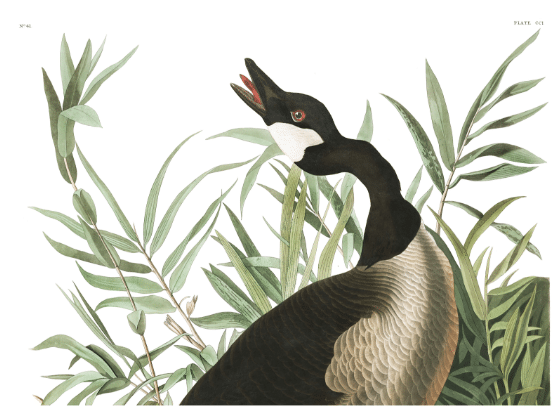
Over much of America around this time of the year, the familiar “v” formations of southerly migrating Canada Geese pass noisily overhead as they have for thousands of years. Their untranslatable calls make us stop a second and search the sky. For some, it’s like a call to life,, the way ordinary things can suddenly shine, the way painters and poets find inspiration.
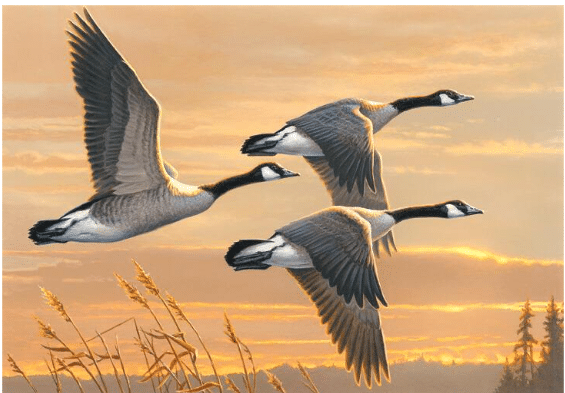
This acrylic painting by James Hautman of three Canada geese in flight served as the design for the federal duck stamp the U.S. Postal Service issued in the summer of 2017.
Like a powerful painting, the poem “The Geese” by American poet Galway Kinnell begins with that “ordinary” moment – hearing and seeing geese flying south. As it progresses, we discover at the core of the experience a sense of awe and wonder at the mysteries and power of the natural forces at work.
While describing the motion of a banking flock of geese, the poem moves increasingly from straightforward description further and further into the mysteries of natural instinct and the unseen currents flowing within, through, and around everything, including us.
THE GEESE
As soon as they come over the mountain
into the Connecticut Valley and see the river
they will follow until nightfall,
bodies, or cells, begin to tumble
between the streamers of their formation,
thinning the left, thickening the right,
until like a snowplowing skier the flock shifts weight
and shaking with its inner noises
turns, and yahonks, and spirit-cries
toward that flow of light spelled into its windings
ages ago – each body flashing white
against the white sky when the wings lift
and black when they fall, the invisible
continuously perforating the visible –
and trembles away, to vanish, but before that
to semi-vanish, as a mirage
or deepest desire does when it gets
the right distance from us and becomes rhythmic.
Galway Kinnell
A flock of geese in flight seems to appear and disappear from existence, “flashing white/against the sky when the wings life/and black when they fall.” Art is made at the intersection of knowledge and feeling. The longer you paint (or write, or compose music, or dance..), the more you discover how much of what we see and know is in flux all the time. No two gardens, no two flowers, no two blades of grass are truly the same.
Poets, artists, dreamers, and lovers (the poem’s ending references “deepest desire”) live most fully in that world-between-worlds, where experience, sensation, imagination, and expression create an ancient, substanceless magic. For we are the music makers and we are the dreamers of dreams, and the invisible continuously perforates the visible, until the thing seen, sung, dreamt, loved, nearly vanishes but doesn’t – only then becoming fully itself, only then fully real – “when it gets/the right distance from us and becomes rhythmic.”
As another poet asks in a different poem about natural things: “what is it you plan to do / with your one wild and precious life”?
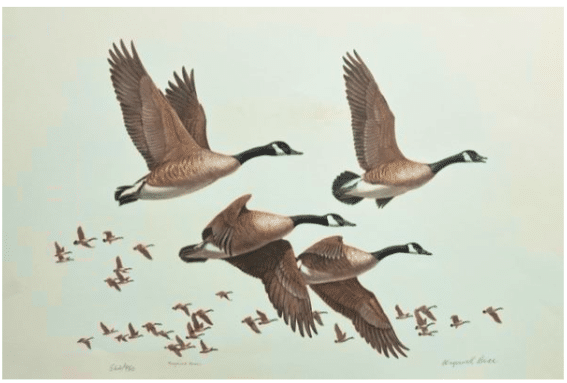
Maynard Fred Reece, Canada Geese in Flight.

Maynard Fred Reece, Canada Geese in Flight.

Maynard Fred Reece, Canada Geese in Flight.
The paintings above by Maynard Fred Reece capture something of the way the birds’ bodies flash between light and dark as they fly. Reece was an American artist based in Iowa whose work focused on wildlife, particularly ducks. He won the Federal Duck Stamp competition a record five times in his life: 1948, 1951, 1959, 1969 and 1971. Reece turned 100 in April 2020 and died in July that year.

Dustin Van Wechel demonstrates in a teaching video how he created this painting of a wild swan in golden light.
If you are interested in painting the marvelous birds of air and water, have a look into Dustin Van Wechel’s video “Painting Wildlife: Birds and Waterfowl”