“When I am feeling low all i have to do is watch my cats and my courage returns.” — Charles Bukowski
Pierre Bonnard seems to have spent a lot of time indoors. He painted dozens of interiors, and apparently he loved staying in and sheltering in place with his cat.
“How many days have I spent alone with my cat,” he wrote, “and when I say alone, I mean without a material being, for my cat is a mystical companion, a spirit.”
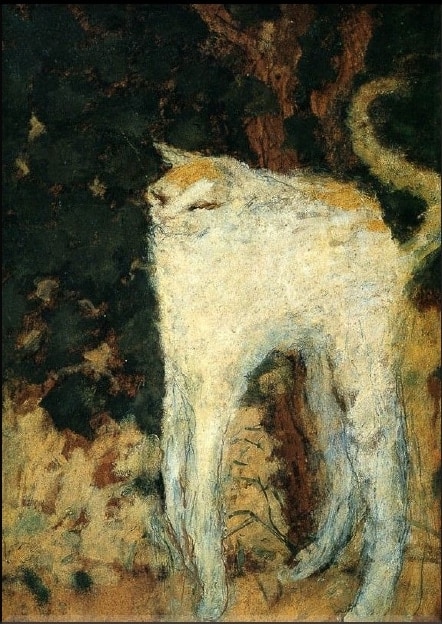 |
| “The White Cat” • Pierre Bonnard • 1894 • Oil on Card • 51x33cm |
Bonnard’s 1894 painting The White Cat has a whimsical innocence and a joie-de-vivre that stays with you long after you’ve seen it. Bonnard has exaggerated the length of the animal’s legs and given it a little head comically peeking out of a big puff of casually applied paint.
Bonnard was painting during the post-Impressionist era in France, and as such, he was among the many avant-garde artists in Paris whose heads were still spinning from Monet and Renoir, and who were asking, “Okay, what now?” He was part of a group calling themselves the “Nabis,” or “Prophets,” who discarded traditional painting methods in favor of playfulness, innovative color, pattern, and design.
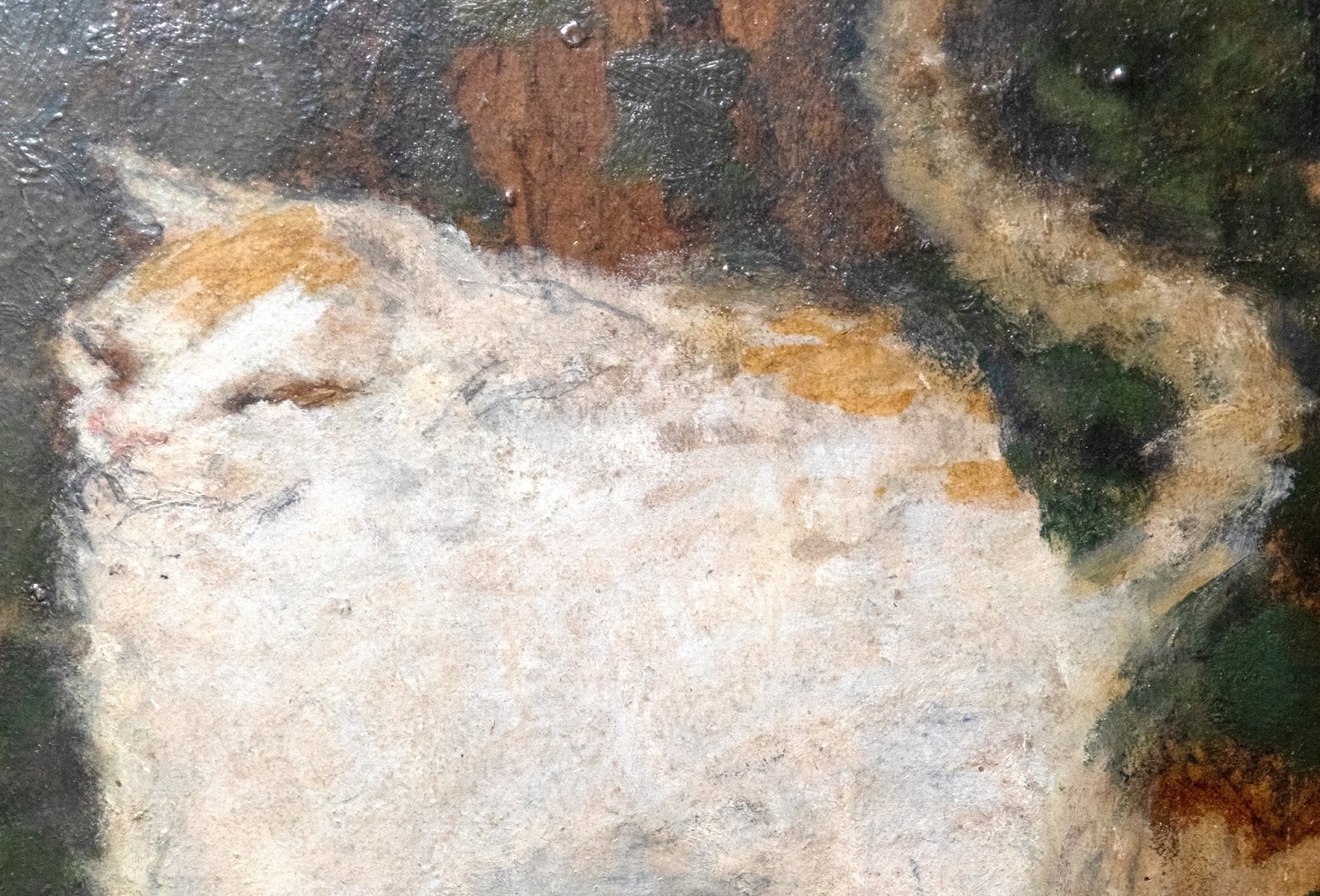
Perhaps this is indeed a “spirit cat”; its paws seem barely to touch the ground, as if the being were levitating, floating across the space like the “mystical companion” the artist believed the feline to be. Although it may look easy, what he was then was pretty new; it’s said it took him months to get the paws exactly as he wanted them.
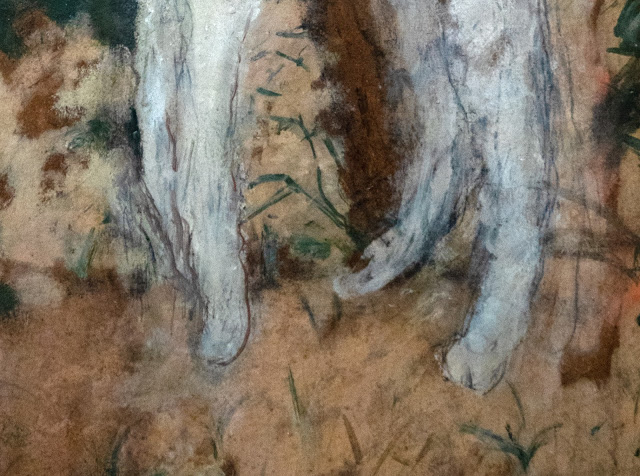
Detail of Bonnard’s “Le Chat Blanc” showing spirit paws.
Compare Bonnard’s mystical spirit cat with Chardin’s decidedly non-spiritual, wild-eyed beast dominating a pile of oysters and staring down a dead fish in Chardin’s 1728 virtuoso still life, The Ray.

Detail: Jean Baptiste Siméon Chardin, La Raie, 1728, Musée du Louvre
In the Chardin, it’s the arch of the back, the pointed-back ears, the round, wide-open eyes that ring true. We’ve all seen cats in a pose something like this. Both artists, Bonnard and Cardin, despite their polar opposite assessments, were faithful witnesses to the inner life of cats, don’t you think?

Pierre Bonnard, The Cat’s Lunch, 1906
Bonnard became known as a painter of cats, and before we leave him, I have to say, when I saw a picture of his 1906 painting The Cat’s Lunch (above), I literally laughed out loud – it struck me like a precursor to the famous salad cat / screaming woman meme.

I know, I know – that’s an insult to art hiss-story!
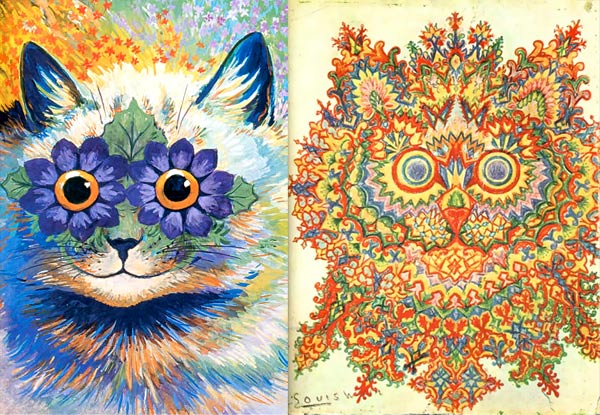
Psychedelic cats by Louis Wain, an artist diagnosed with schizophrenia in the 1920s. Though he died in an asylum in 1939, his cats are in demand among avid collectors. He’s one of art hisstory’s most famous cat fanciers.
So, where are all the famous cat paintings? It’s a curious fact, but there are way more dogs than cats in the works of the old masters. Perhaps it’s because dogs were seen as admirable symbols of loyalty and devotion, while cats were thought of primarily as rat-catching machines (though that hardly seems like a very good reason not to paint them). Perhaps, too, it’s that it’s easier to get a dog to sit still for you than a cat.
On the latter point, animal (and plein air) painter Kathleen Dunphy concurs. She loves to sketch cats, or try to, anyway: “My biggest problem is that every time I sit down with my sketchbook and start to draw them, they have to immediately come over and jump on my lap, purring and rubbing up against me and batting my pencil,” she says. “And then they usually just flop down on top of my sketchbook to get comfortable and take a nap. A friend told me I should just trace around them next time, and that’s really not a bad idea!” Kathleen
Watercolorists have an even harder time of it. Just ask Shlley Prior: “Cats eat paint brushes and drink paint water,” she says. “They also like to walk across or lay down right on the artwork – but not before nonchalantly walking across the wet palette first. The fact that you are in the middle of painting a wash is completely irrelevant.” Shelley has a whole video on painting pets in watercolor. Check it out if you’d like to learn how to paint our “furry friends” using watercolors.
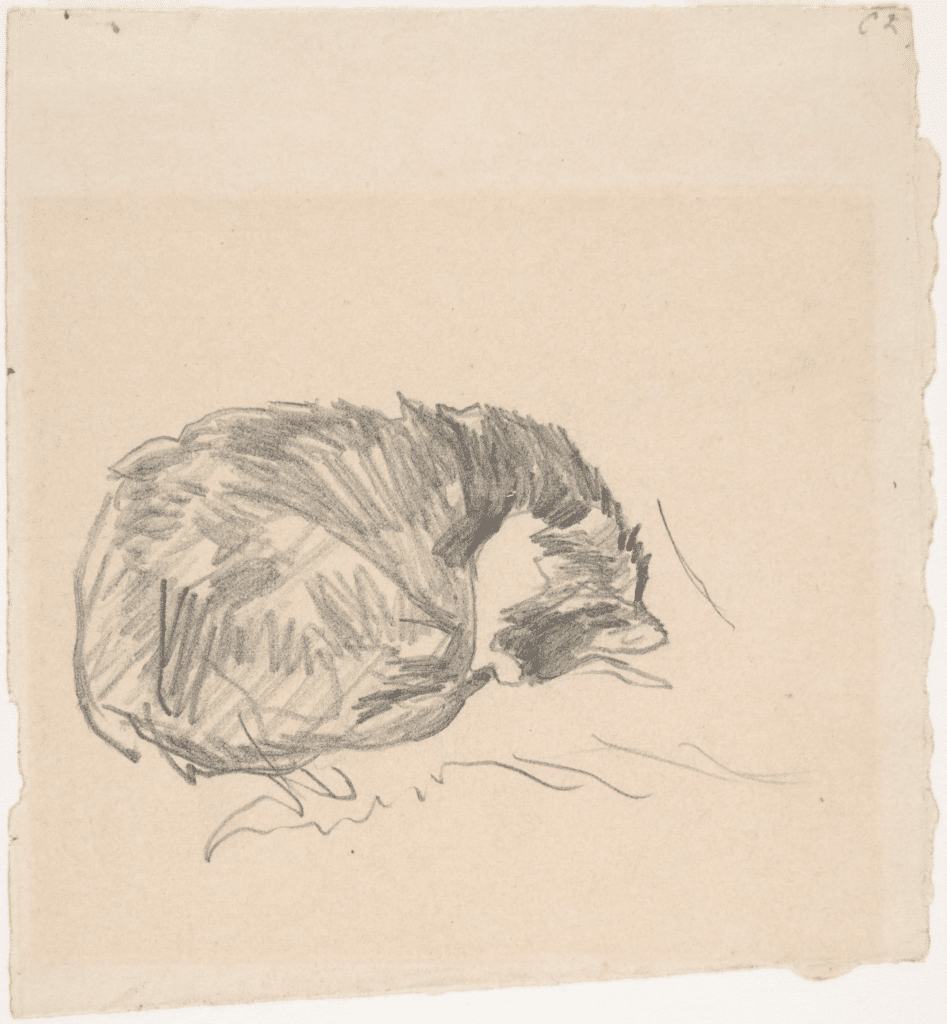
Sketch of a sleeping cat by Manet
Maybe that’s the secret – wait until they’re asleep.
I would love to hear from readers about favorite paintings of cats – (hold the memes, though, please – my plate is already full). I’d be happy to post pics in a future article. In fact, any thoughts about art and cats would be welcome …
- Do you have a favorite cat painting or know of a determined and successful cat painter?
- Have you painted a cat or know anyone who’s tried?
- Do you have a story about an artist and his or her cats, or know someone, like @LittleLostLad on Twitter, whose girlfriend made an art gallery for their cat during lockdown?

Please write in!

I’ll leave you with “Pangur Bán,” an Old Irish poem by an anonymous monk of the 9th century or thereabouts. It’s about how a cat and its human pursue their individual “arts” alongside each other, though not exactly “together.”
I and Pangur Bán, each of us two at his special art:
his mind’s on hunting, mine is in my own special craft.
I love to rest—better than any fame—at my booklet with diligent science:
not envious of me is Pangur Bán: he himself loves his childish art.
…
Though we are thus always, neither hinders the other:
each of us two likes his art, amuses himself alone.
He himself is master of the work he does each day:
while I’m at my own work, bringing clarity to the complex.