
By John MacDonald
In part one of this two-part series, artist John MacDonald writes about the difference between painting from photos and painting from life and about how to get out of our own way when confronted with the vast treasure-store of the great outdoors.
Painting plein air is substantially different from painting in the studio. Painting in the studio is like cross-country skiing. It’s deliberate and methodical. We take one step at a time with our focus on the far destination, a goal that is often visible during the entire, slow process.
Plein air painting is skiing downhill at a blistering pace on a narrow, twisting run that always seems to be rated one level above our ability. It’s risky and unpredictable and crazy and frequently ends in crashes that are anything but pretty. So why do so many representational painters do it?
There are probably as many reasons to paint plein air as there are artists. All my reasons can be reduced to this: painting plein air is unparalleled training for the eye, the head, and the heart.

John MacDonald, Late October Light on Deerfield, 12×9 inches
Eye Training
Those of us who paint in the studio invariably rely on photographs. They’re often an important and necessary resource for painters. But even the most expensive camera can’t compete with the astonishing sensitivity of the human eye. It’s through repeated painting in front of raw nature that we train the eye to see clearly and sensitively and consequently we learn the limitations of the camera.
We discover that a camera cannot capture many of the subtle tonal and color relationships found in nature nor the way in which light reveals form. Painting plein air vastly expands our visual vocabulary as we become much more knowledgeable and skilled in seeing and understanding tone, color, and the interplay of light and form.
Head Training (Facing Down Fear)
Simply put, plein air painting is superb fear training. It will show us how we manifest and react to fear—all those subtle little games we play with ourselves to avoid feeling the uncomfortable emotions of fear and anxiety. When a painting begins to fall apart during a plein air session, do we succumb to the temptation to fall back into safe, formulaic, painting?
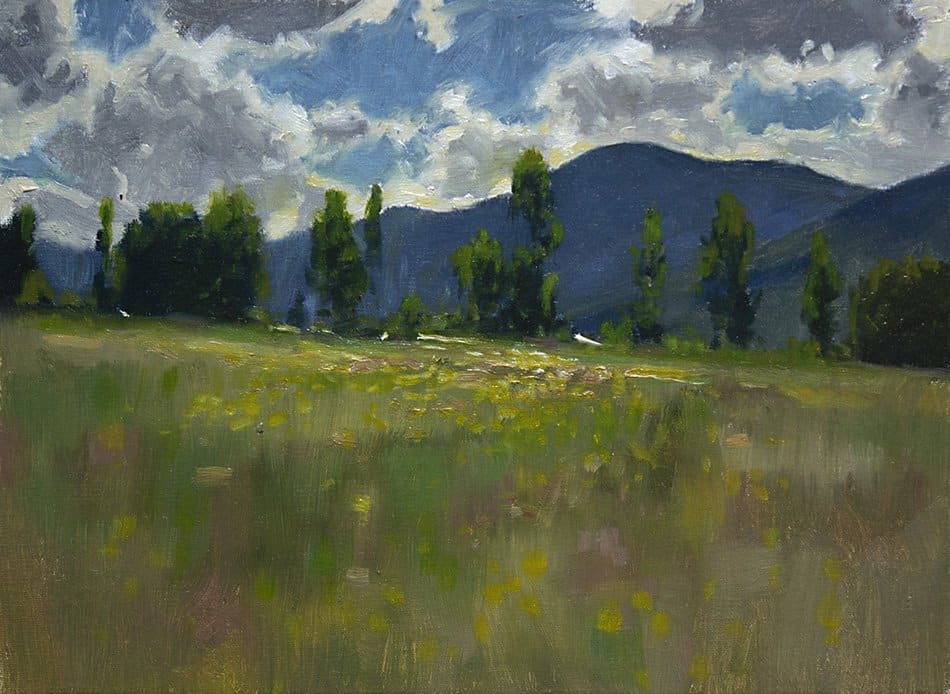
John MacDonald, June Meadow, 9×12 inches
To avoid the uncomfortable feelings of fear, do we shut our eyes and crank out safe, predictable, and boring images that reinforce our belief that we’re in control? Instead, why not use plein air painting to help us learn to recognize, understand, and then manage our fears?
We can learn to keep a beginner’s mind and an open eye—looking intently and freshly at the visual information in front of us—even while our mind is in panic mode and is throwing a fit. Managing our fears and trusting in the process is no guarantee that the painting will succeed but it does guarantee that we’ll have an opportunity to learn and come out of the experience as a better painter.
John MacDonald teaches the principles of standout landscape painting in his video, Creating Dynamic Landscapes. Download it today.

John MacDonald, Woods, November Sunset, 12×16 inches
In part two of “On Plein Air,” John MacDonald addresses the role of failure (it’s a good thing – no, really!) and the role of the heart while painting in front of the motif in nature.
Land Yourself in the Thick of It!

By Chula Beauregard – plein air subject or flight of fantasy?
Chula Beauregard (b. 1974) will be among the over 80 painters giving demos and sharing their time during the five days of teaching and painting during the Plein Air Convention & Expo (PACE) May 21-25, 2023.
Chula is a sixth-generation Coloradan, passionate about painting since the age of 11. Bridging classical painting techniques with modern mark-making, she paints in order to honor the infinite Beauty of the West, while striving to lend a relevant voice in these modern times. A signature member of the American Impressionist Society and the American Women Artists, Chula has been honored with AWA and the Presidential Award of Excellence (Oil Painters of America). She is represented by the Broadmoor Galleries (Colorado Springs, CO), Simpson-Gallagher Gallery (Cody, WY), and R-Diamond Gallery (Steamboat Springs, CO).
Every year, hundreds of the world’s most enthusiastic outdoor painters gather at PACE to learn painting techniques from the world’s top artists. They come to see what’s new, what’s hot, and what’s working RIGHT NOW in art marketing. It is the largest gathering of plein air painters on the planet and there is no other event like it. The “Woodstock of plein air” is different every year, yet every year there are artists at PACE who are, or will become, some of the greatest artists of our time… and you get to meet and mingle with them.
Learn more about PACE.