“Art is probably one of the only true things left which exist for its own sake and nothing else…..It has alchemy with those that take part in looking at it, at the gaze of it.” – Tracey Emin
Of the primary colors, blue is the most elusive and the most mystical.
“Blue are the life-giving waters,” sang Jimi Hendrix, who at Woodstock wore a cloud-colored jacket and plush turquoise pants.
Blue is the sapphire’s sheen, Our Lady’s sacred robe. Bluets can blanket a field in spring like cross- and star-shaped confetti.
“Blue is the deepest color;” says the Penguin Dictionary of Symbols, losing itself in cerulean poetry, “unimpeded the gaze plumbs infinity, the color forever escaping it…. the most insubstantial of colors, it seldom occurs in the natural world except as a translucency, that is to say, an accumulation of emptiness, the void of Heaven, of the depths of the sea, of crystal or diamond.”
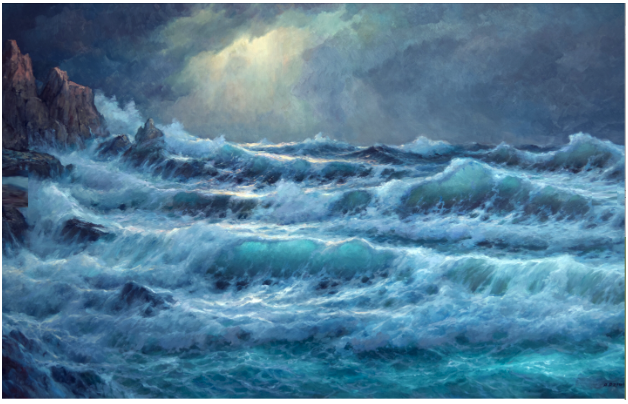
Alex Dzigurski, “Silver Sea,” oil on canvas, approx. 36” x 48.” Dzigurski I (1911-1995), was a Serbian-American master known as “The Poet of the Sea” for his ability to capture nature’s essence through sublime color combinations. His son, Alex II inherited his father’s exceptional skills and created his own unique style. He demonstrates the family legacy of dazzling moonlit seascapes steeped in multiple shades of blue in his teaching video, How to Paint Crashing Waves.
“Blue disembodies whatever becomes caught in it,” they say. It retains a purity not of this world, into which “movement and sound, like shapes disappear… sink and vanish like a bird in the sky….. It is the road to infinity ln which the real is changed to the imaginary.” (Surely The Penguin Dictionary of Symbols is the most imaginative dictionary ever published.)
And, “After all,” the writers say, “it is the color of the bird of happiness, that blue bird which is always so near and yet so far…. Light blue is the color of meditation, and as it darkens naturally, it becomes the color of dreams.”
Blue is mystery, twilight, the Deep. Picasso’s blue period paintings shimmer with the unearthly aura of introspection, melancholy, and moonlight. When the moon comes out, “water covers land,” wrote the poet Garcia Lorca, “And the heart feels itself/An island in infinity.”
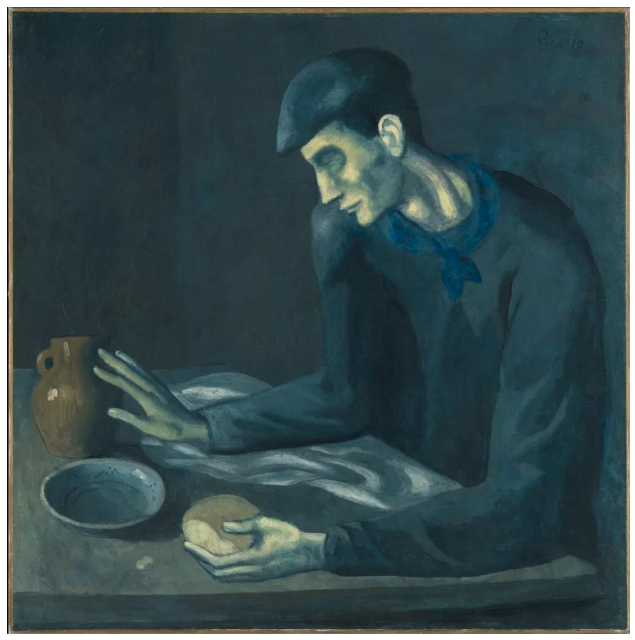
Pablo Picasso, The Blind Man’s Meal, (Le Repas de l’aveugle), 1903, The Metropolitan Museum of Art
Poets find in it feeling and connection, as in A.E. Housman’s “blue remembered hills” and Walt Whitman’s gladdening “clear blue arching over all.” But for painters, Maggie Nelson‘s words, from her book-length prose-poem titled Bluets, perhaps ring truest of all:
“Don’t fool yourself and call it sublimity. Admit that you have stood in front of a little pile of powdered ultramarine pigment in a glass cup at a museum and felt a stinging desire…. You might want to reach out to disturb the pile of pigment, for example, first staining your fingers with it, then staining the world.”
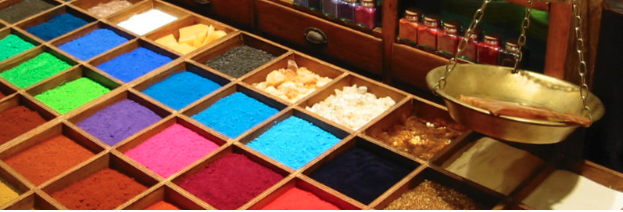
If your painting prowess would get a boost from a better understanding of color, you might like Johnnie Lilidahl’s teaching video, Understanding Color.”
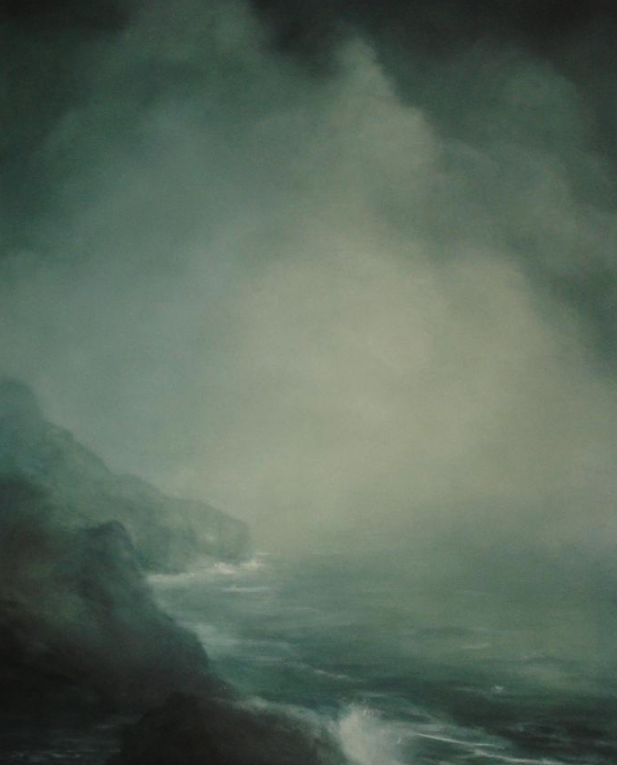
Shelley Breitzmann, “Safe in Our Unknowing,” acyclic, 20” x 16” Breitzmann won an honorable mention in one of our recent monthly PleinAir Salons. Learn more and consider entering yourself right here.
Catching Up with Cassatt
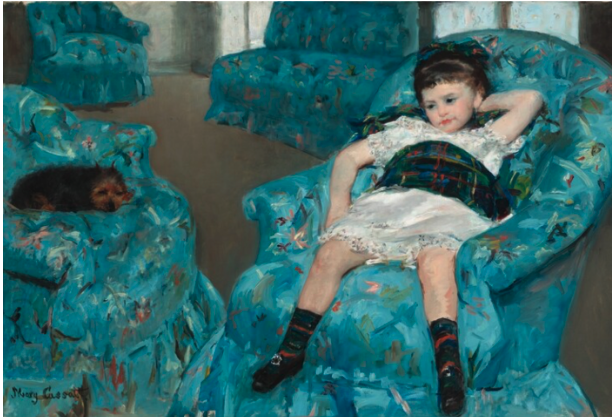
Evidently, Mary Cassatt, whose painting of the girl on the blue couch crowns this page, loved animals almost as much as children and mothers. In “Woman on a Striped Sofa with a Dog” (below) there’s more connection between the dog and the woman pausing at her sewing (below) than there is between the sleepy pooch and the bored little girl in on the bright blue furniture above.
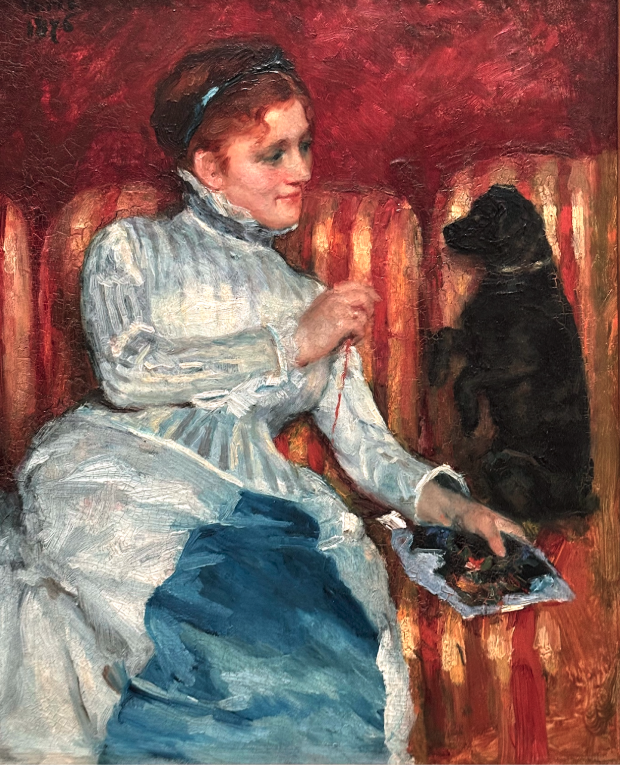
Woman on a Striped Sofa with a Dog,” 1876, Oil on panel. Fogg Museum, Harvard.
Mary Cassatt was born on May 22, 1844, in Allegheny City, Pennsylvania. She was the daughter of a wealthy real estate broker and grew up in a privileged environment, which allowed her to pursue her artistic ambitions. Cassatt moved to France for her artistic training and became a prominent figure in the Impressionist movement, known for her depictions of women and children. She was the only American artist to exhibit with the Impressionists in Paris, where she formed close friendships with artists like Edgar Degas.
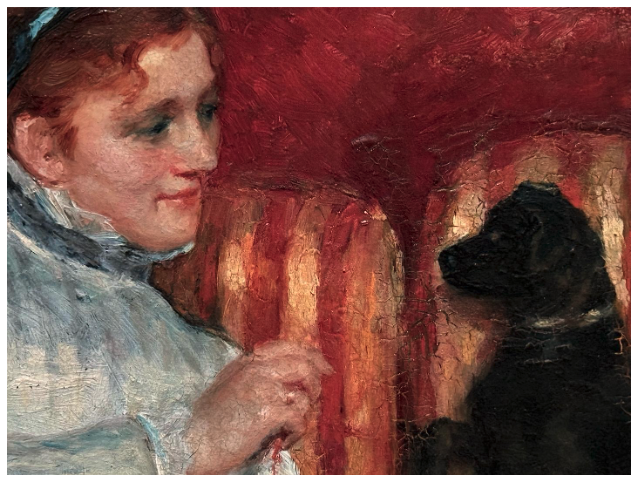
This painting, from 1876, and the one at the top of the page from 1878 both date to a transitional period in her career, when she was still seeking official recognition from the French Academy. Here, the deep-red wall behind the sitter can be considered part of that effort, as this work was painted in the same year that another of Cassatt’s works was finally accepted to the Salon – albeit after she darkened its background. Three years later, at the invitation of Degas, Cassatt began exhibiting with the Impressionists.
Cassatt was one of three women and the only American in the group. The rest of America, for the most part, would need another 10 years or so to catch on to what the Impressionists were getting up to.
It doesn’t hurt to know how to add a dog now and again. If four-pawed pals are up your alley, check out the instructional video, “Johanne Mangi: The Fine Art of Painting God Portraits.”