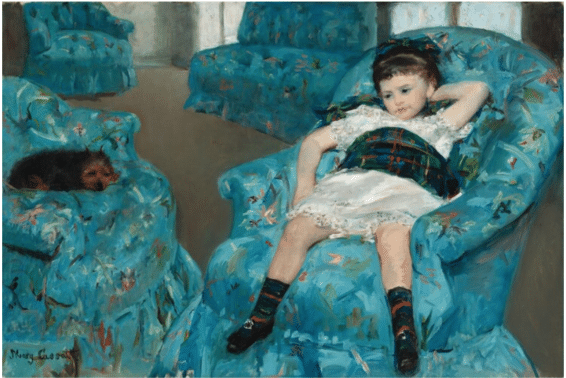
“Art is probably one of the only true things left which exist for its own sake and nothing else…..It has alchemy with those that take part in looking at it, at the gaze of it.”
-Tracey Emin
Of the primary colors, blue is the most elusive and the most mystical.
“Blue are the life-giving waters,” sang Jimi Hendrix, who at Woodstock wore a cloud-colored jacket and plush turquoise pants.
Blue is the sapphire’s sheen, Our Lady’s sacred robe. Bluets can blanket a field in spring like cross- and star-shaped confetti.
“Blue is the deepest color;” says the Penguin Dictionary of Symbols, losing itself in cerulean poetry, “unimpeded the gaze plumbs infinity, the color forever escaping it…. the most insubstantial of colors, it seldom occurs in the natural world except as a translucency, that is to say, an accumulation of emptiness, the void of Heaven, of the depths of the sea, of crystal or diamond.”

Alex Dzigurski, “Silver Sea,” oil on canvas, approx. 36” x 48.” Dzigurski I (1911-1995), was a Serbian-American master known as “The Poet of the Sea” for his ability to capture nature’s essence through sublime color combinations. His son, Alex II inherited his father’s exceptional skills and created his own unique style. He demonstrates the family legacy of dazzling moonlit seascapes steeped in multiple shades of blue in his teaching video, How to Paint Crashing Waves
“Blue disembodies whatever becomes caught in it,” they say. It retains a purity not of this world, into which “movement and sound, like shapes disappear… sink and vanish like a bird in the sky….. It is the road to infinity ln which the real is changed to the imaginary.”
And, “After all,” they say, “it is the color of the bird of happiness, that blue bird which is always so near and yet so far…. Light blue is the color of meditation, and as it darkens naturally, it becomes the color of dreams.”
Blue is mystery, twilight, the Deep. Picasso’s blue period paintings shimmer with the unearthly aura of introspection, melancholy, and moonlight. When the moon comes out, “water covers land,” wrote the poet Lorca, “And the heart feels itself/An island in infinity.”
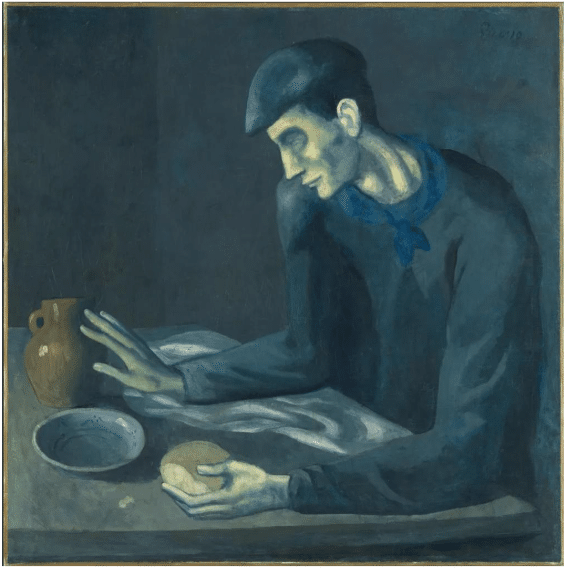
Pablo Picasso, The Blind Man’s Meal, (Le Repas de l’aveugle), 1903, The Metropolitan Museum of Art
Poets find in it feeling and connection, as in Housman’s “blue remembered hills” and Whitman’s gladdening “clear blue arching over all.” But for painters, Maggie Nelson‘s words, from her book-length prose-poem titled Bluets, perhaps ring truest of all:
“Don’t fool yourself and call it sublimity. Admit that you have stood in front of a little pile of powdered ultramarine pigment in a glass cup at a museum and felt a stinging desire…. You might want to reach out to disturb the pile of pigment, for example, first staining your fingers with it, then staining the world.”
If your painting prowess would get a boost from a better understanding of color, you might like Johnnie Lilidahl’s teaching video, Understanding Color.”
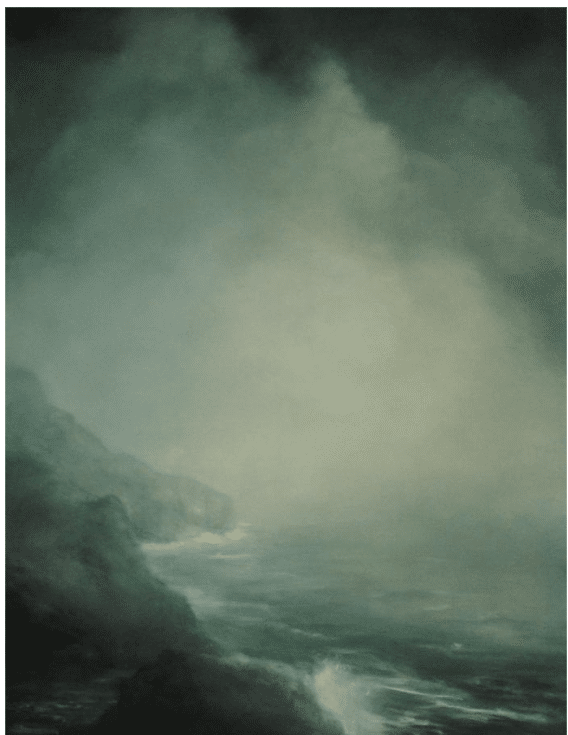
helley Breitzmann, “Safe in Our Unknowing,” acyclic, 20” x 16” Breitzmann won an honorable mention in one of our recent monthly PleinAir Salons.
Learn more and consider entering yourself right here.

Photo by Eleonora Catalano on Unsplash
Three Ways to Paint Better Right Now
By Kelly Kane
Hoping to be a stronger, better painter in 2025? Thought so. Streamline Publishing Editor Kelly Kane has three ways you begin, starting today:
- Attend a painting event such as the Plein Air Convention & Expo, or Watercolor Liveif you can’t join us in person.
- Learn from a favorite artist. We have more than 700 step-by-step art video workshops available at PaintTube.tv, where you can learn from home and at your own pace.
- On a budget right now? We understand. Take a free dive into the library of Art School Live, and then invest in your art education when you’re able.
Other ideas are to explore new subject matter, complete a specific number of works in a given time period, or focus on a “basic” element such as value or composition.
When it comes to prioritizing your time for art, be firm but flexible. At the start of every week, look at your calendar and reserve space for art — whether that’s flipping through your favorite art books, visiting your local museum, doing a quick sketch, or setting aside a block of time for serious studio work, and then protect it. That includes turning off your phone.
(Or whatever device you’re reading this on right now! – cv)