From radioactive threat to saintly halo to honeybee fur, yellow shines, the most luminous of the primaries. Whether strident, dazzling, or molten, yellow is light, intense and uncontainable, symbolic of joy, youth, strength, and divine immortality. Yellow is the brightest color that the human eye can see.
Yellow ochre pigment was one of the first colors used in art. Because it’s widely present in nature, it appears in prehistoric cave paintings in various locations all over the world. The famous cave paintings of Lascaux, France from over 17,000 years ago portray horses and wild animals in vivid tones of yellow. Thousands of year later in China, bright yellow was the color of the Middle Kingdom and could be worn only by the Emperor and his household. Special guests were welcomed on a yellow carpet.
In religions the world over – ancient Egyptian, Islamic, Christian, Judaist, Buddhist – the color yellow-gold radiates enlightenment, prosperity, attainment, absolute perfection. The Tibetan divine word, om, sonic essence of the universe itself, is traditionally depicted in gold, representing the earthly-cosmic unity, the flame of purity, knowledge, and illumination.

Golden mosaics in the Byzantine apse of the Basilica of San Vitale in Ravenna, Italy. Consecrated in 547 A.D.
Adornment of emperors, kings, heroes and gods, proclaiming the divine source of their power; spiritual color of eternal life, aspects of Mithras and Apollo: Yellow is the divine essence on Earth, whose light partakes of the almighty sun. Gold is the mystical vision; in in ancient Egyptian art, it’s both the deific light of the sun god Ra and the flesh of the gods and Pharaohs themselves.

Gold funerary mask from the sarcophagus of King Tutankhamun, ancient Egyptian pharaoh who ruled c. 1332 – 1323 BC during the late Eighteenth Dynasty of ancient Egypt. Fashioned from two layers of high-karat gold inlaid with lapis lazuli, quartz (the yes), obsidian (the pupils), carnelian, amazonite, turquoise and faience. It weighs about 230 pounds.
“The glitter of gold sometimes becomes a two-way channel of communication, an intermediary between gods and mankind,” notes The Penguin Dictionary of Symbols. “From an ounce of gold you can make a thread as thin as a hair and long enough to encircle a whole village…. gold, by its purity and incorruptibility, is the metal above all others of hidden knowledge.”
In nature, yellow appears often, in buttercups and dandelions, in fields of rye and wheat such as we see in van Gogh. Vincent stands out among historical artists for his mastery of the newly discovered chrome-yellow hues in all their radiant beauty. During what scholars call his “yellow period” (around 1886-1890), he was all but obsessed with the yellow of sunshine. According to his friend Paul Gaugin, the Dutch painter had “a fondness for yellow” because “sun baths bathed his soul. He was a man who feared darkness. He needed heat.”

Vincent van Gogh, “Sunflowers” (1888), one of Van Gogh’s favorite subjects.
“Nature’s first green is gold,” says Robert Frost, likening spring shoots to the precious metal so imbued with value, both monetary and symbolic.

Odilon Redon, “Yellow Tree,” (1900), oil
The visionary French painter Odilon Redon wove marvelous, colorful dreams in oils and pastels. Redon’s use of evocative color in his late pastels and oil paintings explore the expressive and suggestive powers of color. In many of these works, such as “Yellow Tree” below, Redon’s figurative subjects flicker and fade in and out of ethereal chromatic backgrounds.
All of the color’s associations – historical, earthly, cosmic, and divine – swirl around the subjects of Gustav Klimt’s unforgettable paintings. With its life-size figures, ornate designs and gold, The Kiss is Klimt’s most popular work and visitors flock annually to see it in Vienna’s Austrian Gallery.

Gustav Klimt, “The Kiss,” (1907) oil and gold leaf, 72in x 72in (180cm x 180cm).
Klimt’s lovers wrapped in embroidered golden-yellow cloths inhabit a world of their own where gold stars swim the cosmic air around and wildflowers flood the earth beneath them. It was seeing the Byzantine mosaics at Ravenna (image near top of this page) that inspired his greatest work.
Not unlike Van Gogh, Wassily Kandinsky, the father of modern abstraction, believed that different colors have distinct spiritual and emotional properties. However, Kandinsky thought of paintings like a musical score, and he composed his works (with titles such as “Improvisations” and “Impressions”) based on the emotional resonance of color alone. He very nearly abandoning representation altogether to give his colors the freedom to be wholly expressive of what he called the creative work’s “inner nature.”

Wassily Kandinsky, ““Impression III (Concert)” Oil on canvas. 30.5 × 39.4″ (77.5 × 100.0 cm). Munich, The Städtische
In Kandinsky’s “Impression III (Concert)” of 1911 (above), the mass of bright yellow sweeping in from the righthand side suggests how the music spreads over an enthusiastic audience. The crowd, ranged round on the left side in carefully considered primary reds and blues, presses forward, drawn toward the central, high-contrast field of black, where we find the suggestion of a tiny performer sitting at a massive piano. The piece isn’t meant to be read through details like a Tintoretto or a Leonardo; it’s to be experienced all at once, and playfully, as a fully aesthetic object, the immediate equivalent of a highly charged experience, a spontaneous burst of untamed feeling for music and life.
Of course, no meditation on the color yellow in painting can omit a nod to the outsized role that lemons have played, and continue to play, in riveting eyes to canvases.

Willem Claesz. Heda, Still Life with Fruit Pie and various Objects, (1634) Oil on panel., 43.7 x 68.2 cm. Museo Nacional Thyssen-Bornemisza, Madrid.
From the first still life paintings in oil, yellow lemons blazed life into the muted tones of Dutch interiors. The (imported) orange or lemon with curling peel suggested simultaneously the wealth of the patron’s household, the strength of Dutch trade, and the paring away of mortal life by the inexorable blade of time.
Contemporary realist Fraser takes the motif, sheers away the symbolism, and runs with it. “Contemporary painters still use this luscious visual conceit,” Fraser says of the peeled lemon in painting. “I decided to exaggerate the effect by extending the lemon peel to extreme lengths, keeping the eye moving and creating a kind of surreal tension.”
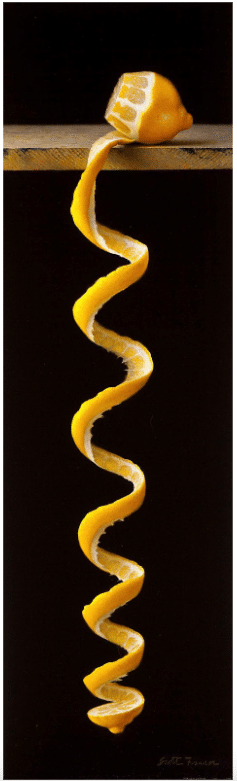
Scott Fraser, “Peeled,” 27 x 8.25 inches, Oil on board.
Designers consider yellow the color of optimism, energy, enthusiasm, happiness and upbeat positive thinking. Thus, the color yellow is often used for children’s toys and clothes. It’s considered a color that resonates with the left (or so-called logical) side of the brain, inspiring thought and curiosity – the flash of illumination, fresh thinking, the color of new ideas.

Yellow Cactus, 1929, Georgia O’Keeffe
If you’re looking to improve your paintings with a stronger grasp on color and color relationships, check out Suzie Baker’s video, “Color Magic for Stronger Paintings.”