Some of the very earliest expressive landscape paintings in America came out of early 19th century artists’ visits to the Adirondack mountains.
Government agencies commissioned early American landscapists to report on and document newly “settled” regions of the country. Along with the White Mountains in New Hampshire and the Catskills in New York, the Adirondacks rate among the earliest regional subjects for these adventurer-artists. What’s more, it may well be in the Adirondacks that an artist first gave us much attention to feeling as to topological documentation, thus creating, perhaps, one of the first fully realized plein air paintings in America.
New York State’s Adirondack Park contains 6 million acres of private and public land graced with mountains, streams, valleys, waterfalls, forests, fields and lakes (more than 3,000 lakes in all).
According to the New York Almanac, though tourists were flocking to Saratoga Springs in the 1830s, few ventured further north into the “lofty chain of granite” visible from Lake George. One guidebook described the mountain range’s mysterious forms as “a wild repulsive aspect.”
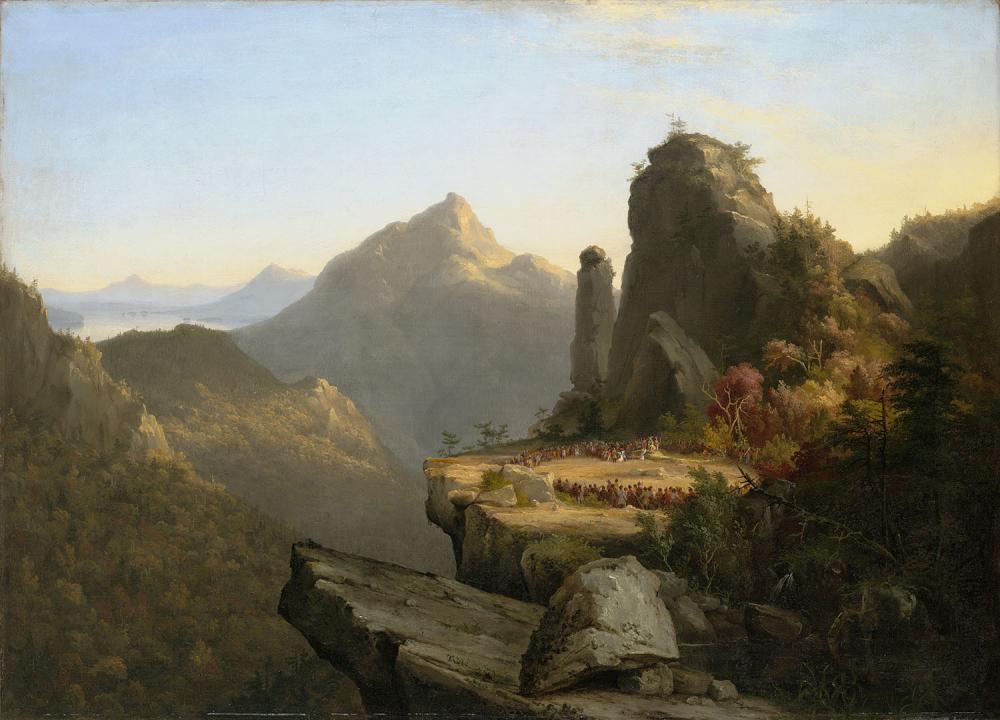
Thomas ColeScene from “The Last of the Mohicans,” Cora Kneeling at the Feet of Tamenund Oil on canvas, 1827
And yet, from its earliest exploration, the region of the Adirondack Mountains tempted artists lured by the prospect of nature in its purest form. Thomas Cole, the “father of the Hudson River School,” is known to have taken at least four journeys northward toward the headwaters of the Hudson River and into the depths of the Adirondack wilderness. Cole’s adventures in the Adirondacks began with his 1826 trip to Lake George, which resulted in his Ticonderoga and Last of the Mohicans paintings.
Still, little enough was known of the Adirondack Mountains in 1836, when the New York State legislature commissioned geologist Ebenezer Emmons and artist Charles Cromwell Ingham to make exploratory surveys and bring back images of the wild and rocky region.

Charles Cromwell Ingham, The Great Adirondack Pass Painted on the Spot, 1836
During the trip, Ingham painted The Great Adirondack Pass Painted on the Spot (right). Although Cole and others made “on-the-spot” oil sketches for larger studio works (see above), plein air painting per se wasn’t a major force in America until French Impressionism finally made an impact in the 1890s.
Before Cole and Ingham, most “topographic” paintings were strictly about recording information about a place. Indeed, travelers later commented on the accuracy of Ingham’s painting. However, overall, the painting captures the awe and wonder that characterized early settlers’ views of the Adirondacks. Ingham has embellished his reportage with drama and beauty by placing in his foreground a remarkable line of standing stones made mysterious by enveloping shadow – can we call it one of the first intentional, complete plein air paintings in America? May be a stretch, still an unusual and compelling painting.
Asher B. Durand was another early Adirondack fan. Durand’s paintings of Lake George and nearby forests demonstrate attention to detail and documentary-like views, suggesting early settlers’ views of the Adirondacks as novel, uncharted territory. Similar to map makers and surveyors, in paintings like Butternut Tree at Hague (below), Durand gives first importance to line and accuracy over color and personal expression.

Asher B. Durand, Butternut Tree at Hague (1862) 23″ x 16″
However, Durand’s studio paintings of the region tend to exhibit less attention to line and detail so as to capture the expansiveness of the Adirondack landscape. Durand’s 1870 painting, Adirondack Mountains, N.Y. (below) suppresses some of the specific details that characterized paintings like Butternut Tree at Hague while remaining faithful to the specific topography of the location.

Asher B. Durand, Adirondack Mountains, NY, 1870
Eventually, dozens of painters arrived who painted landscapes of the region including John Frederick Kensett, Homer Dodge Martin, and Alexander Hedwig Wyant, who is associated with the Tonalist movement of 1880-1920.
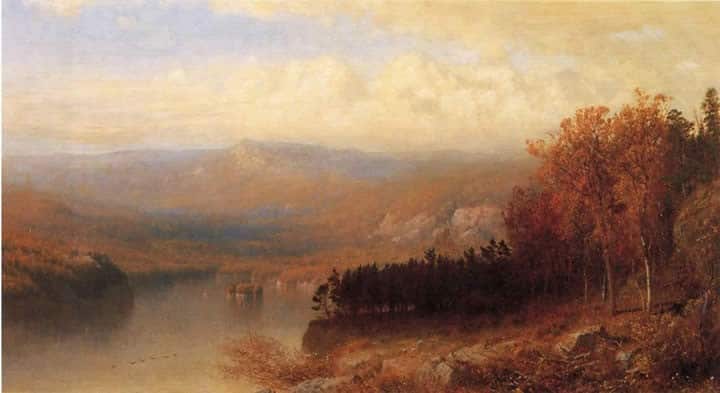
Alexander Hedwig Wyant, Adirondack Scene in Autumn, 1871-72 about 20″ x 30″

Alexander Hedwig Wyant, Autumn in the Adirondacks 1871-72 about 20″ x 30″
Artists still adore the Adirondacks for their rugged natural beauty. Dozens are gathering nest week (June 10-17, 2023) to paint in the footsteps of the greats at the annual Adirondack Mountains “Publishers Invitational” plein air event with Eric Rhoads, publisher of Inside Art and Plein Air Magazine.
Drawn to Perfection

Paco Martin, Tangerine Reflections, drawing, 10.5 x 16.5 inches
Paco Martin, whose primary medium is colored pencils, has clinched the award for best drawing in the April PlenAir Salon for his still life, Tangerine Reflections.
Enter your best work today in the PleinAir Salon, which rewards artists with over $33,000 in cash prizes and exposure of their work, with the winning painting featured on the cover of PleinAir magazine. The next deadline is soon, so visit PleinAirSalon.com now to learn more.