By Guest Contributor Laura Vailati
“I love to paint flowers simply because I love flowers,” says Karen Margulis.
A sensitive artist devoted to painting with pastels, Karen has made simplification the key to the success of her compositions.
After working in a family daycare center for 21 years as an educator and with her own children grown, she realized in 2005 that she could resume her passion for art, which she had abandoned in her high school days.
“Fortunately, I discovered pastels and fell in love with them,” says the artist, who recognizes in the pastels the immediacy and vibrancy of this medium. “With pastels, I can leave a mark; it’s beautiful, it’s vibrant, and it will never change over time.”
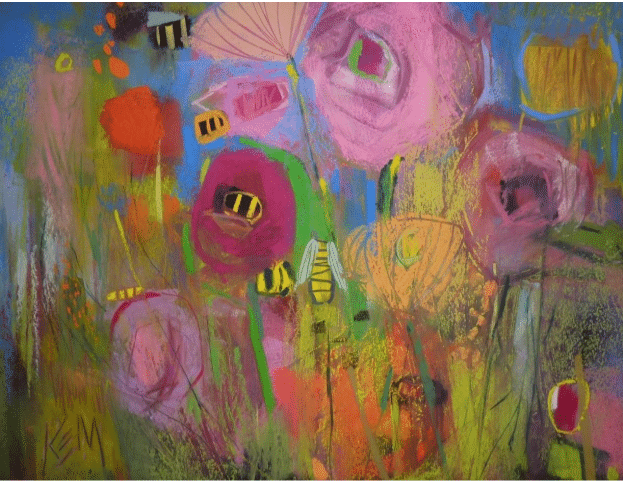
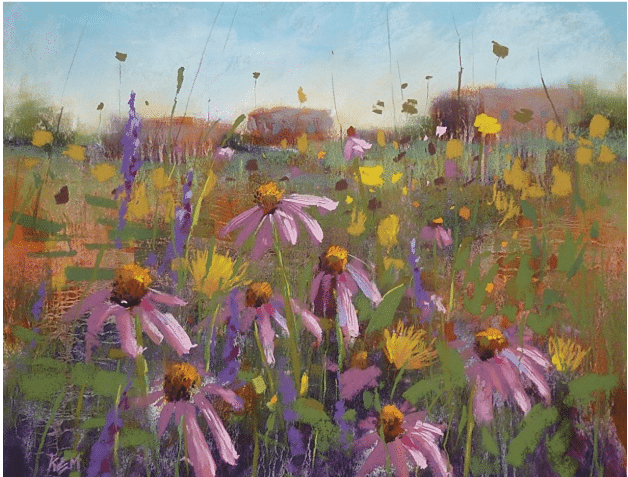
Karen Margulis, “Floral Fantasy Wildflowers,” Pastel, 11 x 14 in.
Meeting Marsha H. Savage – “really a guide for me,” the artist said – and doing a workshop with Richard McKinley were revelatory for her and led her to accept the challenge of painting in plein air. It “was anything but easy because the light is changing so you have to only capture the essence of the scene.” Karen also says she loves the intimacy of plein air and the sounds of the pastels on the paper as she moves across the surface with different marks and pressure.
According to Karen, plein air painting is essential to learn and see how things really are, because “what you see in nature is what really happens.”
Her rendering of flowers is poetic, both when she makes flowers realistically and in a more abstract way. The latter approach is a style the artist began working on three years ago, experimenting with the almost abstract representation of the elements of nature. Elements that, while remaining clearly recognizable, are charged with a dreamlike and playful atmosphere and in which the use of rich colors in terms of chroma, values, and hue are counterbalanced by the softer colors of atmospheric perspective with which she creates the compositional pathos of the scene.
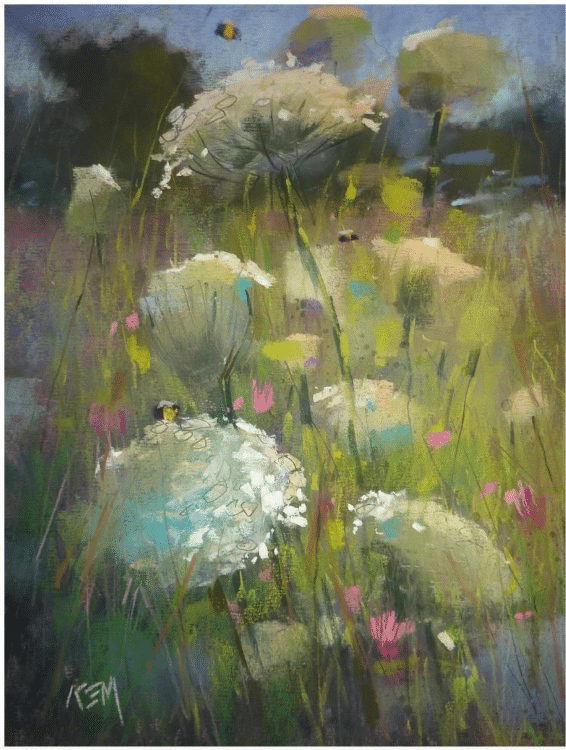
Karen Margulis, “Contemporary Wildflowers – Queen Anne’s Lace,” Pastel, 14 x 11 in.
Be they red, white, or pink, Karen’s pastel wildflowers are mostly depicted in their natural environment, surrounded by their peers and submerged by herbaceous plants that adorn them, surround them, or soar skyward, individually to the point of making them the absolute protagonists of her paintings. It’s an effect that is also emphasized by the assumed point of view of the artist, who portrays her subjects with viewpoints and perspectives both, linear and aerial, to create the illusion of depth in the painting. It seems that the artist’s eye rises precisely from that silent micro-environment that coexists in the midst of the green undergrowth and that she recreates with single, vibrant touches of pastel or with a massed drafting of more or less full-bodied color spread with different pressure.
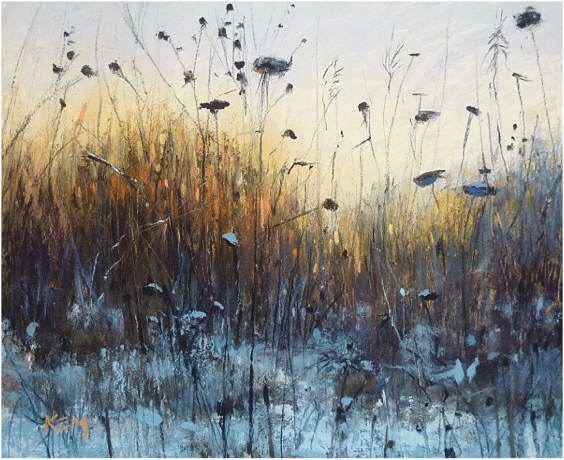
Karen Margulis, “Frozen in Time,” Pastel on paper, 9 x 12 in.
Technically, Karen likes to work on a small format while painting with pastels because as she says, in small size, “everything is whispering.” She usually works with a limited palette and begins the compositional process by choosing the subject. She then works with a simple value thumbnail based on three or four values of the same color family. She chooses pastels to represent the extremes in the subject, one pastel for the darkest dark, one for the lightest light, one for the most intense color, and the remaining middle values.

Karen Margulis’s palette and plein air tools and equipment.
According to Karen, in order to make the picture more realistic and believable, it’s necessary to follow some guidelines. Among these, you need to create variety in terms of sizes and spacing of shapes in order to create and reinforce areas of contrast within the painting, and to establish the visual path toward which the viewer is guided. The connection between earth and sky is equally important for the credibility of the painting and it’s therefore necessary that there is continuity in terms of light direction and atmospheric conditions.
Karen Margulis shares her pastel techniques in her teaching video “Expressive Pastel Painting.”
Leading Japanese Printmakers to be Exhibited on Cape Cod
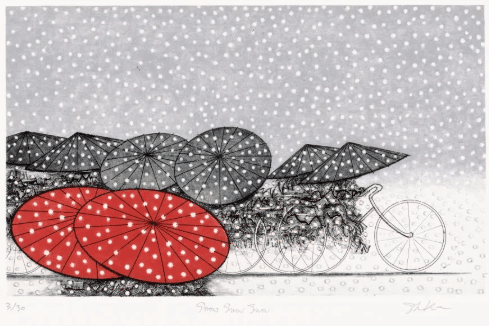
KURODA Shigeki, “Snow Snow Snow”, engraving, 2022
This summer, Highfield Hall & Gardens on Cape Cod is planning to showcase the prestigious College Women’s Association of Japan (CWAJ) Contemporary Japanese Print Show.
The exhibition includes the work of 137 renowned Japanese printmakers, with proceeds supporting cultural programming and scholarships. Trailblazers: Celebrating Contemporary Japanese Prints is on view from June 21 to October 26. Highfield Hall & Gardens is the exclusive U.S. venue for this prestigious juried exhibition.
The exhibition celebrates CWAJ’s 75th anniversary by spotlighting five pioneering women artists in particular —Shinoda Toko, Yoshida Chizuko, Iwami Reika, Yanagisawa Noriko, and Tatsuno Toeko — whose bold innovations helped shape the evolution of contemporary Japanese printmaking.
“These women are visionaries who overcame social and academic barriers to pursue professional careers in the visual arts, paving the way for future generations of artists,” say the curators. “Their work reflects bold innovation, resilience, and a dedication to artistic expression.”
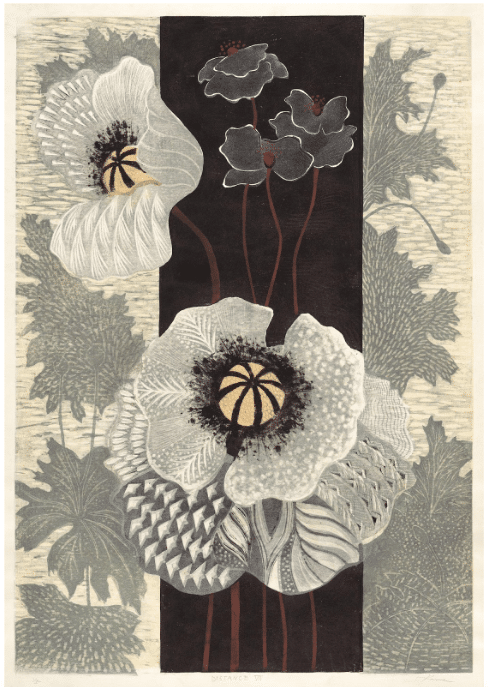
HAMAGUCHI Kanako, “Distance VII”, Woodcut, lithograph, 2023
Not only has Japan led the world in printmaking since forever; Japanese prints have profoundly influenced Western art since the 19th century. There are few better teachers from which to learn design and composition than the work of Japanese print artists, traditional and contemporary.
The exhibition is designed to display a huge range of printing techniques too, from traditional woodblock and intaglio to lithography, etching, aquatint, and silkscreen to cutting-edge digital processes and the newest innovations in the medium.
For more information, visit Highfield’s website.