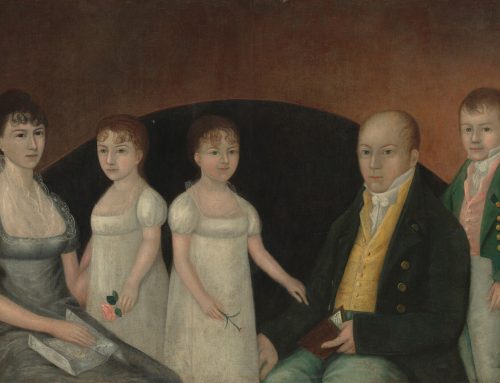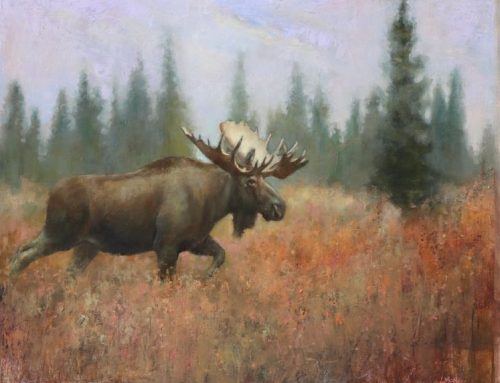
“In our fine arts, not imitation, but creation is the aim… The details, the prose of nature, he should omit and give us only the spirit and splendor.” – Ralph Waldo Emerson
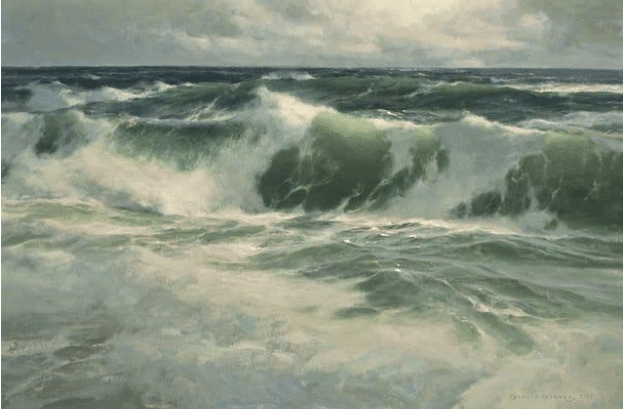
Donald Demers, “Over the Undertow,” oil on canvas
American Transcendentalist philosopher Ralph Waldo Emerson anonymously published a radical essay titled “Nature” in1834. Part of its premise is that a harmonious relationship between humans and the natural world is not only possible but essential for human well-being. The current interpretation is that we have become detached from nature due to societal distractions. Through a self-reliant process of seeing and thinking for ourselves as individuals (as well as artists), he said, we must seek out the wondrous to rediscover wholeness and renew our spiritual connection to the universe.
Whether we find it in a roughly hewn mountain, a gently aged face, or sunlight striking two eggs and a pear on a shelf, the experience of beauty, or a kind of “creative seeing” if you like, reconnects us to aspects of the world for which science and reason have little use. One of the artist’s greatest services to humanity is waking people up. Emerson thought art should insist on the meaning and worth of a fully conscious, heightened sensation of being, on living the knowledge that there’s more to life than we’ve been taught and tend to believe.
Consequently, Emerson was skeptical about the then-fashionable idea that nature is like a clockwork, a deterministic machine, and that human beings work roughly the same way. As we are now learning painfully, the sense of superiority and separateness from any kind of sympathetic or spiritual relationship with the natural conditions of our being invites in the “will to power,” which can serve (and has) as a rationale for exploitation of nature, ecological indifference, Machiavellianism, and genocide.
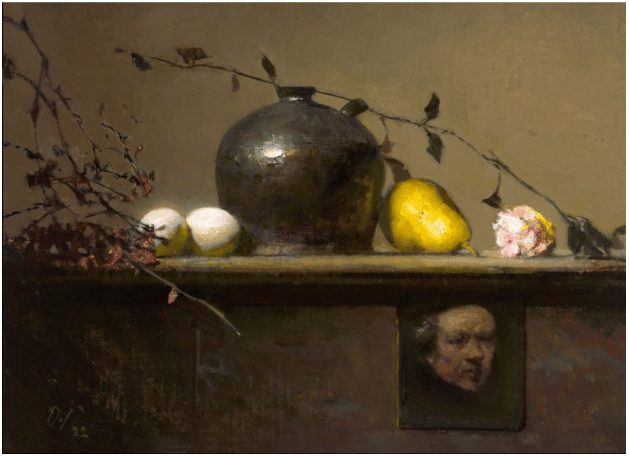
David Leffel, “Two Eggs, a Rose, and Rembrandt Too,” oil
Instead of accepting our fate as cogs in a rational, cosmic machine, Emerson celebrated our part in nature’s wonderful and complex mysteries, which defy science’s attempts at definition and codification. Emerson wanted for us all to be artists of our own lives. He pleaded for us to keep our senses alive so that we see and trust our perception to lead us independently to the value and meaning of life, to distinguish, as he puts it, “facts amid appearances.” Because every soul partakes of the divine wisdom of the All, Emerson implies, every one of us has equal access to the invisible world of spirit, which, because we are imperfect, we must access through the imperfections of the physical world around us.
At the center of these insights was a vision of nature’s intimate relationship with the human and the divine. It wasn’t that God is nature (a misreading for which he was unjustly criticized and later dismissed), but that Nature embodies a divine intelligence that implies the divinity in all things. For Emerson, body and soul are one; it is an error to separate the scientific understanding of physical being with the equally valid truths of spiritual experience.
“America largely ignored Emerson’s insights about what is “natural” for a century and a half,” notes Frederick Turner in an insightfl 2003 article for Smithsonian Magazine. “Instead, we divided the world into the populated urban wasteland and the “empty” untouched wilderness. Thus, we felt justified in uglifying our cities….But Emerson sees nature as potentially improved by human beings and human beings as the epitome of nature. Such a view would lead, as it has begun to do recently, to an environmental ethic in which human activity can enrich nature, rather than just lay waste to it or fence it off. “Only as far as the masters of the world have called in nature to their aid, can they reach the height of magnificence,” he writes. “This is the meaning of their hanging-gardens, villas, garden-houses, islands, parks, and preserves.”
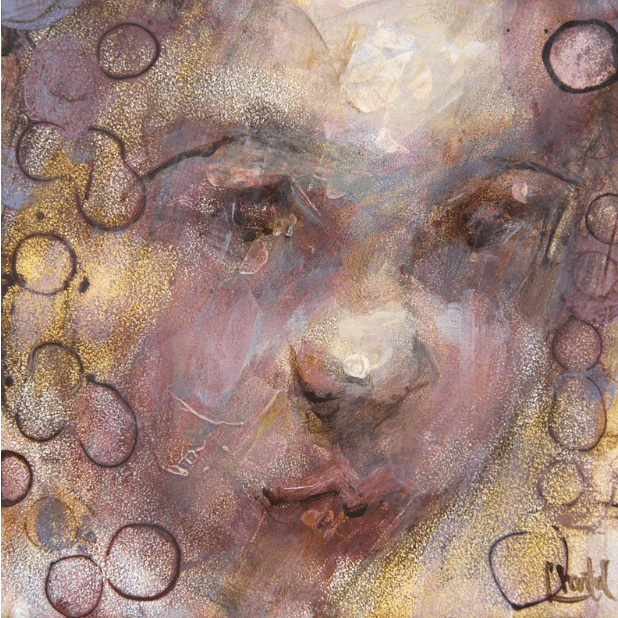
Chantel Barber, “Calling on Hope,” acrylic, 4×4 in.”
Emerson believed in humanity, but he realized revelations come neither easily nor often, nor do they lead inevitably to change overnight, if ever they do. Yet each passing minute is another chance to recognize and work with the divine intelligence in nature. “Every moment instructs, and every object; for wisdom is infused into every form,” he writes. “It has been poured into us as blood; it convulsed us as pain; it slid into us as pleasure; it enveloped us in dull, melancholy days, or in days of cheerful labor; we did not guess its essence until after a long time.”
To paraphrase Emerson’s poetic protégé, Walt Whitman: missing our greatest insight now, may we later come to find it under our boot-soles.
Learn solid technique from the artists featured in this issue:
Don Demers, Mastering the Sea.
David Leffel, The Art of Painting (A Still Life Workshop)