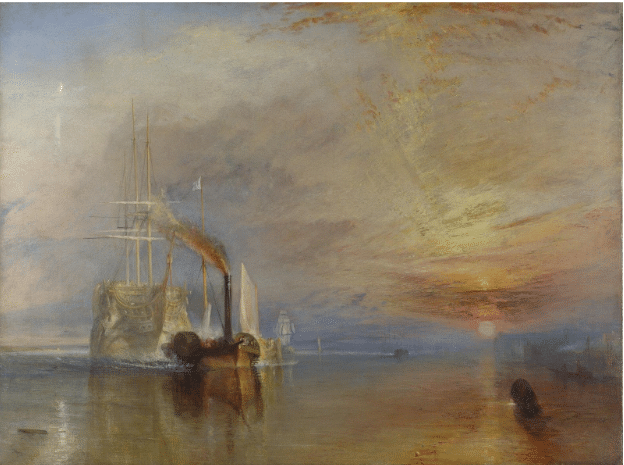
One of the greatest paintings of the 19th century, JMW Turner’s The Fighting Temeraire depicts a formerly glorious jewel of the British Royal Navy being towed to “her last berth” for retirement from service and ultimate dismantling. Its greatness has everything to do with what Turner invented rather than what he saw. Although historically the Temeraire was already de-masted and stripped of all its ornamentation, in Turner’s painting the broken-down warship shimmers majestically in and out of existence, an ornate, silvery ghost.
Turner’s painting is consistently voted among Britain’s most beloved paintings. It’s not just because it records the decommissioning of an old warship. It’s because Turner’s imagination saw the universal in the particular: he showed the meaning of the event as the far-reaching moment of historical importance it was, not only in England’s history, but in the history of the world.
Contrasted with the sooty, black-chimneyed steamer towing it a final time as the sun goes down, the HMS Temeraire resonates with symbolism: its sails furled, the ship is a mournful stand-in for the history and tradition being lost as the sun sets on one age – that of the British Empire – and another, the new age of global industrialization taking over. The mood is melancholy, contemplative, the sea calm and reflective as glass.
Comparing Turner’s initial study for The Fighting Temeraire to the final version yields insight not only into how to “read” a painting but into how great artists think and work. The difference is between painting from observation and making paintings that embody an experience.
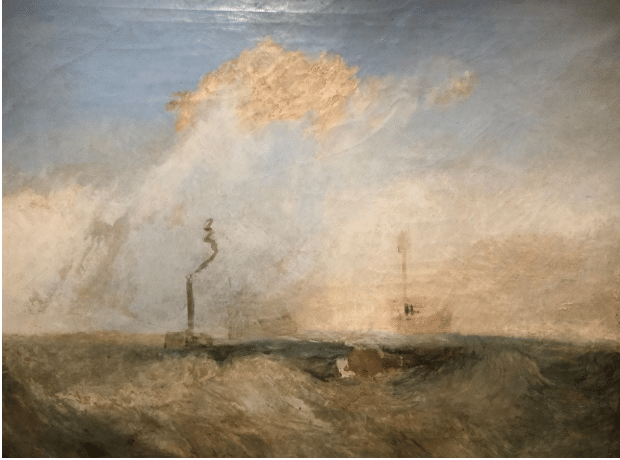
The study: JMW Turner, Steamer and Lightship, Study for “The Fighting Termeraire,” oil on canvas, 1839
Observation vs. Experience
Did Turner paint the above study from observation or from memory? Neither, it turns out. His practice was to sketch on location in watercolor and pencil in tiny pocket notebooks and then paint, as here, a larger oil. Moreover, it would have taken two steamers, not one, to move the warship’s hulk up the Thames. The final work differs significantly from the sketch, so why is that? It’s perhaps because the sketch is less an accurate compositional study for a larger painting than a placeholder for an idea for the painting based on an insightful experience Turner had in the world.
Britons celebrated the Temeraire as the hero of the Battle of Trafalgar in 1805, the defeat of Napoleon, which secured imperial naval dominance for England on the world stage. By the late 1830s, however, the Temeraire was no longer relevant. Its scrapping signaled the end of an historical era eclipsed by technological changes already affecting daily life more profoundly than any battle.
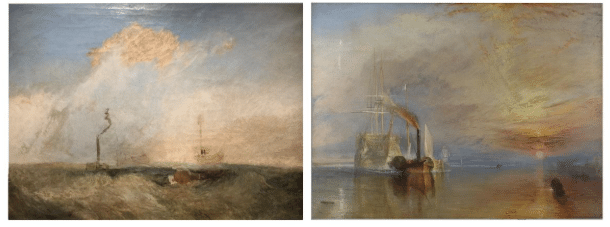
Turner’s “first study” (left) for The Fighting Temeraire with the final work next to it.
Looking at the sketch, the basic idea and primary players are there: the steamship, the ghost-ship behind it (barely visible, literally fading away), even the basic placement of the horizon line and the ships left of center. In the earlier sketch the sea is choppy (without hinting at the final work’s mirror-calm, so much better befitting the moment). Nowhere to be seen is the final work’s low, setting sun. In the sketch, the barren, spectral Temeraire sits to the right of the steamer; in the final work, it appears, majestic and significantly larger than the nonetheless capable steamer, to the left, in what now becomes a slow and solemn procession beneath a classical arch of clouds.
These differences suggest how The Fighting Temeraire began as an experience, a flash of insight, an idea for a painting, but just a kernel – not a blueprint or even a distinct vision of the final work-to-be. Turner sketched a study that hastily put the basic elements in place. Later, drawing upon the study but not tied down by it, he revisited his initial impulse and evolved the painting into a more meaningful whole.
In that process, he created a mood corresponding to his experience enriched by inner vision and reflection. The final work shows a newly invented composition with additional elements and enhancements ideally suited to convey the vision.
Turner’s genius lies in how his paintings beguile us with beauty and mysticism even as they engage with major political and social events, including arguably the core issue of his time (and ours!) – the passing away of the Old World’s agrarian, pastoral relationship with nature to make way for the coming of the modern industrial age.
The lesson for artists is to notice what you notice – to value your experiences and use them to guide your creative endeavors. Don’t discount your ideas just because they are yours or because you can’t remember anyone else making a corresponding painting you could use as a model. Your experiences are the seeds of your best and truest work.
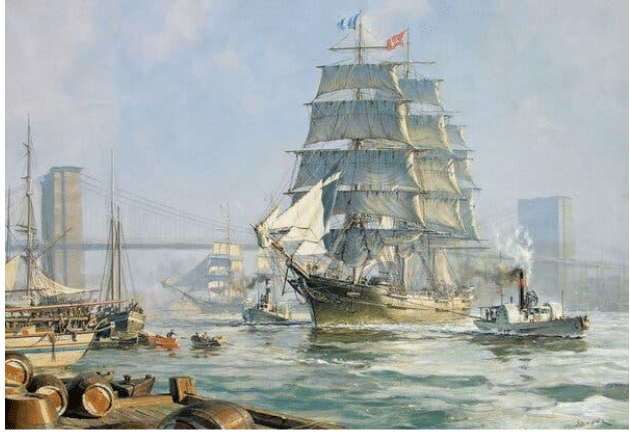
John Stobart, “The David Crockett Sailing From the East River, 1888,” oil on canvas (1968).
John Stobart was a contemporary painter of ships and the sea influenced by Turner who traced his fascination for the subject to a visit to Liverpool at the age of eight. Following four years of training in drawing and painting as a young man at Derby College of Art, he continued his studies at London’s Royal Academy, where he was influenced by Constable as well as by Turner. In this teaching video, Stobart details his techniques when painting en plein air.