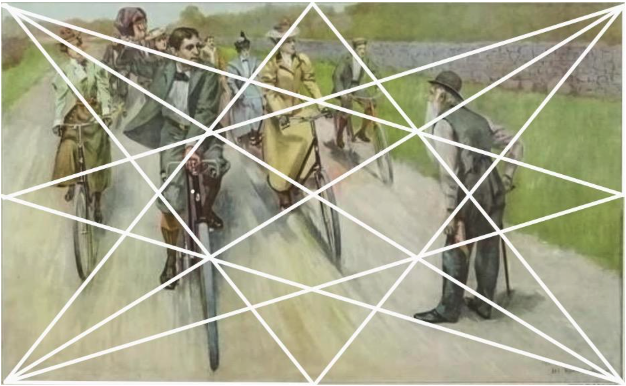
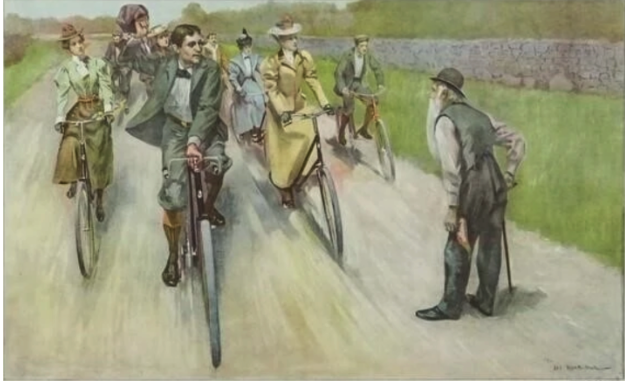
Jay Hambridge, “The Century Run,” lithograph, 1897, 12.5 x 19.5 in.
By Christopher Volpe
Compare the two images above. Note how the bicycle wheels arrange themselves precisely at and around axis points and intersections of the overlaid white grid lines. Or look at the heads of the figures clustered to the left of the center – check the grid to see how each rider’s head rests on or above the guiding diagonals. In contrast, notice how the grid reveals that the onlooker to the right of the group is distinctly separate; he’s neatly enmeshed in a vertical enclosure that opposes the horizontal arrangement of the riders. The result is a balanced and harmonious composition that’s lively with tension and syncopated rhythm.
Here the structure does more than arrange things pleasingly; it also supports the content: the “century run” of the title confirms that this painting is a wink at the perennial standoff between youth and age. One side (the left) is all motion and speed, while the other is solidity and immobility. There’s even a sly visual rhyme that reinforces this reading “hidden” in the symmetrical arrangement of the parallel vertical lines of the bicycle wheels and the old man’s walking stick (or cane), all about the same size, neatly arranged in a sequence, and all tilted at the same angle.
Dynamic symmetry in art refers to the application of predetermined “ideal” geometry in the form of an underlying structure or “armature” as a framework for the composition. The idea is that a time-tested scaffolding made of diagonal lines, perpendiculars, and rectangles can be used to create a more balanced, harmonious, and energetic composition.
Though classical painters used it for centuries, many trace the modern revival of dynamic symmetry to turn-of-the-twentieth-century artist Jay Hambridge, who published a popular manual on it. Dynamic symmetry, like the ancient Greek “canon” of mathematical rules for music, sculpture, and architecture, uses grids derived from root rectangles and golden ratios to guide the placement of compositional elements for visual flow, movement, and unity.
Art Guild of Port Washingron instructor Rob Silverman is a contemporary artist who uses dynamic symmetry in his paintings. He points to Winslow Homer as a modern example of how you can make it work for you.
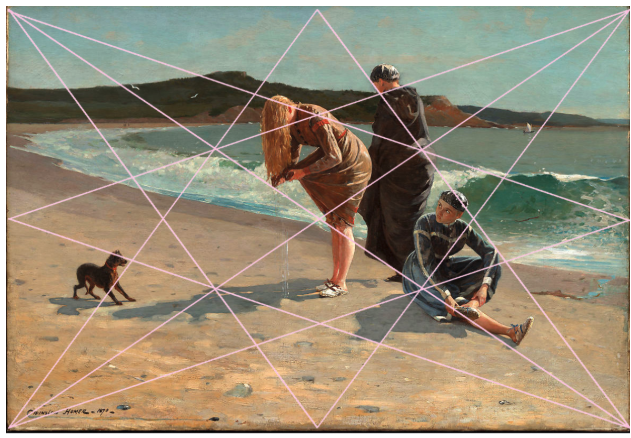
Winslow Homer’s “Beach Scene.”
Like many artists trained in ateliers or academies, “Homer believed that art was a craft to be studied,” Silverman says. The structural overlay in the beach scene by Homer above is created by drawing an “X” from corner to corner and then drawing a large four large triangles with their points lined up with the central intersection of the two diagonals of said “X.”
In such a painting, Silverman points out, “there is no clutter or extraneous storylines. For the beach scene below, if you take out the dog, the composition is less effective. The dog’s gaze leads you to the seated woman’s foot which leads you back up to the woman drying off, whose back leads you to the darker figure behind them both.”
Additionally, the drying-off woman’s shadow visually connects to the dog to complete a unified whole composed of different, dynamically related elements. Unlike the Hambridge example, the grid structure has a purely formal, structural function without specifically supporting content or meaning.
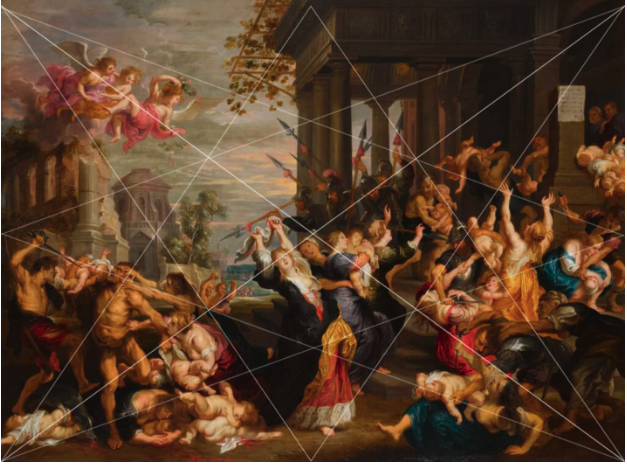
“The painting by Homer would be harmonic,” he says, like a comparatively simple tune, while the Rubens (below the one by Homer) would be more like a clamorous symphony. “Rubens used the grid but without so few intervals between notes, so to speak,” Silverman says.
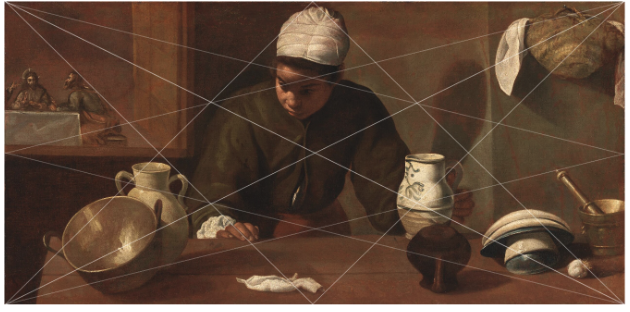
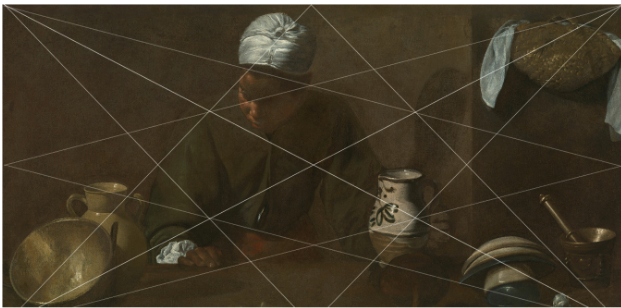
“There are two paintings attributed to Velazquez that I use in my classes as examples of where the grid is kind of a check of quality,” Silverman says. “The version with the Last Supper (top) seems alive. With the cook listening to the supper conversation, it’s a striking scene. The other version (without the Last Supper scene, bottom of the two) seems randomly composed and chaotic. I assume this (bottom) one was done first and corrected in the final version (above).”
In Silverman’s own figure painting below, the composition subtly changes based on the grid.
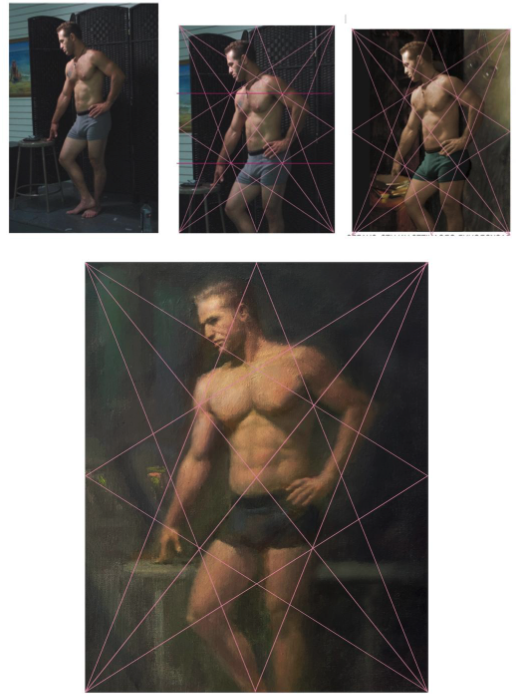
From the top left to right, the first image is the painting before applying dynamic symmetry. The next is cropped for dynamic angles, and the third shows the background simplified by a reorganization of values and shapes. Below the first three, the final version reorients the figure fully in conformity with the grid.
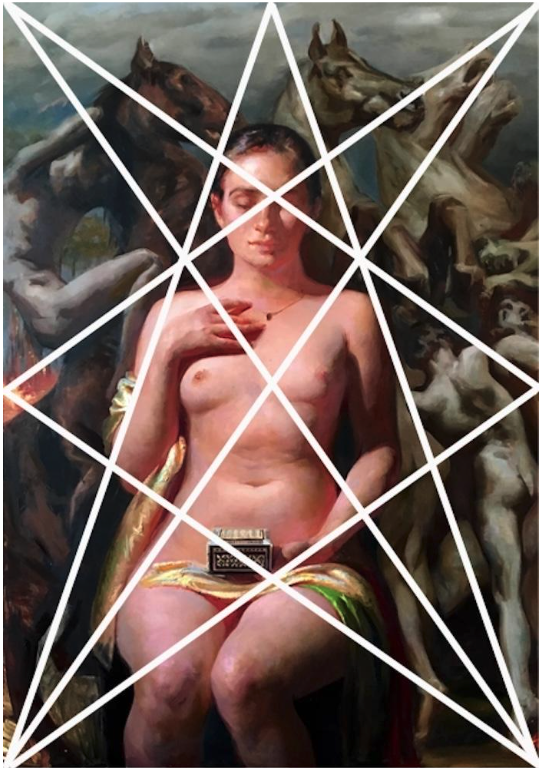
Julia Aristides, “Pandora’s Box,” oil on canvas
Julia Aristides is another contemporary painter who occasionally makes use of dynamic symmetry. She teaches the entire gamut of classical painting techniques in her video, “Secrets of Classical Painting.”