The quote is innocent enough: Art’s true purpose is not to portray but to evoke. If you think about what that means though, it’s saying that essentially, art is not about depicting the observable world. Rather, art is about using the materials of art to evoke – to call forth from our emotions and psyche.
All the great artists who ever lived have done this. Cave art: Does it evoke and not just portray? Yep – check. Michelangelo – evoke? Check. Vermeer? Check. Rembrandt? Check. Monet? Check. Van Gogh? Double check. Andrew Wyeth? Check. Try it! Bet you can’t think of a single artist whose reputation and body of work outlasted their lifetime who didn’t use painting to evoke rather than to depict or portray. Doesn’t matter whether it’s representation or abstraction either; the litmus test holds just the same.

Jackson Pollock, “Lavendar Mist,” (“Number One”) 1950 (source: Jackson-pollock.org). Many feel this painting evokes a combination of gentle intensity and wild kinetic energy.
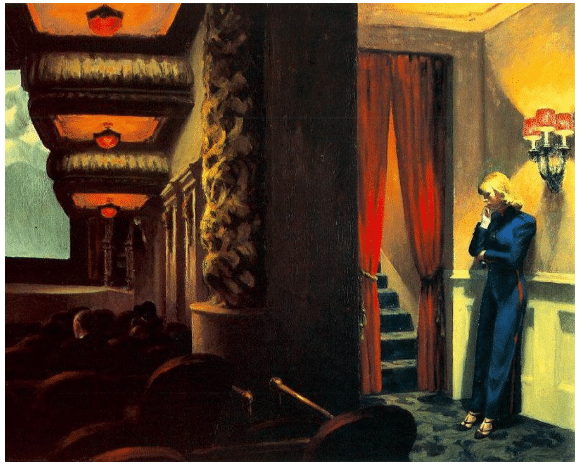
Edward Hopper, New York Movie, 1939. Many of Hopper’s paintings evoke the loneliness and isolation in American life.
So why don’t artists train for this? Well, for one thing it’s hard to even talk about For another, it’s very hard to do, because to evoke something, you have to get something of yourself into the work, and getting yourself into your work has to do with letting go of trying to do it right. And everyone wants to do it right. It’s not for everyone. Painting is a pleasurable challenge and a wonderful way of spending one’s time, and if that’s what you want it to be for you, then absolutely let it be that.
For the few devotees who might want to try this, in a culture that prizes surface rather than substance, knowledge over imagination, you have to train yourself to paint this way, which has to do with resisting the expectations of others that you must paint one way and not another. It’s deciding what feeling the painting is going to have and adjusting everything in it to support that feeling.
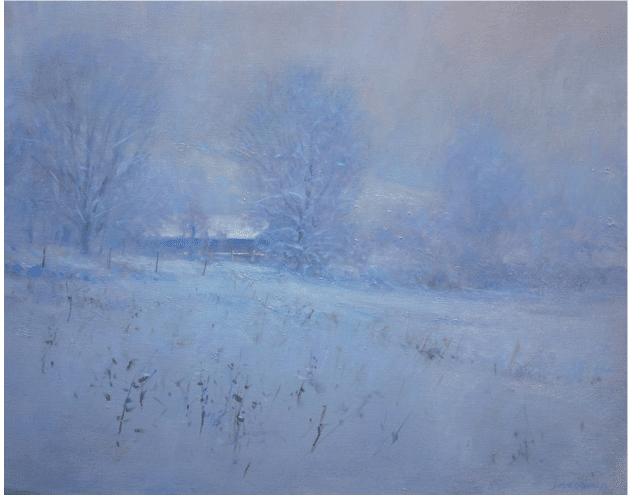
John MacDonald, “Heavy Squall,” 16×20 in. oil on aluminum
John MacDonald didn’t paint “Heavy Squall” (above) with the intention of accurately portraying a snowstorm. Its colors alone tell us that. No, he painted it to evoke the beauty and magic, the wonder even, that we can find in nature, even in extreme conditions. Again, it’s having an intention for the painting’s mood, feeling or content, and adjusting everything portrayed in a way that supports that feeling.
In practice, it could mean modifying or inventing a sky not for compositional reasons but for emotional resonance, or deciding it’s NOT imperative to get the proper angle of an old barn roof (at least not yet – you can always fix it later), or letting go (just for a minute or two) of trying to mix the accurate flesh tone of a child’s cheek, or willfully ignoring (or at least adapting) the correct curvature of a shadow – as long as you’re doing it intentionally, to evoke an idea and/or a feeling, to “make a point,” as it were.
Because in the end it’s not really about choosing between portrayal and evocation, as the Kosinsky quote might seem to imply. At least as far as drawing and painting is concerned, it’s more about choosing a set of essential characteristics based on a felt perception of the way things are.
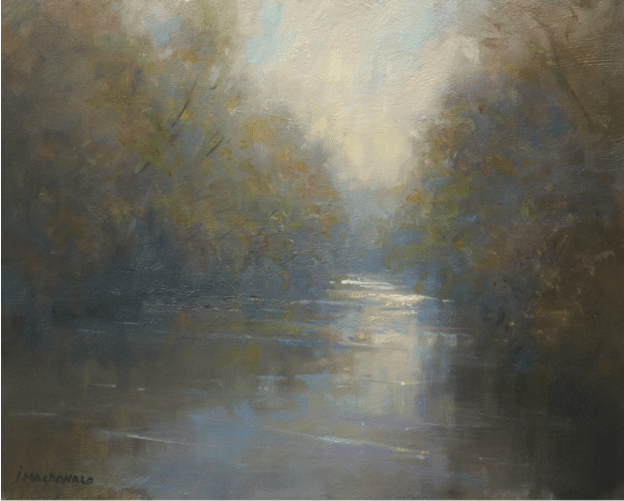
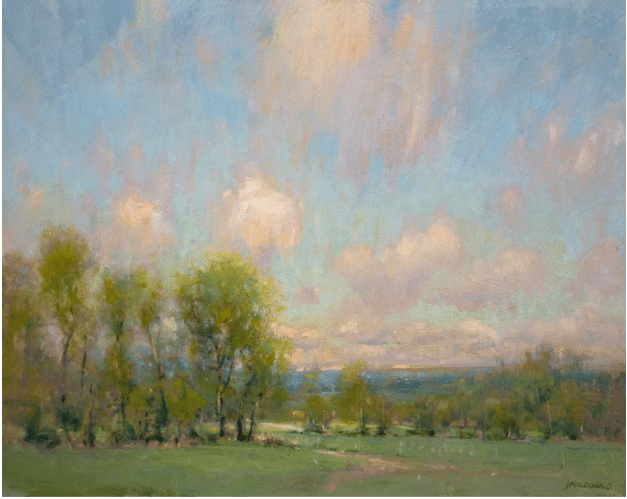
John MacDonald, “Mist,” 16×20 in. oil on aluminum
Painting is about feeling. Whatever the balance between portrayal and evocation, a good work of art raises questions, and the best writing about art provides just enough context to clarify without trying to answer them.
John MacDonald teaches his approach to capturing the poetry of painting in a number of professional videos, including “Poetic Landscapes” and “Creating Dynamic Landscapes”, both of which are available here.