At this time of year, plein air painters can be found crisscrossing the American landscape, portable easels, sun umbrellas, and paper towels in tow. Whether they know it or not, many are after what psychologist Abraham Maslow called “Peak Experiences” – extraordinary moments of heightened joy, serenity, wonder, or insight into life as a powerful unity and a sense of one’s own potential fulfilled.
Along the way, many will aim to tackle the literal peaks of mountains and mountain ranges with a=their paint brushes and palette knives. For those brave souls setting out to meet that challenge, three professional painters have some tips and tricks you might want to try.
Kathryn Stats has developed a keen eye for the landscape and nature. She wandered the Utah countryside on her horse until her early twenties and later studied with artists in the Salt Lake City area on a continuous basis for about 20 years.
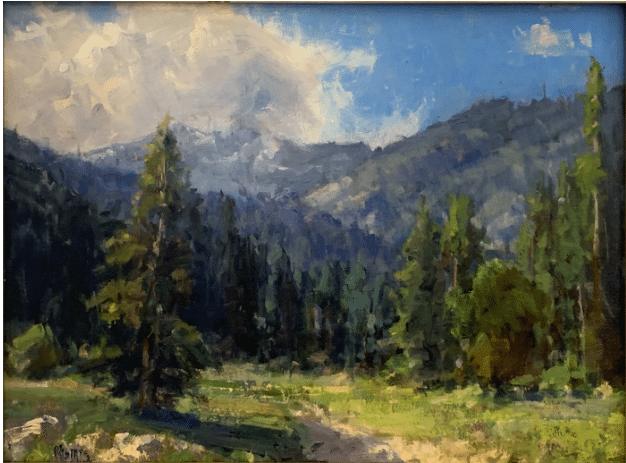
Her direct approach and eye for contrast make her mountain scenes feel solid and vibrant. Her mountainscapes can feature deep, richly colored darks overlaid by highlights added in last stages with a swift, painterly touch. Spontaneous-looking highlights (such as in the foreground grass in “High Mountain Valley” (above) are applied in a single quick, light stroke or two; the brush must be loaded with enough paint of just the right value and hue.
That may sound intimidating, but if you aren’t a master like Kathryn Stats and you don’t nail it the first time, don’t worry. At least if you’re using oils, you get second and third chances to remix and reapply: brighten the color’s intensity and lighten its value and go for the “bravura” single-stroke finish (however many times it takes!).
Whether observing and representing nature directly, like Kathryn, or else from memory or a reference, you can do a lot for your final painting by deliberately making the darks (really) dark and the lights (really) light AND balancing out the two in a way that designs for the eye. That’s not as easy as it sounds, perhaps – but look at “Paradise in West Glacier” (below) and ask where your eye goes and moves through the painting and what part that value plays in that process.
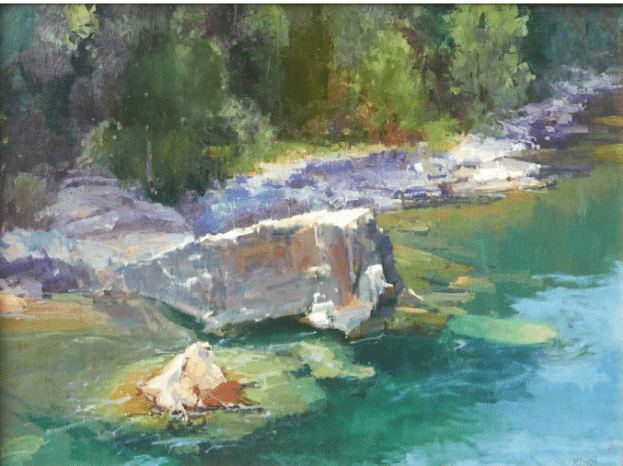
Kathryn Stats, “Paradise in West Glacier,” oil, 18” x 24”
One of Kathryn’s keys to keeping a fresh eye for color and design is to keep challenging herself with new motifs and new locations to paint in. She has traveled to and painted the coastal areas of California and Oregon as well as locations in Alaska, Russia, Spain, Italy, France and Portugal.
“I try not to get too comfortable working in a particular size or subject matter, because I feel that comfort leads to staleness,” she says. “For that reason I’m always looking for fresh territory.”
In her instructional video on mountain painting, Kathryn teaches her alla prima method using a previously painted, on-site study and a computer monitor for references. She demonstrates her unique style using both palette knife and, mostly, bristle brushes.
She clearly describes her palette of colors – key to producing the realism of her impressive mountain scenes. Kathryn also discusses and demonstrates the importance of aerial perspective in creating the three-dimensional form, while maintaining the loose nature of the painting. Watch as she looks, then corrects, to maintain optimal color and value relationships.
Advanced Mentorship Program Available
After fielding years of requests, Kathryn is offering a new individualized mentorship program for professional or amateur artists looking to take their art to the next level. The program is designed to meet each participant’s specific needs and strengths.
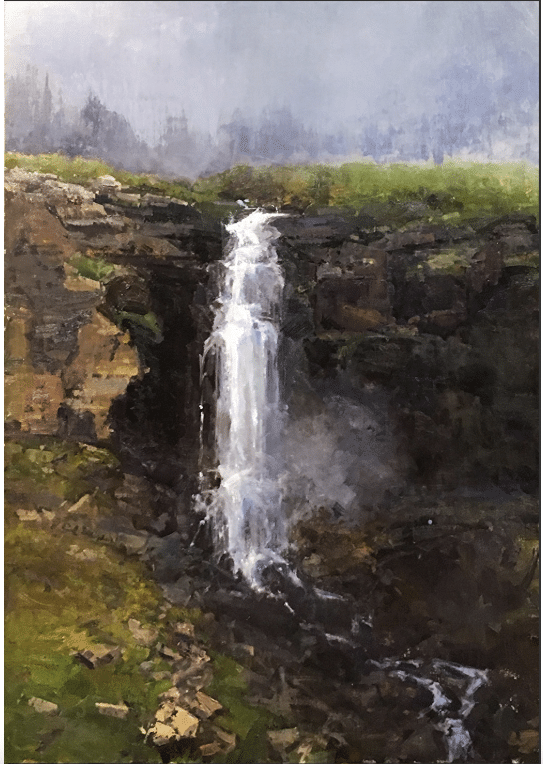
Kathryn Stats, “Runoff Glacier,” oil, 36 x 24 inches
“Each artist will have developed a manageable and concretely-defined goal for their study after the first 30 days” Stats suggests. “Each month, artists will submit work which Ms. Stats will review and provide feedback via one-on-one conference call. These personal one-on-one monthly sessions allows the artist a rare opportunity to interact with Ms. Stats on an ongoing basis. Work submitted can be any work chosen by the artist as well as work required from specific assignments by Ms. Stats. This personal approach to teaching allows Ms. Stats to get to know each artist, their work, goals, strengths and challenges. Direct contact with an internationally known master artist who can answer questions and offer solutions to painting difficulties presents a rare opportunity.”
“Each artist will interact directly with Ms. Stats via phone at a prearranged time. Even though there will be 10 artists selected, artists and their work will only be shared directly with Ms. Stats and the program staff, not with other students. For special issues such a competitions or exhibitions, more access to direct consultation with Ms. Stats can be available.”
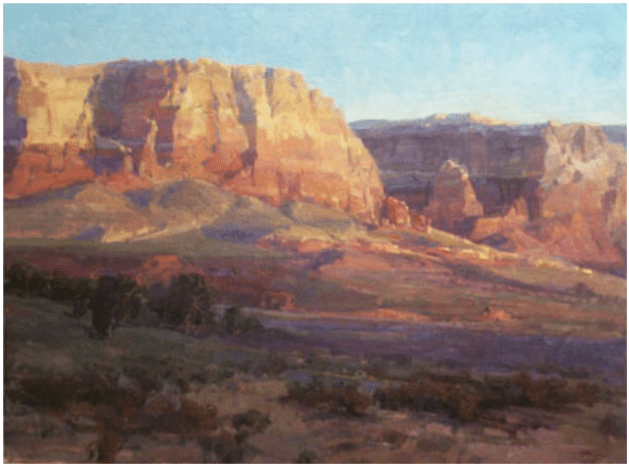
Kathryn Stats, “Vermillion Morning,” oil, 30 x 40 in.
“Monthly, each mentored artist will also receive a teaching module with specific goals directly targeting the needs and challenges that fit their personal needs. As Ms. Stats believes that at higher levels of mastery, mentoring must address the individuals versus the group’s needs. Teaching modules will be written for each individual student to enhance strengths and address challenges such as advanced understanding and assignments related to value, color harmony, temperature and vibration, composition, brushwork, how to advance in competitions, gallery sales and shows.”
The program offers 6 or 10 month sessions. Tuition for 10 months is $4500 or $3200 for 6 months. To apply, contact Marcy Bailey at [email protected]
For more on plein air techniques, check out the free newsletter, “Outdoor Painter,” published by the same folks who bring you the very popular print publication PleinAir™ Magazine. To sign up, click here.
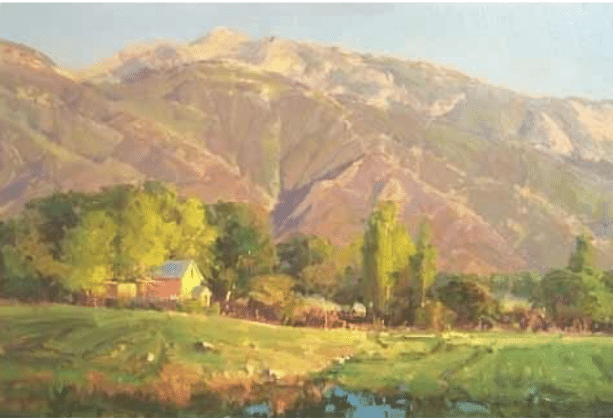
Kathryn Stats, “Wasatch PM,” oil, 18 x 24 in.