With a certain slant of early morning light, as a critic recently wrote, Edward Hopper “captured the anxious stillness of twentieth-century American life.”
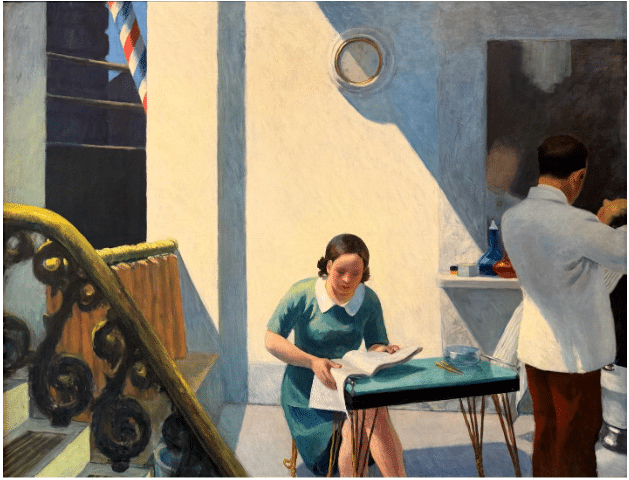
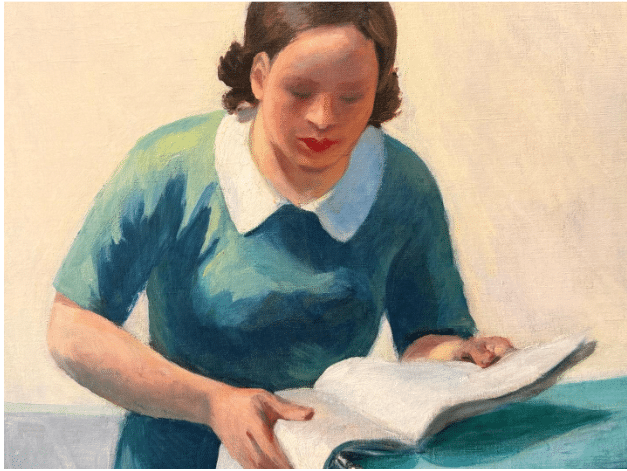
Tightly cropped like a photo or a scene glimpsed through a shopwindow, the large painting Edward Hopper titled “Barber Shop” (1931) gives us (as many Hoppers do) the vague feeling that we’re spying on a strangely frozen world. Unseen witnesses to self-absorbed figures in a harshly lit scene of mid-century American life, we get the sense that things like this are happening all over America at any given moment, and that the isolated people amid the still and undecorated surfaces might at any moment get up in disgust and just start walking. And not come back. Or at least suddenly look up, blankly, somewhat startled to catch us watching.
Hopper’s paintings feel like they’re about what isn’t there as much as what is. The directional light makes one think of religious paintings or a spotlit stage. Only in this painting, there’s no heavenly redeemer and no drama of importance.
These aren’t saints or apostles, and there’s no revelation, and in place of divine redemption there’s only its opposite – mundane material reality. The flat slant of afternoon light falling on a blank, featureless wall invests this tableau with a deadly quiet and that odd sense of time crawling by or standing still. The theme of temporality is emphasized by the line of light slicing across the clock dominating the painting’s top half.
Hopper deliberately suggests and withholds information about his characters. Is the woman reading with the absent expression the wife (or the daughter) of the man in the barber’s chair? If so, then her boredom and lack of interest in the proceedings says plenty about how empty and uninteresting she finds their life together. Whatever her relationship to the others, for her this is just another boring moment in a tedious life filled with boring moments.
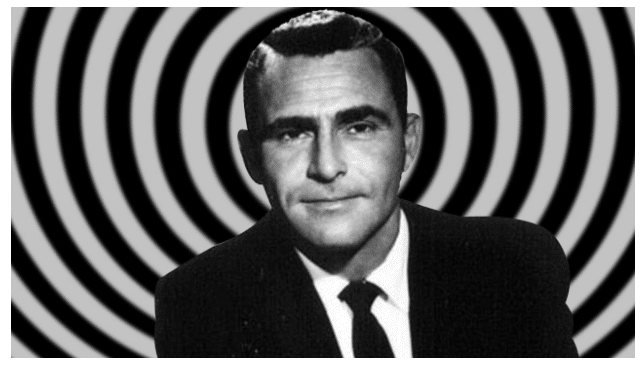
There’s an old Twilight Zone episode in which some astronauts from earth crash-land on a planet just like ours only it’s an earlier time, a simpler one, and everything and everyone they encounter is motionless, frozen in the midst of daily activities. This painting feels a lot like that.
The barbershop is an icon of smalltown America. When Hopper painted this, just about every town in America had at least one, and it usually served as a central community gathering place, a major hub of gossip, information, and gab about politics, people, and all things under the smalltown sun.
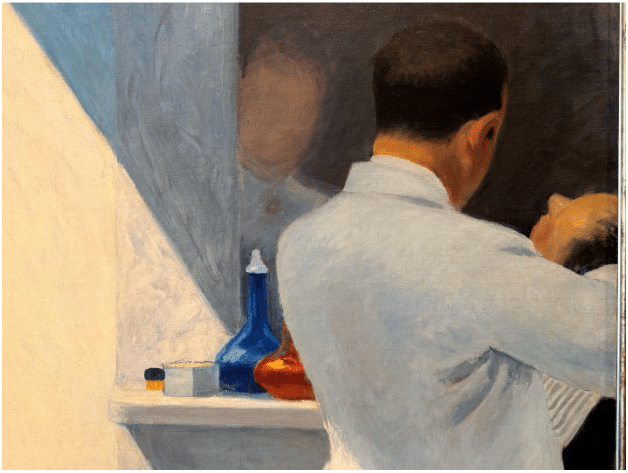
But this barber shop is not a place to which one goes for any sort of shared or enriching experience. It’s just a stop in a series of stops, a place-between-places as forgettable in its vacuity as it is necessary in its function. The barber himself, reflected in his mirror, is a non-entity; the reflection of his “face” is nothing but a featureless blur.
If the barbershop is emblematic of American life, by portraying it the way he did Hopper is making a statement about loneliness, isolation, and stagnation below the surface.
Did Hopper deliberately think all of this through before he started? Almost certainly not. More likely, he just looked, felt what he felt, and then remembered and painted in a way that brought out that feeling. He liked to quote the German writer Goethe when describing his process: “the reproduction of the world that surrounds me by means of the world that is in me.”
Hopper’s work is like an American Vermeer’s – it’s realism alright, but like Vermeer’s interiors, each painting is a rebus, a puzzle, an intimate and mysterious picture-poem. To get the most pleasure from such paintings, we must read them line by line as it were, image by image, to fully appreciate them.
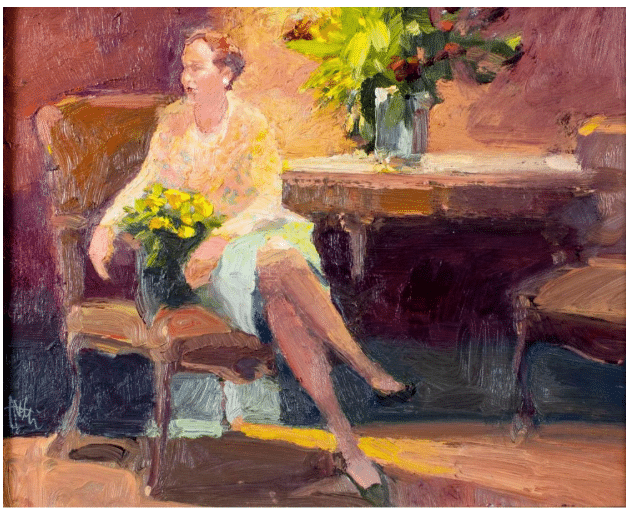
Ken Auster, “Flowers from a Friend,” oil on canvas, 16×20 in.
If your skills at painting settings like Hopper’s could use a tidying up, check out the amazing teaching videos on painting architecture in various media, including Ken Auster’s “Mastering Street Scenes,” available here.
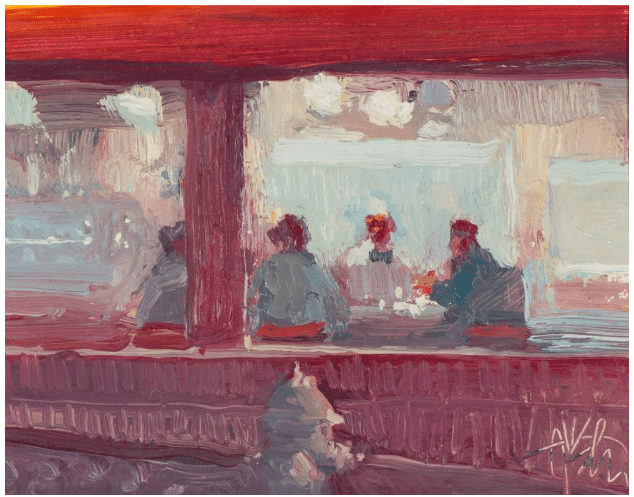
Ken Auster, “Rocket Man,” oil on board, 6×8 in. HOPPER MEETS THE TWILIGHT ZONE!!